Pharmacognosy with the Basics of Plant Biochemistry - Kovalyov, V. M. 2004
Special Part
Essential Oils
Diterpenes
More than 800 diterpenes of various types with the general formula C2OH32 have been discovered in nature. Like other Terpenes, diterpenes can possess an acyclic, mono-, di-, tri-, or tetracyclic Structure. The most common types include labdane, abietane, and kaurane.
Class="center">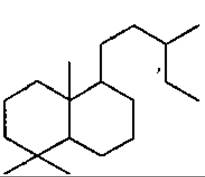
Labdane type
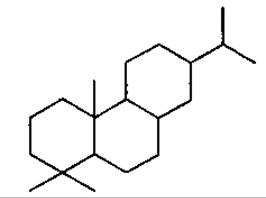
Abietane type
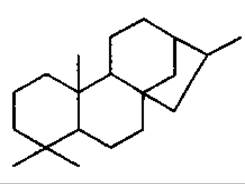
Kaurane type
Some diterpenes are quite widespread in the plant kingdom. For instance, the alcohol phytol is a fragment of chlorophyll. The bitter taste of plants belonging to the Lamiaceae family is due to diterpenes. Resins and balsams (solutions of resins in Essential Oils) contain diterpenoids classified as abietane-type compounds—namely, resin acids such as abietic, lambertianic, and levopimaric acids.
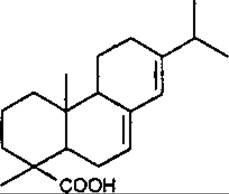
Abietic acid
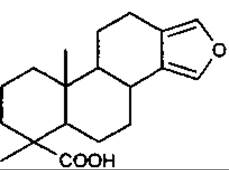
Lambertianic acid

Levopimaric acid
Abietic acid is found in rosin; in Siberian pine oleoresin (Pinus sibirica), lambertianic acid predominates, whereas in Siberian fir (Abies sibirica), levopimaric acid is the primary constituent.
The kaurane type includes the well-known sweetener stevioside. Biogenetically, it is related to an important plant hormone, gibberellic acid.
Diterpene compounds are most commonly found in the plant families Pinaceae, Ericaceae, Thymelaeaceae, and Euphorbiaceae.
In terms of their physicochemical properties, diterpenes behave as amphoteric substances, exhibiting both lipophilic and hydrophilic characteristics. The degree of hydrophilicity depends on the number of sugar residues. Unlike mono- and sesquiterpenes, they are not steam-volatile.
Diterpenoids exhibit high physiological activity, though they are frequently toxic and carcinogenic. In medicine, diterpene Alkaloids derived from plants of the genera Aconitum, Delphinium, and Taxus find clinical application. Stevioside is widely used as a sugar substitute, while vitamin A is a monocyclic diterpene alcohol. Phytol serves as a structural foundation for the semi-synthesis of tocopherol and vitamin K. Sage and rosemary diterpenoids modulate protease activity, and resin acids account for the wound-healing properties of oleoresin.
In the flora of Ukraine, the most widespread sources of terpenoid compounds, particularly diterpenes, are Representatives of the Pinaceae family: Scots pine (Pinus sylvestris L.), Norway spruce (Picea abies L.), and Siberian fir (Abies sibirica L.).
Pharmacaceutical preparations are manufactured using buds (Gemmae), green immature cones (Strobili), needles (Folia), oleoresin, and its processed derivatives. Buds are young shoots located at the apices of the trunk and branches and are harvested before they begin to open. Cones are gathered from June to September, whereas needles can be harvested year-round, ideally during timber-felling operations. The collected raw material is used fresh or dried in a warm room, or outdoors in favorable weather conditions by spreading it in a thin (3–4 cm) layer. Finished botanical Materials are stored in dry, well-ventilated, and dark rooms.
Oleoresin (gum turpentine) is obtained by tapping. Purified oleoresin (Terebinthina communis) is used to produce turpentine (Oleum Terebinthinae), rosin (Colophonium), and tar (Pix liquida).
Shoots are harvested throughout May and the first ten days of June and are used fresh. Oleoresin is harvested during the growth period of young cones (June–August) in dry weather. Resin ducts (resin reservoirs) are located in the bark and appear as swellings. To stimulate The formation of resin ducts, the trunk surface is struck with a wooden mallet, resulting in the formation of an unusually large resin pocket at the impact site. Essential oil (turpentine), which serves as a raw material for The production of synthetic medicinal camphor, is obtained from needles, shoots, and cones.
Pine buds contain essential oil (0.36%), resins, Tannins, the bitter principle pinipicrin, carotene, ascorbic acid, and methyl flavonoid derivatives. The essential oil includes α- and β-pinene, carene, terpineol, limonene, and Other Compounds.
Fir buds, shoots, needles, and cones contain essential oil (0.6–3.0%), tannins, ascorbic acid (0.3%), carotene, and tocopherols. The essential oil is composed of bornyl acetate (30–60%), free borneol, camphene (10%), α-pinene, santene, bisabolene, dipentene, and phellandrene. Oleoresin is a solution of resin (rosin)—accounting for up to 70%—dissolved in the essential oil. The principal Components of the resin are resin acids (up to 50%) and resenes.
Spruce buds, needles, and unripe cones contain essential oils, tannins, resin, carotene, ascorbic acid (up to 0.2% in needles), and salts of iron, chromium, manganese, copper, and aluminum. Oleoresin is a solution of resin in essential oil. Wood tar contains various phenols.
Pine bud decoction exhibits expectorant, mucolytic, antimicrobial, anti-inflammatory, diuretic, and choleretic effects. Pine essential oil is a component of Pinosol nasal drops, and pine needle infusion is used in Traskov's anti-asthma mixture.
Needle infusion is prescribed as an effective remedy for the Prevention and Treatment of scurvy. Oleoresin ointments are used to treat wounds, ulcers, and boils.
In homeopathy, fresh pine shoots are used for Disorders of the nervous and respiratory systems, Skin conditions, rheumatism, Gout, and Rickets.
Turpentine is obtained by the distillation of the volatile fraction of oleoresin. This colorless or yellowish liquid with a characteristic pine scent is a complex mixture of Hydrocarbons, predominantly terpenes (up to 75% α-pinene, β-pinene, camphene, dipentene, limonene, cymene). It is used in ointments and liniments for rheumatism and colds, for inhalation in respiratory tract infections, and as a raw material for the synthesis of terpin hydrate and camphor.
Rosin (named after the ancient Greek city of Colophon in Asia Minor) is the solid component of coniferous tree resins that remains after turpentine distillation. It is a brittle, glassy, transparent resin ranging in color from light yellow to dark brown. It contains 60–92% resin acids (primarily abietic acid), up to 12% saturated and Unsaturated Fatty acids, and 8–20% neutral hydrocarbons (sesqui-, di-, and triterpenes). Rosin can be gum rosin (a byproduct of turpentine production), wood rosin, or tall oil rosin (a byproduct of coniferous wood pulp Processing). It is used in the manufacture of medicinal plasters.
Another raw material containing diterpenes is stevia leaves — Folia Steviae. They are harvested from the herbaceous plant *Stevia rebaudiana* of the aster family, Asteraceae. The plant is also known as sweet herb or sugar stevia. Native to South America, it is cultivated as an annual crop in Ukraine, Moldova, Germany, China, the USA, Canada, and elsewhere.
The plant material contains eight sweet-tasting Glycosides whose aglycone is steviol, a tetracyclic diterpene alcohol of the kaurane type:
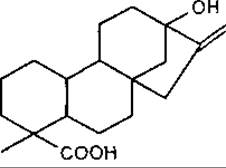
Steviol
The main glycosides are stevioside (5–10%), which is 300 times sweeter than sucrose, and rebaudioside A (2.4%), which is 450 times sweeter. The content of other glycosides—rebaudiosides B, C, D, and dulcoside—ranges from 3 to 4%. These glycosides differ in the composition and number of sugar moieties, as well as their attachment site to the aglycone (C-13 or C-4).
The Biosynthesis of steviol is similar to that of gibberellic acid, an important plant hormone. Scientists believe that steviol glycosides help regulate the levels of this acid in plants.
Crushed plant material (powder, tablets, capsules) or pure stevioside, produced on an industrial scale as a sugar substitute, is used for medicinal and preventive purposes. Stevia is a zero-calorie product that helps normalize Blood pressure, Nervous system function, and Carbohydrate METABOLISM, particularly in overweight individuals, and exhibits cardiotonic effects.
Last update: 06/08/2026
Editorial and Educational Adaptation: This material has been compiled based on the primary/original source text. The project team performed an editorial review, corrected technical inaccuracies, structured sections, and adapted the content for an educational format.
What was processed:
- elimination of formatting defects (OCR errors, structural breaks, corrupted characters);
- editorial organization of content;
- standardization of terminology in accordance with academic sources;
- verification of factual statements against the original source text.
All mentions of the author, publication year, and origin of the primary text have been preserved in accordance with the source.