LEHNINGER PRINCIPLES OF BIOCHEMISTRY - VOL. 2. BIOENERGETICS AND METABOLISM - 2014
PART II. BIOENERGETICS AND METABOLISM
14. GLYCOLYSIS, GLUCONEOGENESIS, AND THE PENTOSE PHOSPHATE PATHWAY
14.5. The Pentose Phosphate Pathway of Glucose Oxidation
In most animal Tissues, the major pathway of glucose-6-phosphate Catabolism is glycolytic breakdown to Pyruvate, with the bulk of the pyruvate then oxidized via The Citric Acid Cycle to yield ATP. However, glucose-6-phosphate also undergoes other conversions to meet specific cellular needs. In some tissues, the most important of these pathways is The oxidation of glucose-6-phosphate to pentose phosphates via the Pentose Phosphate Pathway (also called the phosphogluconate pathway or Hexose monophosphate pathway) (Fig. 14-20). In this oxidative pathway, NADP+ serves as the electron acceptor, becoming reduced to NADPH. Rapidly dividing Cells, such as those in Bone Marrow, Skin, and intestinal mucosa, use pentoses to synthesize RNA, DNA, and Coenzymes such as ATP, NADH, FADH2, and coenzyme A.
Class="center">Figure 14-20. Overview of The pentose phosphate pathway. The NADPH generated in the oxidative phase is used to reduce Glutathione (GSSG) (see Box 14–4) and to support reductive Biosynthesis. This phase also produces ribose 5-phosphate, which is essential for the synthesis of NUCLEOTIDES, coenzymes, and Nucleic Acids. In cells that do not require ribose 5-phosphate for biosynthesis, the nonoxidative phase converts six pentose molecules into five hexose molecules (glucose 6-phosphate), allowing the continued production of NADPH and the Complete oxidation of glucose 6-phosphate to CO2 (via six cycles).

In other tissues, the primary product of the pentose phosphate pathway is not pentoses, but the electron donor NADPH, which is required for reductive biosynthesis and defense against the damaging effects of reactive oxygen species. Tissues with the highest demand for NADPH are those active in the synthesis of Fatty acids (Liver, adipose tissue, Mammary Glands) or Cholesterol and Steroid Hormones (liver, Adrenal Glands, Gonads). Erythrocytes, as well as the Cells of the lens and cornea, are directly exposed to oxygen and therefore vulnerable to free radicals generated by it. Maintaining reducing conditions in these cells (high ratios of both glutathioneOX/glutathioneRED and NADPH/NADP+) prevents or reverses oxidative damage to Proteins, Lipids, and other sensitive molecules. The NADPH produced in the pentose phosphate pathway is so critical for preventing oxidative damage in erythrocytes that a genetic defect in the first enzyme of this pathway, glucose-6-phosphate dehydrogenase, can have severe clinical consequences (Box 14–4). ■
The Oxidative Phase Yields Pentose Phosphates and NADPH
The first reaction of the pentose phosphate pathway (Fig. 14-21) is the oxidation of glucose-6-phosphate to the intramolecular ester 6-phosphoglucono-γ-lactone, catalyzed by the enzyme glucose-6-phosphate dehydrogenase (G6PD). NADP+ serves as the electron acceptor; the reaction equilibrium strongly favors NADPH formation. The lactone is hydrolyzed by a specific lactonase to 6-phosphogluconate, which is then oxidized and decarboxylated by 6-phosphogluconate dehydrogenase to yield the ketopentose ribulose 5-phosphate. A second molecule of NADPH is generated in this reaction. (Ribulose 5-phosphate is required for the Regulation of Glycolysis and Gluconeogenesis, as discussed in Chapter 15.) Next, phosphopentose isomerase converts ribulose 5-phosphate into its isomer, ribose 5-phosphate. In some tissues, the pentose phosphate pathway ends here, and the overall process can be summarized by the following equation:
Glucose-6-phosphate + NADP+ + H2O —> ribose-5-phosphate + CO2 + 2 NADPH + 2 H+
Figure 14-21. Oxidative Reactions of the pentose phosphate pathway. The End products of this pathway are ribose 5-phosphate, CO2, and NADPH.

The pathway yields NADPH, a reductant for biosynthetic reactions, and ribose 5-phosphate, a precursor for nucleotide synthesis.
The Nonoxidative Phase Converts Pentose Phosphates Back to Glucose-6-Phosphate
In tissues with a high demand for NADPH, the pentose phosphates produced during the oxidative phase of the pathway are recycled back into glucose-6-phosphate. In this nonoxidative process, ribulose 5-phosphate is first converted into its epimer, xylulose 5-phosphate:
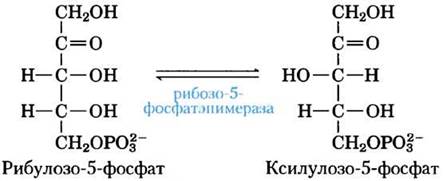
Subsequently, through carbon-Skeleton rearrangements (Fig. 14-22), six 5-carbon sugar phosphates are converted into five 6-carbon sugar phosphates, thereby completing the cycle and driving the continuous oxidation of glucose-6-phosphate to generate NADPH. This cyclic process ultimately results in The conversion of glucose-6-phosphate into six molecules of CO2. Two Enzymes unique to the pentose phosphate pathway participate in this process: transketolase and transaldolase. Transketolase catalyzes The transfer of a two-carbon fragment from a ketose donor to an aldose acceptor (Fig. 14-23a). The first transketolase-catalyzed reaction of the pathway transfers carbons C-1 and C-2 from xylulose 5-phosphate to ribose 5-phosphate, forming the seven-carbon product sedoheptulose 7-phosphate (Fig. 14-23b). The remaining three-carbon fragment from xylulose is converted into glyceraldehyde 3-phosphate.
Figure 14-22. Nonoxidative reactions of the pentose phosphate pathway. (a) These reactions convert pentose phosphates into hexose phosphates, enabling the continuous operation of the oxidative phase of the pathway (Fig. 14-21). This stage involves both pathway-specific enzymes (transketolase and transaldolase) and enzymes shared with glycolysis and gluconeogenesis. (b) Schematic overview of the conversion of six pentoses (5C) into five hexoses (6C). Note that the reactions consist of a series of interconversions (a). Each reaction shown here is reversible; the unidirectional arrows indicate the net direction of flux during the continuous oxidation of glucose-6-phosphate. In the dark reactions of Photosynthesis, these same reactions run in the reverse direction (see Fig. 20-10).

Figure 14-23. The first transketolase-catalyzed reaction of the pentose phosphate pathway. (a) The transketolase reaction involves the transfer of a two-carbon unit from a ketose donor to an aldose acceptor, facilitated by a TPP-dependent enzyme. (b) Conversion of two pentose phosphates into a triose phosphate and the seven-carbon compound sedoheptulose 7-phosphate.

Next, the enzyme transaldolase catalyzes a reaction reminiscent of the aldolase reaction in glycolysis: it transfers a three-carbon fragment from sedoheptulose 7-phosphate to glyceraldehyde 3-phosphate, yielding fructose 6-phosphate and the tetrose erythrose 4-phosphate (Fig. 14-24). Transketolase then acts once more, reacting erythrose 4-phosphate with xylulose 5-phosphate to form fructose 6-phosphate and glyceraldehyde 3-phosphate (Fig. 14-25). The two molecules of glyceraldehyde 3-phosphate produced by these repeated reactions are converted into a molecule of fructose 1,6-bisphosphate, much as in gluconeogenesis (Fig. 14-16). Finally, fructose 1,6-bisphosphatase-1 and glucose phosphate isomerase convert fructose 1,6-bisphosphate into glucose-6-phosphate. The cycle is complete: six pentose phosphates have been converted into five hexose phosphates (Fig. 14-22b).
Figure 14-24. The transaldolase reaction.

Fig. 14-25. The second reaction catalyzed by transketolase

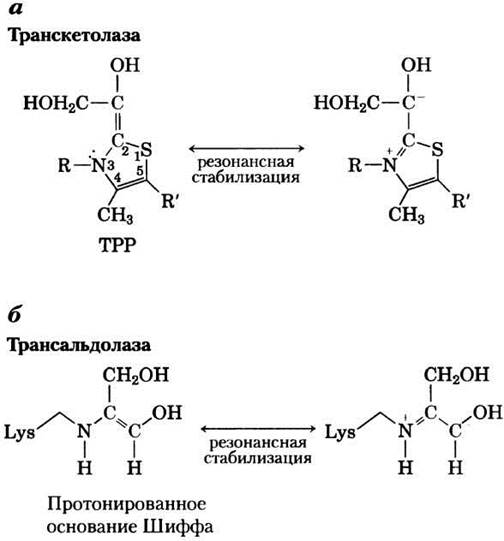
The action of transketolase requires the cofactor thiamine pyrophosphate (TPP), which stabilizes the two-carbon carbanion formed in the reaction (Fig. 14-26a), much like what was described for pyruvate decarboxylase (Fig. 14-14). Transaldolase (Fig. 14-26b) stabilizes the carbanion generated during The formation of a Schiff base between the side chain of a Lysine residue and the carbonyl group of the substrate (ketose).
Fig. 14-26. Stabilization of carbanions through covalent interactions with transketolase and transaldolase. (a) The TPP ring stabilizes the two-carbon carbanion transferred by transketolase (for The Mechanism of TPP action, see Fig. 14-14). (b) In the reaction catalyzed by transaldolase, stabilization of the three-carbon carbanion resulting from aldolytic Cleavage occurs via the formation of a protonated Schiff base between the ε-amino group of a lysine side chain and the substrate.
Wernicke-Korsakoff syndrome is exacerbated by a transketolase defect
Wernicke-Korsakoff syndrome is associated with a deficiency of thiamine, which is a component of thiamine pyrophosphate (TPP). This syndrome is most commonly encountered in chronic alcoholism, which impairs intestinal absorption of thiamine. The symptoms of the disorder can be aggravated by a mutation in the transketolase Gene, leading to The production of an enzyme whose affinity for TPP may be up to 10 times lower than that of the normal enzyme. This defect makes an individual much more sensitive to thiamine deficiency: even a mild deficiency of this substance (imperceptible to individuals with the normal form of transketolase) can cause TPP levels to drop below the threshold required to saturate the enzyme. As a result, the reactions of the pentose phosphate pathway slow down overall. In sufferers of Wernicke-Korsakoff syndrome, this leads to an intensification of disease symptoms, manifested as memory loss, confusion, and partial paralysis. ■
The process illustrated in Fig. 14-21 is termed the oxidative pentose phosphate pathway. The first two oxidation reactions are characterized by a large negative change in Standard Free energy and are irreversible under intracellular conditions. The reactions of the nonoxidative phase of the pentose phosphate pathway (Fig. 14-22) are readily reversible and thus provide a mechanism for converting hexose phosphates into pentose phosphates. As we will see in Chapter 20, the conversion of hexose phosphates to pentose phosphates is central to photosynthetic CO2 assimilation in plants. This metabolic route, known as the reductive pentose phosphate pathway, is essentially the reverse of the process shown in Fig. 14-22 and utilizes many of the same enzymes.
All enzymes participating in the pentose phosphate pathway are localized in the Cytosol, much like the enzymes of glycolysis and the majority of gluconeogenic enzymes. Indeed, all three processes share several common intermediates and enzymes. Glyceraldehyde 3-phosphate, produced by the action of transketolase, is readily converted into dihydroxyacetone phosphate by the glycolytic enzyme triose phosphate isomerase, and these two trioses combine under the action of aldolase to form fructose 1,6-bisphosphate, just as in gluconeogenesis. Alternatively, these trioses can be oxidized to pyruvate via glycolytic reactions. The specific pathway taken by triose phosphates is determined by the cellular demand for pentose phosphates, NADPH, and ATP.
Glucose 6-phosphate is partitioned between glycolysis and the pentose phosphate pathway
The entry of glucose 6-phosphate into either glycolysis or the pentose phosphate pathway depends on the current needs of The Cell and the cytosolic concentration of NADP+. Without this electron acceptor, the first reaction of the pentose phosphate pathway (catalyzed by G6PDH) cannot proceed. If NADPH is rapidly converted to NADP+ in The Cell as a result of reductive biosynthetic reactions, the NADP+ level rises, Allosteric Regulation of G6PDH takes place, and the net result is an increase in The amount of glucose 6-phosphate channeled into the pentose phosphate pathway (Fig. 14-27). When the demand for NADPH decreases, the level of NADP+ drops, the pentose phosphate pathway slows down, and a greater fraction of glucose 6-phosphate is directed toward glycolysis.
Fig. 14-27. The Role of NADPH in regulating the partitioning of glucose 6-phosphate between glycolysis and the pentose phosphate pathway. If NADPH is produced faster than it is consumed in biosynthetic reactions and glutathione reduction (see Fig. 14-20), the NADPH concentration increases, leading to the inhibition of the first enzyme of the pentose phosphate pathway. As a result, more glucose 6-phosphate becomes available for glycolysis.

Summary of Section 14.5 The Pentose Phosphate Pathway of Glucose Oxidation
■ The oxidative pentose phosphate pathway (also known as the phosphogluconate or hexose monophosphate pathway) involves the oxidation and decarboxylation of glucose 6-phosphate at the C-1 carbon atom, with the reduction of NADP+ to NADPH and the formation of pentose phosphates.
■ NADPH serves as a reducing agent in biosynthetic reactions, while ribose 5-phosphate acts as a precursor for nucleotides and nucleic acids. Rapidly proliferating tissues, as well as cells actively engaged in the Biosynthesis of Fatty acids, cholesterol, or steroid hormones, channel more glucose 6-phosphate into the pentose phosphate pathway than do tissues with a lower demand for pentose phosphates or reducing equivalents.
■ The oxidative phase of the pentose phosphate pathway is a two-step conversion of glucose 6-phosphate to ribulose 5-phosphate, accompanied by the reduction of NADP+ to NADPH. The nonoxidative phase consists of the conversion of pentose phosphates back into glucose 6-phosphate, thereby restarting the cycle.
■ In the second (nonoxidative) phase of the pentose phosphate pathway, transketolase (with TPP as a cofactor) and transaldolase catalyze the interconversion of three-, four-, five-, six-, and seven-carbon sugars, resulting in the reversible formation of five hexose phosphates from six pentose phosphates. During the METABOLISM/17.html">Light-Independent Reactions of photosynthesis, these same enzymes catalyze the reverse process—known as the reductive pentose phosphate pathway—namely, the conversion of five hexose phosphates into six pentose phosphates.
■ A genetic defect in transketolase that lowers the enzyme's affinity for TPP exacerbates Wernicke-Korsakoff syndrome.
■ The participation of glucose 6-phosphate in either glycolysis or the pentose phosphate pathway is largely determined by the concentration ratio of NADP+ to NADPH.
Last update: 06/08/2026
Editorial and Educational Adaptation: This material has been compiled based on the primary/original source text. The project team performed an editorial review, corrected technical inaccuracies, structured sections, and adapted the content for an educational format.
What was processed:
- elimination of formatting defects (OCR errors, structural breaks, corrupted characters);
- editorial organization of content;
- standardization of terminology in accordance with academic sources;
- verification of factual statements against the original source text.
All mentions of the author, publication year, and origin of the primary text have been preserved in accordance with the source.