BIOCHEMISTRY: A TEXTBOOK FOR UNIVERSITY STUDENTS - E. S. Severin - 2004
SECTION 2. ENZYMOLOGY
IV. Mechanism of Enzyme Action
The METABOLISM/10.html">Mechanism of enzyme Action can be examined from two Perspectives: in terms of the Thermodynamics of Chemical Reactions and in terms of events occurring at the Active Site.
A. Energetic Changes in Chemical Reactions
All chemical reactions proceed in obedience to the two fundamental Laws of Thermodynamics: the law of conservation of energy and the law of Entropy. According to these laws, the total energy of a chemical System and Its surroundings remains constant, while the chemical system tends toward decreased order (increased entropy). To understand the energetics of a chemical reaction, it is not enough to know the Energy balance of the reactants entering and leaving the reaction; one must also account for Energy Changes During the course of the reaction and The Role of Enzymes in the dynamics of this process. Let us consider the decomposition of carbonic acid:
H2CO3 —> H2O + CO2.
Carbonic acid is a weak acid; its decomposition reaction will proceed under normal conditions provided the carbonic acid molecules possess an energy exceeding a certain threshold, known as the activation energy Ea (Fig. 2-10).
Class="center">Fig. 2-10. Free energy change during the decomposition of carbonic acid.

Activation energy is defined as the additional kinetic energy required by reactant molecules for them to enter into a chemical reaction.
Upon reaching this energy barrier, structural changes occur within the molecule that lead to the redistribution of chemical bonds and The formation of new compounds. Molecules possessing Ea are said to be in a Transition State. The energy difference between the initial reactant H2СO3 and the final products H2O and СO2 is called the free energy change of the reaction, DG. The molecules of H2O and СO2 are more stable substances than H2СO3—that is, they possess lower energy and practically do not react under normal conditions. The energy released As a result of this reaction is dissipated into the environment as heat.
The greater the number of molecules possessing energy exceeding the Ea level, the higher The rate of the chemical reaction. The rate of a chemical reaction can be increased by heating, which increases the energy of the reacting molecules. However, high temperatures are lethal to living organisms; therefore, Cells utilize enzymes to accelerate chemical reactions. Enzymes ensure high reaction rates under the optimal conditions existing within The Cell by lowering the Ea level. Thus, enzymes reduce the height of the energy barrier, thereby increasing the number of reactive molecules and, consequently, the reaction rate.
A crucial role in the Mechanism of Enzymatic catalysis is played by the formation of unstable intermediate compounds—the enzyme-substrate complex ES—which undergoes conversion into an unstable transition complex EP that almost instantaneously dissociates into the free enzyme and the reaction product.
Thus, biological catalysts (enzymes) do not alter the Free energy of substrates and products and therefore do not change the reaction equilibrium (Fig. 2-11).
Fig. 2-11. Free energy change during a chemical reaction, both uncatalyzed and catalyzed by enzymes. The enzyme lowers the activation energy Ea—that is, reduces the height of the energy barrier—thereby increasing the fraction of reactive molecules and, consequently, the reaction rate.

In performing the function of a chemical reaction catalyst, an enzyme obeys the general laws of catalysis and possesses all the properties characteristic of non-biological catalysts, while also exhibiting distinctive properties associated with the Structural Features of enzymes.
The similarities between enzymes and non-biological catalysts are that:
✵ enzymes catalyze thermodynamically feasible reactions;
✵ the energy of the chemical system remains constant;
✵ the direction of the reaction does not change during catalysis;
✵ enzymes are not consumed in the course of the reaction.
The differences between enzymes and non-biological catalysts are that:
✵ the Rate of Enzymatic reactions is higher than that of Reactions Catalyzed by non-protein catalysts;
✵ enzymes exhibit high Specificity;
✵ enzymatic reactions take place within the cell, i.e., at 37 °C, constant atmospheric pressure, and a physiological pH value;
✵ the rate of an enzymatic reaction can be regulated.
B. Stages of Enzymatic Catalysis
1. Formation of the Enzyme-Substrate Complex
The fact that enzymes are highly specific led to the hypothesis proposed in 1890 that the Active Site of an enzyme is complementary to the substrate, matching it like a "lock and key." Following the interaction of the substrate (the "key") with the active site (the "lock"), the substrate undergoes chemical transformation into the product. The active site was thus viewed as a stable, rigidly determined Structure.
In 1959, an alternative version of the "lock-and-key" hypothesis was proposed to explain events within the enzyme's active site. According to this hypothesis, the active site is a flexible structure with respect to the substrate. Upon interacting with the enzyme's active site, the substrate induces a conformational change in it, leading to the formation of an enzyme-substrate complex favorable for chemical modifications of the substrate. At the same time, the substrate molecule also alters its conformation, ensuring higher efficiency of the enzymatic reaction. This "induced fit hypothesis" was later confirmed experimentally.
2. Sequence of Events during Enzymatic Catalysis
The process of enzymatic catalysis can be conventionally divided into the following stages (Fig. 2-12).
Fig. 2-12. Stages of enzymatic catalysis. I - stage of approximation and orientation of the substrate relative to the enzyme's active site; II - formation of the enzyme-substrate complex (ES) via induced fit; III - substrate deformation and formation of an unstable enzyme-product (EP) complex; IV - dissociation of the (EP) complex, releasing the reaction products from the enzyme's active site and regenerating the free enzyme.

The first, second, and fourth stages of catalysis are brief and depend on the Substrate Concentration (for The First stage) and the Ligand-binding constants within the enzyme's active site (for the first and third stages). Changes in the reaction energetics during these stages are negligible.
The Third Stage is the slowest; its duration depends on the activation energy of the chemical reaction. This stage involves the Cleavage of bonds within the substrate molecule, the formation of new bonds, and the Generation of the product molecule.
3. The Role of the Active Site in Enzymatic Catalysis
Research has demonstrated that an enzyme molecule is typically much larger than the substrate molecule undergoing chemical transformation by that enzyme. Only a small fraction of the enzyme molecule—usually between 5 and 10 amino acid residues—comes into contact with the substrate, forming the active site. The role of the remaining amino acid residues is to maintain the proper conformation of the enzyme molecule for optimal chemical reaction progression.
At all stages of enzymatic catalysis, the active site cannot be viewed merely as a passive region for substrate binding. It is a complex molecular "machine" that employs various chemical mechanisms to facilitate The conversion of substrate into product.
Within the enzyme's active site, substrates are positioned in such a way that the reacting Functional groups of the substrates lie in close proximity to one another. This property of the active site is known as the Proximity and Orientation effect of reactants. Such an ordered arrangement of substrates leads to a decrease in entropy and, consequently, a reduction in the activation energy (Ea), which dictates the catalytic efficiency of enzymes.
The active site of an enzyme also promotes the destabilization of interatomic bonds within the substrate molecule, facilitating the chemical reaction and product formation. This property of the active site is referred to as the substrate deformation effect (Fig. 2-12).
C. Molecular Mechanisms of Enzymatic Catalysis
The mechanisms of enzymatic catalysis are determined by the role of the functional groups within the enzyme's active site in chemically converting a substrate into a product. There are two primary mechanisms of enzymatic catalysis: Acid-Base Catalysis and Covalent Catalysis.
1. Acid-Base Catalysis
THE CONCEPT OF acid-base catalysis explains enzymatic activity through the participation of acidic groups (proton Donors) and/or basic groups (proton acceptors) in the chemical reaction. Acid-base catalysis is a frequently occurring phenomenon. The amino acid residues that make up the active site possess functional groups exhibiting properties of both acids and bases.
Amino Acids involved in acid-base catalysis primarily include Cys, Tyr, Ser, Lys, Glu, Asp, and His. The side chains of these amino acids act as acids (proton donors) in their protonated form and as bases (proton acceptors) in their deprotonated form. Thanks to this property of the active site's functional groups, enzymes function as unique biological catalysts, unlike non-biological catalysts, which can exhibit either exclusively acidic or exclusively basic properties.
An example of acid-base catalysis utilizing Zn2+ ions as Cofactors and a NAD+ molecule as a coenzyme is Liver Alcohol dehydrogenase, an enzyme that catalyzes The oxidation of alcohol (Fig. 2-13):
С2Н5ОН + NAD+ —> СН3-СОН + NАDН + Н+.
Fig. 2-13. Mechanism of acid-base catalysis illustrated by liver alcohol dehydrogenase. I - the ethanol molecule features a binding site that ensures hydrophobic interaction between the active center and the methyl group of the alcohol; II - a positively charged zinc atom facilitates proton abstraction from the alcohol group of ethanol, yielding a negatively charged oxygen atom. The negative charge is redistributed between the oxygen atom and the adjacent hydrogen atom, which is then transferred as a hydride ion to the fourth carbon atom of the nicotinamide ring of the NAD+ cofactor; III - this results in the formation of the reduced form NADH and acetaldehyde.

2. Covalent catalysis
Covalent catalysis is based on the nucleophilic (negatively charged) or electrophilic (positively charged) groups of the enzyme's active center attacking substrate molecules, forming a covalent bond between the substrate and a coenzyme or a functional group (typically a single one) of an amino acid residue within the enzyme's active center.
The action of Serine proteases, such as Trypsin, Chymotrypsin, and Thrombin, exemplifies The Mechanism of covalent catalysis, wherein a covalent bond is formed between the substrate and the active-site serine residue of the enzyme. The term "serine proteases" stems from the fact that a serine amino acid residue is part of the active center of all these enzymes and takes direct part in catalysis. Let us examine the mechanism of covalent catalysis using chymotrypsin as an example, which mediates the Hydrolysis of peptide bonds during Protein Digestion in the duodenum (see Section 9). Chymotrypsin substrates are Peptides containing amino acids with aromatic and cyclic hydrophobic side chains (Phe, Tyr, Trp), indicating the involvement of hydrophobic forces in the formation of the enzyme-substrate complex. The mechanism of covalent catalysis by chymotrypsin is illustrated in Fig. 2-14.
Fig. 2-14. Mechanism of covalent catalysis in the active center of chymotrypsin.
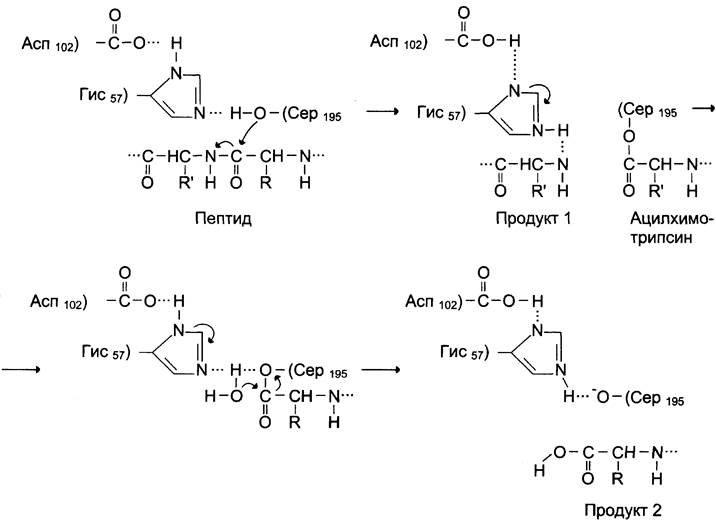
The side chains of Asp102, His57, and Ser195 directly participate in the catalytic event. Nucleophilic attack on the peptide bond of the substrate leads to its cleavage, resulting in the formation of a covalently modified serine—acyl-chymotrypsin. Another peptide fragment is released as a result of the rupture of the Hydrogen bond between the peptide fragment and His57 of the chymotrypsin active center. The final stage of protein peptide bond hydrolysis is the deacylation of chymotrypsin in the presence of a Water molecule, releasing the second fragment of the hydrolyzed protein and regenerating the active form of the enzyme.
Last update: 06/08/2026
Editorial and Educational Adaptation: This material has been compiled based on the primary/original source text. The project team performed an editorial review, corrected technical inaccuracies, structured sections, and adapted the content for an educational format.
What was processed:
- elimination of formatting defects (OCR errors, structural breaks, corrupted characters);
- editorial organization of content;
- standardization of terminology in accordance with academic sources;
- verification of factual statements against the original source text.
All mentions of the author, publication year, and origin of the primary text have been preserved in accordance with the source.