Biological Chemistry - Berezov, T. T., Korovkin, B. F. 1998
Enzymes
Basic Properties of Enzymes
Three main criteria, typical of inorganic catalysts as well, are applicable to Enzymes. In particular, they remain unchanged after the reaction*, meaning that once released, they can react again with new substrate molecules (although environmental influences on enzyme activity cannot be completely ruled out). Enzymes are capable of functioning in vanishingly small concentrations (for example, a single molecule of rennin found in the mucous membrane of a calf's Stomach coagulates about 106 molecules of milk caseinogen in 10 min at a Temperature of 37°C). The presence or absence of an enzyme or any other catalyst has no effect on the Equilibrium Constant and Free energy change (∆G). Catalysts merely increase the rate at which a system approaches thermodynamic equilibrium without shifting the equilibrium point itself. Chemical Reactions with a high equilibrium constant and a negative ∆G are generally termed exergonic. Reactions with a low equilibrium constant and a correspondingly positive ∆G (which typically do not proceed spontaneously) are called endergonic. These reactions require an external supply of energy to initiate and complete them. In living systems, exergonic processes are usually coupled with endergonic reactions, supplying the latter with the necessary amount of energy.
* It has been proven that certain enzymes undergo modification and even degradation during the chemical reaction under METABOLISM/18.html">The Influence of final reaction products, rather than being released unchanged as L. Michaelis claimed; a typical example is the cytochrome P450 family.
Class="center">
Fig. 4.16. Dependence of the enzyme-catalyzed reaction rate on temperature.
a - increase in reaction rate as a function of temperature; b - decrease in reaction rate as a function of enzyme Protein Denaturation; the arrow indicates the temperature optimum.
Being Proteins, enzymes possess A number of properties characteristic of this class of Organic compounds that distinguish them from inorganic catalysts.
Thermolability of enzymes. The rate of chemical reactions depends on temperature; therefore, enzyme-catalyzed reactions are also sensitive to temperature fluctuations. It has been established that the rate of most biochemical reactions doubles with a 10°C increase in temperature and, conversely, halves with a 10°C decrease. This indicator is known as the temperature coefficient. However, due to the protein nature of enzymes, thermal denaturation at elevated temperatures will reduce the effective Enzyme Concentration, leading to a corresponding drop in the reaction rate. Thus, at temperatures not exceeding 45–50°C, the reaction rate increases in accordance with The Theory of chemical kinetics. At temperatures above 50°C, thermal denaturation of the enzyme protein begins to exert a major influence on the reaction rate, ultimately bringing the enzymatic process to a complete halt (Fig. 4.16).
Thus, thermolability, or sensitivity to elevated temperatures, is one of the Characteristic Properties of enzymes that sharply sets them apart from inorganic catalysts. In the presence of the latter, the reaction rate increases exponentially with rising temperature (see curve "a" in Fig. 4.16). At 100°C, almost all enzymes lose their activity (with the notable exception of myokinase, a Muscle tissue enzyme that can withstand heating up to 100°C). The optimal temperature for the action of most warm-blooded animal enzymes is 40°C; under these conditions, the reaction rate reaches its maximum due to the increased kinetic energy of the reacting molecules. At low temperatures (0°C and below), enzymes are generally not destroyed, although their activity drops almost to zero. In all cases, the duration of exposure to a given temperature matters. Currently, for Pepsin, Trypsin, and a number of Other Enzymes, a direct correlation has been proven between the rate of Enzyme inactivation and the degree of protein denaturation. It should be noted that enzyme thermolability is also influenced to a certain extent by Substrate Concentration, medium pH, and other factors.

Fig. 4.17. Dependence of the enzyme-catalyzed reaction rate on pH (the arrow indicates the pH optimum).
Dependence of enzyme activity on the pH of the medium. Enzymes are generally most active within a narrow range of hydrogen ion concentrations, which for animal Tissues largely corresponds to the evolutionary physiological pH range of 6.0–8.0. On a bell-shaped graphical curve, There is a distinct point where the enzyme exhibits maximum activity; this point is called the pH optimum for the action of a given enzyme (Fig. 4.17). When determining the dependence of enzyme activity on hydrogen ion concentration, the reaction is carried out at various pH values, usually at an optimal temperature and in the presence of sufficiently high (saturating) substrate concentrations. Table 4.3 lists the optimal pH values for a number of enzymes.
Table 4.3. Optimal pH values for some enzymes
Enzyme |
pH |
Enzyme |
pH |
Pepsin |
1.5—2.5 |
Catalase |
6.8—7.0 |
Cathepsin B |
4.5—5.0 |
Urease |
7.0—7.2 |
Malt amylase |
4.9—5.2 |
Lipase |
7.0—8.5 |
pancreatic |
|||
Intestinal sucrase |
5.8—6.2 |
Trypsin |
7.5—8.5 |
Salivary amylase |
6.8—7.0 |
Arginase |
9.5-10.0 |
As seen from Table 4.3, the pH optimum for enzyme action lies within physiological ranges. An exception is pepsin, whose pH optimum is 2.0 (at pH 6.0 it is inactive and unstable). This is explained, firstly, by the Structural Organization of the enzyme molecule and, secondly, by the fact that pepsin is a component of gastric juice, which contains free Hydrochloric acid that creates the optimal acidic environment for this enzyme to function. On the other hand, the pH optimum of arginase lies in the strongly alkaline zone (around 10.0); such an environment does not exist in Liver Cells, and therefore, in vivo, arginase presumably Functions outside its optimal pH zone.
According to modern concepts, changes in medium pH affect the enzyme molecule by altering the state and degree of ionization of acidic and basic groups (in particular, the COOH groups of dicarboxylic Amino Acids, the SH groups of Cysteine, the imidazole nitrogen of Histidine, the NH2 groups of Lysine, etc.). With drastic shifts away from the pH optimum, enzymes may undergo conformational changes leading to a loss of activity due to denaturation or a shift in the net molecular charge. At different pH values, the Active Site may exist in a partially ionized or non-ionized form, which affects the Tertiary Structure of the protein and, consequently, The formation of the proper enzyme-substrate complex. Furthermore, the ionization state of substrates and Cofactors is also of significant importance.
Enzyme Specificity. Enzymes possess a high degree of catalytic specificity. This property fundamentally distinguishes them from inorganic catalysts. For instance, finely dispersed platinum and palladium can catalyze the reduction (using molecular hydrogen) of tens of thousands of chemical compounds with diverse structures. The high specificity of enzymes is driven, as noted earlier, by conformational and electrostatic complementarity between the substrate and enzyme molecules, as well as by the unique structural ORGANIZATION OF THE active site. These features ensure the "recognition," high affinity, and selective channeling of one specific reaction out of thousands of other chemical reactions occurring simultaneously in living cells.
Depending on their MECHANISM OF ACTION, Enzymes are classified as having relative (or group) and absolute specificity. Thus, for certain hydrolytic enzymes, the type of chemical bond within the substrate molecule is of primary importance. For example, pepsin cleaves animal and plant proteins to the same extent, even though these proteins differ significantly in chemical structure, Amino Acid Composition, and physicochemical properties. However, pepsin splits neither CARBOHYDRATES nor fats. This is because the target point and Site of Action for pepsin is the peptide —CO—NH— bond. For lipase, which catalyzes the Hydrolysis of fats into glycerol and Fatty acids, the corresponding target is the ester bond. Trypsin, Chymotrypsin, peptidases, and enzymes that hydrolyze α-glycosidic bonds (but not β-glycosidic Bonds Found in Cellulose) in Polysaccharides exhibit a similar group specificity. Typically, these enzymes are involved in Digestion, and their group specificity most likely serves a distinct biological purpose. Certain intracellular enzymes are also endowed with relative specificity; an example is hexokinase, which catalyzes the phosphorylation of almost all hexoses in the presence of ATP, although the Cells also contain hexose-specific enzymes that perform the same phosphorylation (see Chapter 10).
Absolute specificity refers to the ability of an enzyme to catalyze The conversion of a single, unique substrate. Any structural changes or modifications in the substrate render it inaccessible to the enzyme's action. Examples of such enzymes include arginase, which splits Arginine under natural (in vivo) conditions, and urease, which catalyzes The breakdown of urea, among others.
There is experimental Evidence for the existence of so-called stereochemical specificity, which arises from the presence of optically active L- and D-forms or geometric (cis- and trans-) isomers of chemical substances. For instance, L- and D-amino acid oxidases are well known, even though only L-Amino acids are found in natural proteins. Each of these oxidase types acts exclusively on its own specific stereoisomer*.

A clear example of stereochemical specificity is bacterial aspartate decarboxylase, which catalyzes the removal of CO2 exclusively from L-aspartic acid, converting it into L-Alanine. Stereospecificity is also displayed by enzymes that catalyze synthetic reactions. For example, the L-isomer of glutamic acid, a constituent of natural proteins, is synthesized from ammonia and α-ketoglutarate in All living organisms. If a compound exists in cis- and trans-isomeric forms with different spatial arrangements of atomic groups around a double bond, as a rule, only one of these geometric isomers can serve as a substrate for the enzyme. For instance, fumarase catalyzes the conversion of fumaric acid (the trans-isomer) alone and has no effect on maleic acid (the cis-isomer):
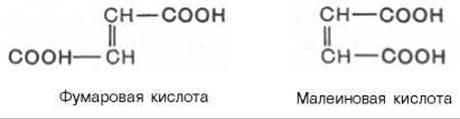
Thus, owing to their high catalytic specificity, enzymes ensure that only specific chemical reactions proceed at a high rate amidst the vast array of potential transformations within the microenvironment of cells and the whole Organism, thereby regulating the intensity of metabolism.
Last update: 06/08/2026
Editorial and Educational Adaptation: This material has been compiled based on the primary/original source text. The project team performed an editorial review, corrected technical inaccuracies, structured sections, and adapted the content for an educational format.
What was processed:
- elimination of formatting defects (OCR errors, structural breaks, corrupted characters);
- editorial organization of content;
- standardization of terminology in accordance with academic sources;
- verification of factual statements against the original source text.
All mentions of the author, publication year, and origin of the primary text have been preserved in accordance with the source.