Molecular Biology: Protein Structure and Functions - Stepanov V.M. 2005
Chemical modification of proteins
Standard reactions for the chemical modification of protein functional groups
9.2.1. ε-Amino Groups
ε-Amino groups belong to the side chains of Lysine residues. As a rule, they are located On the surface of the globule, are quite accessible, and exhibit chemical properties typical of aliphatic primary amines. The pKa of these groups is usually close to 10; therefore, reactions involving these groups are carried out in weakly alkaline media at pH 8 and above—that is, under conditions where they are at least partially deprotonated and can act as nucleophilic agents. Note that α-amino groups react similarly, although their reactivity is somewhat affected by their slightly lower basicity (pKa of about 8).
Acylation. These groups are easily acylated, for which many Reagents can be used, such as activated acid esters:
Class="center">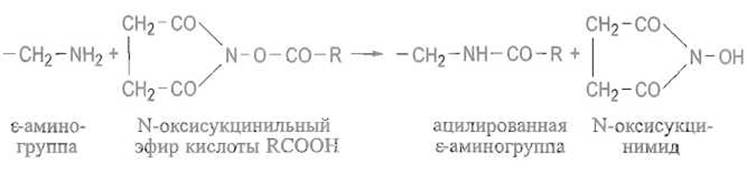
However, tyrosyl phenolate ions, which have a similar nucleophilicity, generally undergo the same reaction in parallel. For a more selective blocking of amino groups, one can take advantage of the much lower resistance to Hydrolysis of the esters formed upon the acylation of the phenolic hydroxyl of Tyrosine. This instability is particularly pronounced in the case of dicarboxylic acid monoesters formed during the acylation of tyrosine with anhydrides, such as succinic or citraconic anhydrides. In these cases, the tyrosine modification products are so unstable that they are practically undetectable, making it possible to achieve specific acylation of the ε-amino groups of lysine:
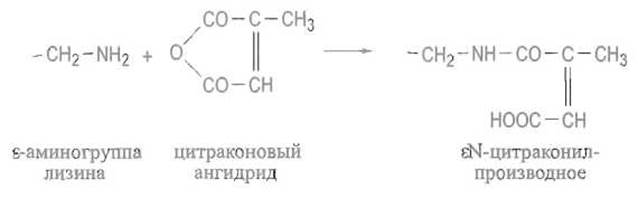
In the resulting derivative, the amino group, which is normally cationic, is replaced by an anionic carboxylate ion. It is important to note that the products of the acylation of lysine amino groups with dicarboxylic acid anhydrides are labile due to the proximity of the carboxyl group released during the reaction to the newly formed amide bond; in an acidic medium, the dicarboxylic amino acid residues are cleaved, releasing the ε-amino groups of the lysine residues. This possibility of reversibly blocking lysine ε-amino groups is used to perform the tryptic hydrolysis of a modified protein (e.g., a citraconylated protein) initially only at Arginine residues, and—after separating the resulting large fragments and deblocking the ε-amino groups—at lysine residues.
Arylation. The ε-amino groups of lysine residues can act as nucleophilic agents in reactions with 2,4-dinitrofluorobenzene and other activated aromatic halogen compounds:

In the resulting dinitrophenyl derivative of a characteristic yellow color (λmax ≈ 350–360 nm), the amino nitrogen completely loses its basic properties, and the hydrophilic amino group is replaced by a highly hydrophobic Structure.
Formation of Schiff Bases. Amino groups react with aldehydes by interacting with the carbonyl group in two stages According to the following scheme:

This reaction is selective; however, Schiff bases are unstable and easily cleaved—especially in an acidic medium—with the regeneration of free amino groups and the aldehyde. Taking this into account, the formed structure is stabilized by reducing the double bond —CH=N— with sodium borohydride NaBH4:

Conversion into Amidines. The Modification of lysine ε-amino groups with the indicated reagents leads to A change in the charge at a given point of the protein molecule, and sometimes to the Introduction of a hydrophobic substituent. The reaction with imidoesters differs in that it results in the replacement of the cationic amino group by a cationic amidine group as well, whose basicity is somewhat higher than that of amines:

If the substituent R is small, such a modification will lead only to the replacement of the amino group by an amidine group—neither the charge nor the hydrophilicity will change noticeably, which allows the modification results to be interpreted with greater confidence. For the same reasons, bis-imidoesters are readily used to cross-link two protein molecules. When a protein derivative modified with an imidoester according to the described scheme is treated with a large excess of a primary amine, such as methylamine, the amidine groups are transferred to this amine, the lysine residues are released, and the protein can be regenerated.
9.2.2. Phenolic Groups of Tyrosine
Tyrosine hydroxyl groups in Proteins are located partly inside and partly on The surface of the protein globule. In the latter case, they are characterized by a pKa ≈ 10 corresponding to the transition midpoint:

The resulting phenolate ion very actively enters into reactions also characteristic of lysine ε-amino groups, in particular the acylation reaction.
Acylation. This reaction can be carried out using various reagents, such as acetylimidazole:

However, substitution reactions in the aromatic ring, discussed below, are much more characteristic of tyrosine.
Iodination. This reaction is most often used as a method for introducing radioactive iodine isotopes into a protein molecule. A complex of iodine and potassium iodide can serve as a source of iodine atoms; in some cases, iodine generated by The oxidation of iodide ions in the presence of the enzyme peroxidase is used. The latter method makes the reaction more selective, since free iodine is formed wherever the large peroxidase molecule can penetrate. Iodination leads to The formation of both mono- and diiodotyrosine, with substitution occurring at the o-position:
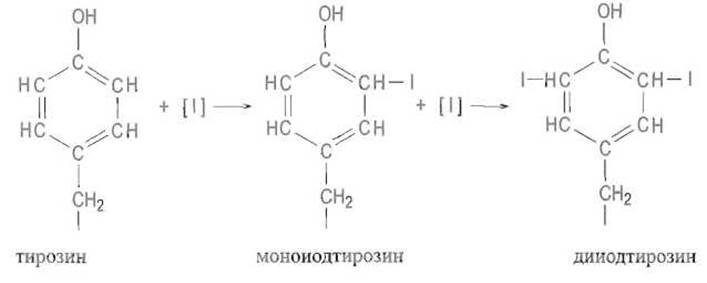
The introduction of iodine into a tyrosine residue has a dual effect: along with the incorporation of one or two bulky iodine atoms, the hydroxyl group of the phenol ring becomes significantly more acidic. This reaction is frequently employed for the radioactive iodination of proteins, during which various surface-exposed tyrosine residues can undergo modification.
Nitration. Nitration is achieved using tetranitromethane C(NO2)4, where the nitronium cation +NO2 typically acts as the active species:

In this case as well, the introduction of a second nitro group (also at the o-position) is possible, although it proceeds with significantly greater difficulty.
The hydroxyl group in o-nitrotyrosine exhibits pronounced acidic properties, essentially similar to those of o-phenol. Alongside nitronium cations, tetranitromethane also generates free-radical species +NC2. These also react to yield o-nitrotyrosine; however, the unpaired electron delocalized across the aromatic ring triggers a series of Side Reactions, notably the dimerization of o-nitrotyrosine residues.
Azo coupling. The reaction of tyrosine residues with aromatic diazonium salts, which are also cationic reagents, likewise leads to the formation of mono- and di-o-substituted products featuring an extensive system of conjugated double bonds. This imparts a deep, typically red-orange coloration to them (the so-called Pauli reaction, sometimes utilized for the detection of PROTEINS AND Peptides containing tyrosine or Histidine):

This reaction also enhances the acidic Properties of the tyrosine hydroxyl group. It is fairly specific, affecting only histidine residues In addition to tyrosine. Occasionally, however, the reaction of diazonium salts with lysine amino groups is observed, yielding highly unstable triazenes. For the analytical determination of o-nitro- and azotyrosine, researchers sometimes resort to the reduction of the nitro or azo groups, respectively, to amino groups. The resulting o-aminotyrosine survives complete acid hydrolysis of the protein and can be quantified using an amino acid analyzer.
9.2.3. Reactions of Carboxyl Groups
The ω-carboxyl groups of aspartic and glutamic acids are generally very numerous and, for the most part, located in the surface layer of the protein. As already mentioned, their reactivity depends significantly on the microenvironment. The following Methods are most commonly applied for the modification of these groups.
Reaction with amines in the presence of carbodiimides. This reaction is carried out in Water using water-soluble carbodiimides, such as N-ethyl-N'-trimethylaminopropyl carbodiimide:

The reaction with this or other carbodiimides proceeds according to the following scheme (R1—N=C=N—R2 is a carbodiimide, R3—NH2 is an aliphatic amine, often Glycine methyl ester):

If an exhaustive substitution of the carboxyl groups in a protein is carried out using glycine methyl ester or, better yet, the methyl ester of a non-protein amino acid such as norvaline as the amine, the Amino Acid Composition of the reaction product can be used to determine the number of carboxyl groups that participated in the reaction and, consequently, the total number of reagent-accessible carboxyl groups. As a rule, this number is large, with only isolated groups remaining buried. It should be borne in mind that the carboxyl Group activation product—an o-acylisourea—can not only react with an amine but also stabilize via an intramolecular acyl transfer from the oxygen atom to the nitrogen atom. This leads to the formation of a very stable N-acylurea:

Reactions with aliphatic diazo compounds. Stable aliphatic diazo compounds, such as diazoacetamide derivatives, react in the presence of copper ions with certain carboxyl groups—for example, the carboxyl group of one of the aspartic acid residues in the Active Site of Pepsin or other aspartic proteinases:

Alkylation of carboxyl groups. Alpha-haloketones (such as p-bromophenacyl bromide Br—СН2СС—С6Н4Вr and its analogs) as well as alpha-halo acids can be used as agents for alkylating certain carboxyl groups in proteins. The reaction with p-bromophenacyl bromide proceeds as follows:

9.2.4. Modification of Methionine Residues
Methionine residues in proteins and especially peptides are readily oxidized to methionine sulfoxide:
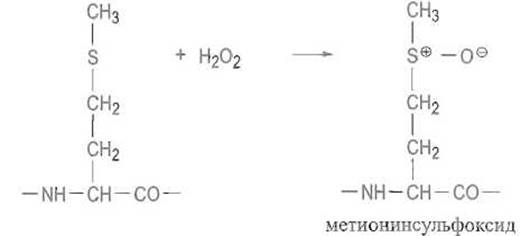
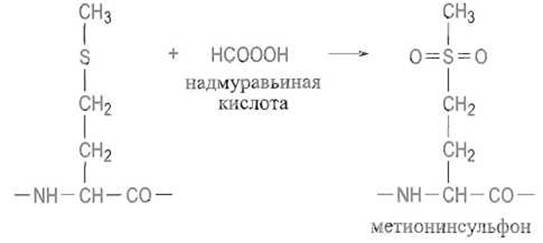
In A number of cases, this reaction proceeds even under the action of atmospheric oxygen. Under harsher conditions, such as Treatment with performic acid, oxidation goes further and yields methionine sulfone:
However, alkylating agents are more commonly used to modify methionine residues, such as the aforementioned n-bromophenacyl bromide or a-halogenated acids, particularly iodoacetic acid or its amide. It is characteristic that methionine sulfur reacts with such compounds even in a weakly acidic medium, whereas most other nucleophilic protein groups, particularly the imidazole groups of histidine, do not enter into the reaction because they are protonated:

The reaction of methionine residues with a-bromoketones proceeds similarly.
9.2.5. Modification of Cysteine Residues
Sulfhydryl groups of cysteine residues are highly reactive. They can both participate in substitution reactions as a nucleophilic component—facilitated by their dissociation to form a thiolate ion (with a pKa of around 8)—and undergo oxidation or form stable salts with heavy Metal Ions.
Alkylation of thiol groups. Thiol groups are readily alkylated in a mildly alkaline environment. For example, treatment with iodoacetic acid converts cysteine residues into S-carboxymethylcysteine, whereas treatment with iodoacetamide converts them into S-carboxamidomethylcysteine:

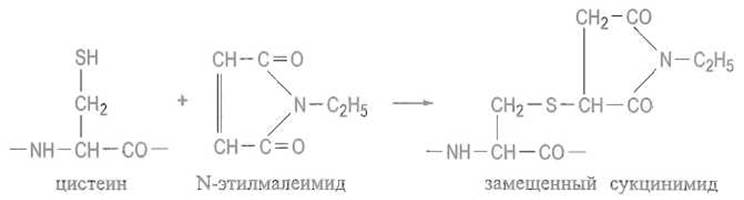
The cysteine thiol group readily adds to double bonds if they are activated by a conjugated carbonyl group or another means:
Oxidation of sulfhydryl groups. The sulfhydryl groups of cysteine residues can be oxidized to form disulfide groups, i.e., converting into cystine residues under relatively mild conditions, particularly under the action of atmospheric oxygen. This reaction is specific and may only be accompanied by the oxidation of sulfur in methionine. Sometimes, notably during Protein renaturation, a disulfide exchange reaction is employed to convert cysteine residues into cystine residues, for which the oxidized form of Glutathione is considered particularly suitable:

Naturally, this reaction is reversible; however, the equilibrium can be driven almost entirely toward the formation of a disulfide bond (typically intramolecular) within the protein due to a large excess of the oxidized form of glutathione. The Use of the so-called Ellman's reagent—5,5'-dithiobis-(2-nitrobenzoic acid)—for the Quantitative determination of free sulfhydryl groups in proteins is based on the disulfide exchange reaction. Interaction with these groups results in the reduction of the disulfide bond in the reagent. The resulting 5-mercapto-2-nitrobenzoic acid yields a characteristic yellow color due to the dissociation of the sulfhydryl group in an alkaline medium and can be quantified spectrophotometrically:

Formation of metal mercaptides. Once ionized—that is, in the form of a mercaptide ion—the sulfhydryl group specifically interacts with various heavy metal cations and organometallic compounds to form very stable mercaptides. Reactions with the divalent mercury cation are of analytical importance:

as well as with n-hydroxy- (or n-chloro-)mercuribenzoate

The Hg—S bond in such compounds is intermediate between ionic and covalent and is generally quite stable. The Formation of the n-mercuribenzoic acid mercaptide is accompanied by a characteristic change in the UV spectrum, which can be utilized for the quantitative determination of free sulfhydryl groups in proteins and peptides, although this method is less convenient than Ellman's assay.
9.2.6. Modification of the Histidine Imidazole Group
Alkylation. The histidine imidazole group readily undergoes alkylation reactions, for instance, with iodoacetic acid or its amide in a neutral or mildly alkaline medium. Depending on the microenvironment of this group within the protein or the binding mode of the alkylating agent, the reaction can occur at either nitrogen atom (N—1 or N—3):
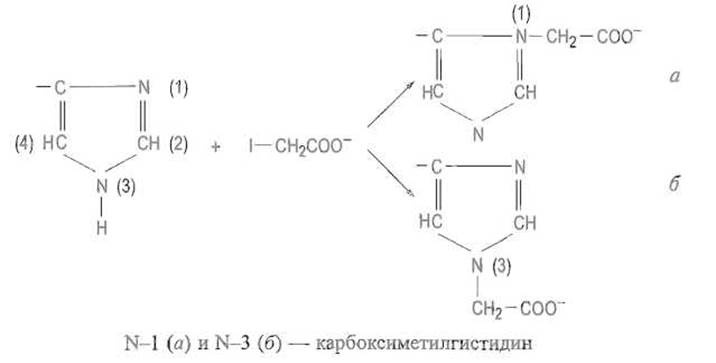
It should be noted that the double bond within the N=C—N System of the histidine imidazole ring is mobile and can shift between either of the two positions. Alkylation is not exclusive to histidine; it can also occur with residues of methionine, lysine, and even certain carboxyl groups, depending on the pH and, to a much greater extent, the specific microenvironment of the modified residue.
Azo coupling. The azo coupling reaction can involve either the C-2 or C-4 atom of the histidine imidazole group:

The azo coupling products of histidine with various diazonium salts (the scheme illustrates the reaction with diasulfanilic acid amide) exhibit an intense, typically red-orange coloration (Pauli reaction).
For the selective destruction of histidine residues, photo-oxidation with oxygen in the presence of sensitizing Dyes is employed.
9.2.7. Modification of the Arginine Guanidino Group
This task is particularly challenging because the δ-guanidino group of arginine is a very strong base (pKa ≈ 14) and can be deprotonated—allowing it to act as a nucleophile—only under extremely harsh conditions involving alkali concentrations that inevitably cause profound Protein Denaturation. Nevertheless, selective Modification of arginine can be achieved by exploiting the ability of the guanidino group to undergo heterocyclization reactions with certain diketones or aldehyde ketones:

9.2.8. Modification of Tryptophan Indole
The indole moiety is quite labile; specifically, it undergoes destruction upon photosensitized oxidation. Among chemical methods, worth noting is the reaction with o-nitrophenylsulfenyl chloride, which proceeds at the α-carbon atom of the pyrrole ring of indole:

Concluding this Brief Overview of reagents used for the modification of specific amino acid residues in proteins, it should be noted that this approach is entirely inapplicable to many Amino Acids. These include all hydrophobic amino acids, glycine, and Proline. Furthermore, there are no general approaches for the modification of Serine, Threonine, asparagine, and glutamine.
Last update: 13/08/2026
Editorial and Educational Adaptation: This material has been compiled based on the primary/original source text. The project team performed an editorial review, corrected technical inaccuracies, structured sections, and adapted the content for an educational format.
What was processed:
- elimination of formatting defects (OCR errors, structural breaks, corrupted characters);
- editorial organization of content;
- standardization of terminology in accordance with academic sources;
- verification of factual statements against the original source text.
All mentions of the author, publication year, and origin of the primary text have been preserved in accordance with the source.