Molecular Biology: Protein Structure and Functions - Stepanov V.M. 2005
Chemical modification of proteins
Applications of the chemical modification method
It must be emphasized once again that the data on protein functional group reactions presented above are approximate. With the possible exception of mercaptide formation, these reactions cannot be regarded as strictly specific. Consequently, the interpretation of chemical modification results offers broad possibilities. As a rule, the modification products must be separated, followed by the localization of modified amino acid residues through protein fragmentation and the Isolation of Peptides containing the reagent residue. Extrapolating results obtained from the action of specific Reagents on functional groups in model structures—such as Amino Acids, peptides, and even Proteins—is highly risky, especially when dealing with active-site components, since The chemical properties of such groups can be drastically altered due to their involvement in a network of non-covalent interactions.
9.3.1. Chemical Modification as a Method for Identifying The Role of Protein Functional Groups
As noted, in The Study of protein Structure and function, this method has been largely superseded by Site-Directed Mutagenesis (Protein Engineering). Nevertheless, initial insights into functionally significant amino acid residues in many proteins were gained precisely through chemical modification. For instance, the involvement of carboxyl groups from two aspartic acid residues in aspartyl proteinases was first demonstrated using specific reactions with diazoacetamide derivatives and diazoketones; in the study of Serine proteinases, identifying the special role of a serine residue that reacts specifically with diisopropyl fluorophosphate played a monumental role, and so forth. These results were subsequently confirmed by X-ray crystallography and site-directed mutagenesis. There is no doubt that chemical modification will continue to play a vital role, particularly in searching for functionally important structures within novel Protein Families.
This is because functionally active centers typically contain ensembles of groups and functional groups in unusual microenvironments, which alters and makes their chemical properties non-standard. For this very reason, the search for amino acid residues exhibiting anomalous reactivity constitutes a crucial stage in protein research.
At the same time, one must account for another difficulty inherent in interpreting results obtained by any modification method. Upon observing that attaching a substituent R to a certain protein group induces a characteristic change in its functional properties—such as the loss of activity—it is not easy to determine whether this occurred due to the blocking of that specific functional group or As a result of introducing the residue R into a site where its presence is intolerable (for instance, due to steric hindrance caused by the substituent). Expecting that The Use of reagents with very small radicals R will resolve this issue is hardly justified, since steric hindrance is not necessarily related to size. This makes the results of chemical modification ambiguous at times. Notably, the method of site-directed mutagenesis is subject to this exact same uncertainty. However, this complication can often be overcome if one can employ not just a single reagent, but a series of reagents featuring fundamentally different groups R.
9.3.2. Affinity Reagents
Regardless of how a chemical modification reagent is structured, its interaction with a given functional group always begins with its binding in the immediate vicinity of that group. Thus, reaction Specificity and selectivity are determined not only by the intrinsic chemical FEATURES OF THE functional group within the Cell/13.html">Protein Structure, but also by the presence of favorable (or, conversely, unfavorable) conditions nearby for binding the modifying reagent. To study functional groups within a protein's Active Site, it is advantageous to use compounds in which the reactive group proper is attached to a structure that "recognizes" the active site—more precisely, the region responsible for binding a specific Ligand (such as a substrate or effector). Such targeted reagents have a high probability of being sorbed into the active site and subsequently forming a covalent bond with functional groups localized therein. The reaction is facilitated by the spatial proximity between the reagent's reactive group and the modified amino acid residue, meaning that the intrinsic reactivity of the former does not necessarily need to be high.
A case in point is a series of peptidyl bromomethyl ketones structured as follows:
Class="center">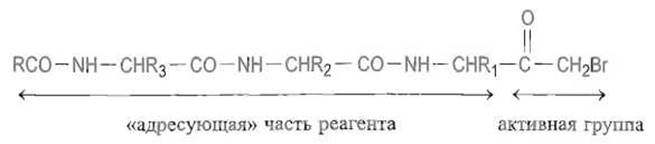
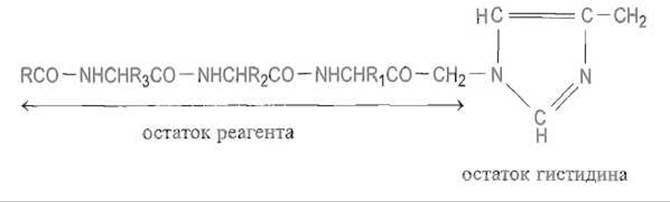
The peptide (targeting) portion of such a molecule specifically binds to the proteinase through The formation of a hydrogen-bonding network between the peptide moieties of the substrate analogue and the enzyme, as well as the interaction of side chains R1, R2, and R3 with the binding pocket. As a result, the reactive COCH2Br group is brought into close spatial proximity to the active site. In serine proteinases, it selectively reacts with the imidazole group of the active-site Histidine:
9.3.3. Chemical Modification in the Study of Intermolecular Complexes and the Synthesis of Protein Conjugates
An important application of chemical modification is the joining or "cross-linking" of a protein molecule with other molecules that are in close proximity within biological structures. This opens up the possibility of studying the geometry of sometimes highly complex intermolecular complexes. For instance, the bifunctional reagent dimethyl 3,3'-dithiobispropionimidate

is capable of modifying, much like a monofunctional imidoester, the ε-amino groups of Lysine residues spaced approximately 12 Å apart. This allows for cross-linking neighboring proteins within ribosomal subunits, F-Actin and Myosin fragments, proteins in Erythrocyte membranes, and so on. Crucially, the cross-link in this case contains a disulfide bond that can subsequently be cleaved by mild reduction. This leads to the Separation of the Conjugated Proteins and facilitates their identification. Intramolecular cross-links formed using identical or similar reagents are sometimes utilized to estimate distances between functional groups On the surface of a protein globule.
Naturally, bifunctional cross-linking reagents may also contain dissimilar reactive groups. This is particularly convenient when preparing conjugates that combine proteins with different functional properties—such as IMMUNOGLOBULINS and Enzymes (typically peroxidase or phosphatase)—which is essential for enzyme immunoassay. One such reagent is the N-hydroxysuccinimide ester of m-maleimidobenzoic acid:
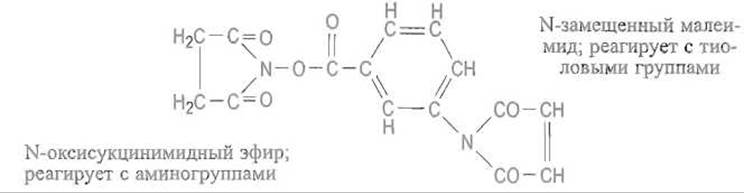
Its maleimide group is capable of adding to The sulfhydryl groups of Cysteine, while the N-hydroxysuccinimide ester acylates the ε-amino groups of lysine residues. Since these reactions proceed under different conditions, the formation of random protein pairs can be avoided.
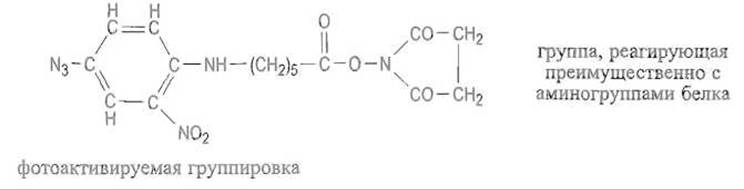
Modifying reagents containing a photoactivatable phenyl azide group have also gained widespread use. Upon irradiation of substituted phenyl azides with UV light at a wavelength of 265–275 nm, these normally quite stable substances decompose to yield reactive intermediates known as arynes (arenes). Being in close spatial proximity, the latter can react with various protein functional groups, including those normally considered inert. In principle, even the reaction of a nitrene with C—H groups is possible, though H—X functional groups are more frequently targeted:

Incorporating phenyl azide groups into The structure of a reagent that possesses an additional reactive group makes it possible to first modify the protein via the latter group. Following this, photoactivation generates a new, highly reactive center (arene) within the already modified protein, capable of forming covalent bonds both with neighboring macromolecules (such as Polysaccharides, Lipids, etc.) and with spatially close groups within the same molecule. For example, the bifunctional reagent shown below makes it possible to attach a photoactivatable group to protein amino groups:
9.3.4. Other Applications of Chemical protein modification
Chemical modification reactions enable the formation of covalent bonds between proteins and an insoluble matrix, such as polysaccharides (agarose and its derivatives, including Sepharose, and Cellulose), organic polymers (polyacrylamide, polyvinyl alcohol, Toyopearl), or inorganic Materials (controlled-pore Glass and silica gel). A variety of reagents are employed for this purpose. For instance, immobilization on polysaccharides involves preliminary activation of the matrix with Cyanogen bromide, after which the resulting cyanic acid ester forms an amidine with the ε-amino group of the protein. This reaction is also utilized as a method for attaching ligands to a matrix during the synthesis of affinity sorbents (see Chapter 3).
Protein immobilization is frequently carried out using a dialdehyde (typically glutaraldehyde) to cross-link a free protein ε-amino group with an amino group on the support:
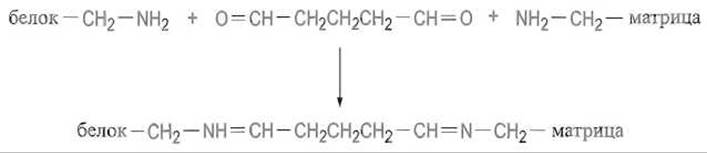
To enhance the stability of immobilization, labile —CH=N— bonds are reduced with sodium borohydride (NaBH4), converting them into highly stable —CH—NH— bonds.
Modification allows altering Protein solubility. For instance, attaching several hydrophobic polymer chains —CH2CH2O—CH2CH2O—CH2CH2—O— to Chymotrypsin makes this enzyme soluble in organic Solvents, enabling its use as a catalyst in organic synthesis.
Last update: 13/08/2026
Editorial and Educational Adaptation: This material has been compiled based on the primary/original source text. The project team performed an editorial review, corrected technical inaccuracies, structured sections, and adapted the content for an educational format.
What was processed:
- elimination of formatting defects (OCR errors, structural breaks, corrupted characters);
- editorial organization of content;
- standardization of terminology in accordance with academic sources;
- verification of factual statements against the original source text.
All mentions of the author, publication year, and origin of the primary text have been preserved in accordance with the source.