LEHNINGER PRINCIPLES OF BIOCHEMISTRY - VOLUME 1. THE FOUNDATIONS OF BIOCHEMISTRY: STRUCTURE AND CATALYSIS - 2011
PART I. STRUCTURE AND CATALYSIS
Class="center">The fat, separated from the salt-forming bases, was dissolved in boiling alcohol. After cooling the solution, very pure crystals were obtained, which were subjected to analysis. Since this substance had not yet been described, I proposed to name it margarine—from the Greek word for pearl, as it bears a certain external resemblance to mother-of-pearl in various combinations of salt-forming bases within its composition.
Michel-Eugène Chevreul, Philosophical Magazine, 1814
10. LIPIDS
Biological Lipids are a chemically diverse group of compounds, the common and defining feature of which is their insolubility in Water. The BIOLOGICAL Functions OF lipids are as varied as their chemical structures. Fats and oils are the major stored forms of energy in many organisms. Phospholipids and sterols are the primary Structure/83.html">Structural elements of Introduction/36.html">Biological Membranes. Other lipids, although present in relatively small amounts, play crucial roles as enzyme Cofactors, electron carriers, light-absorbing pigments, hydrophobic anchors for Proteins, "chaperones" that assist in membrane protein folding, emulsifiers in the digestive tract, Hormones, and intracellular messengers. This chapter introduces each major class of lipids, focusing in particular on their chemical structures and physical properties. The order of presentation reflects their functional Organization, although lipids can also be classified into eight distinct categories based on their chemical structures and other criteria, encompassing about a thousand known lipids (see Table 10-3). The energy-yielding oxidation of lipids is discussed in Chapter 17, and their Biosynthesis in Chapter 21.
10.1. Storage Lipids
Fats and oils used almost universally as energy reservoirs in Living organisms are derivatives of Fatty acids. Fatty acids are hydrocarbon derivatives found in the same low-oxidation (i.e., highly reduced) state as Hydrocarbons in petroleum and natural gas deposits. Cellular Oxidation of Fatty acids (to CO2 and H2O), much like the controlled combustion of gasoline in an internal combustion engine, is highly exergonic.
Below we discuss the STRUCTURE AND NOMENCLATURE of the fatty acids most commonly found in living organisms. To illustrate The Diversity of structure and physical properties within this class of compounds, Two Types of fatty acid-containing substances will be described: triacylglycerols and Waxes.
Fatty acids are hydrocarbon derivatives
Fatty acids are carboxylic acids with hydrocarbon chains ranging from 4 to 36 carbon atoms in length (C4–C36). In some fatty acids, this chain is unbranched and fully saturated (containing no double bonds); in others, it contains one or more double bonds (Table 10-1). Some compounds also incorporate three-carbon rings, hydroxyl groups, or methyl branch points.
Table 10-1. Some Naturally Occurring Fatty Acids: Structure, Properties, and Nomenclature
Carbon Skeleton |
Structural Formula * |
Systematic Name ** |
Trivial Name (Derivation) |
Melting Point (°C) |
Solubility at 30 Water |
°C (mg/g solvent) Benzene |
12:0 |
СН3(СН2)10СООН |
n-Dodecanoic acid |
Lauric acid (from Lat. Laurus, laurel) |
44.2 |
0.063 |
2600 |
14:0 |
СН3(СН2)12СООН |
n-Tetradecanoic acid |
Myristic acid (from Lat. Myristica, a nutmeg genus) |
53.9 |
0.024 |
874 |
16:0 |
СН3(СН2)14СООН |
n-Hexadecanoic acid |
Palmitic acid (from Lat. palma, palm tree) |
63.1 |
0.0083 |
348 |
18:0 |
СН3(СН2)16СООН |
n-Octadecanoic acid |
Stearic acid (from Gk. stear, tallow) |
69.6 |
0.0034 |
124 |
20:0 |
С Н3(СН2)18СООН |
n-Eicosanoic acid |
Arachidic acid (from Lat. Arachis, a legume genus) |
76.5 |
||
24:0 |
СН3(СН2)22СООН |
n-Tetracosanoic acid |
Lignoceric acid (Lat. lignum, wood + cera, wax) |
86.0 |
||
16:1 (∆9) |
СН3(СН2)5СН=СН(СН2)7СООН |
cis-9-Hexadecenoic acid |
Palmitoleic acid |
-0.5 |
||
18:1 (∆9) |
СН3(СН2)7СН- СН(СН2)7СООН |
cis-9-Octadecenoic acid |
Oleic acid (Lat. oleum, oil) |
13.4 |
||
18:1 (∆9,12) |
CH3(CH2)4СH=СНСН2 = СН(СН2)7СООН |
cis,cis-9,12-Octadecadienoic acid |
Linoleic acid (Gk. linon, flax) |
-5 |
||
18:3 (∆9,12,15) |
СН3СН2СН=СНСН2СН- СН(СН2)7СООН |
cis,cis,cis-9,12,15-Octadecatrienoic acid |
α-Linolenic acid |
-11 |
||
20:4 (∆5,8,11,14) |
СН3(СН2)4СН = СНСН2СН= СНСН2СН= СНСН2СН= СН(СН2)3СООH |
cis,cis,cis,cis-5,8,11,14-Eicosatetraenoic acid |
Arachidonic acid |
-49.5 |
* All acids are shown in their un-ionized form. At pH 7, the carboxyl group of all fatty acids is ionized. Note that carbon atom numbering begins with the carboxyl carbon.
** "n-" denotes a normal, unbranched structure. For example, "dodecanoic" simply specifies 12 carbon atoms, which can form various branched structures, whereas "n-dodecanoic" designates the linear, unbranched form. For Unsaturated fatty acids, the configuration of each double bond is specified; biological fatty acids almost invariably have the cis configuration.
Key Conventions.
A simplified nomenclature for these compounds is based on chain length and number of double bonds, separated by a colon (Fig. 10-1a); for example, the 16-carbon saturated palmitic acid is abbreviated 16:0, and the 18-carbon oleic acid with one double bond is 18:1. The positions of any double bonds are specified by superscript numbers following the Greek letter Delta (Δ); a 20-carbon fatty acid with one double bond between C-9 and C-10 (where C-1 is the carboxyl carbon) and another between C-12 and C-13 is designated 20:2 (Δ9,12). ■
Figure 10-1. Two conventions for Fatty Acid Nomenclature. (a) In standard nomenclature, the carbon atom of the carboxyl group is C-1. THE POSITION OF each double bond is indicated by a superscript following the Greek letter delta (Δ), with the number of the lower-numbered carbon in the double bond. (b) For polyunsaturated fatty acids, an alternative convention numbers the carbon atoms in the reverse direction, starting with the methyl carbon at the other end of the chain, designated omega (ω, the last letter of the Greek alphabet). The positions of the double bonds are specified relative to the ω-carbon.

The most common fatty acids have an even number of carbon atoms in an unbranched chain of 12 to 24 carbons (Table 10-1). As we will see in Chapter 21, this even number of carbons results from the mode of biosynthesis of these compounds, which involves the Condensation of two-carbon (acetate) units.
There is also a general pattern in the Location of double bonds: in most monounsaturated fatty acids, the double bond is between C-9 and C-10 (Δ9), and in polyunsaturated fatty acids, additional double bonds are usually at Δ12 and Δ15 (arachidonic acid is an exception to this general rule). The double bonds in polyunsaturated fatty acids are almost never conjugated (alternating single and double bonds, as in –CH=CH–CH=CH–), but are separated by a methylene group: –CH=CH–CH2–CH=CH– (Fig. 10-1b). In nearly all naturally occurring fatty acids, the double bonds are in the cis configuration. trans-Fatty acids are formed by the action of Enzymes in the rumen of ruminant animals and can be obtained from dairy products and meat.
Key Conventions.
Of particular importance in Human Nutrition are polyunsaturated fatty acids (PUFAs) that have a double bond between the third and fourth carbon atoms counting from the methyl terminal. Because The Physiological Role of PUFAs is more closely related to the position of the first double bond from the methyl terminal than from the carboxyl terminal, an alternative numbering system is sometimes used to designate these fatty acids. The methyl carbon (the carbon most distant from the carboxyl group) is designated the ω carbon and is assigned the number 1 (Fig. 10-1b). In this system, polyunsaturated fatty acids with a double bond between C-3 and C-4 are called omega-3 (ω-3) fatty acids, and those with a double bond between C-6 and C-7 are called omega-6 (ω-6) fatty acids. ■
■ Humans require the omega-3 polyunsaturated α-linolenic acid (18:3(Δ9,12,15) in standard nomenclature) for normal METABOLISM, but cannot synthesize it and therefore must obtain it in the diet. α-Linolenic acid serves as the precursor for the synthesis in The Human Body of two other important omega-3 polyunsaturated fatty acids: eicosapentaenoic acid (EPA, 20:5(Δ5,8,11,14,17); see Fig. 10-1b) and docosahexaenoic acid (DHA, 22:6(Δ4,7,10,13,16,19)). An imbalance in dietary omega-3 and omega-6 polyunsaturated fatty acids increases the risk of cardiovascular disease. The optimal ratio of omega-3 to omega-6 fatty acids ranges from 1:1 to 4:1, but in the typical North American diet this ratio is between 10:1 and 30:1, contributing to higher rates of Heart disease and stroke. The "Mediterranean diet," associated with lower rates of cardiovascular disease, features an elevated intake of omega-3 polyunsaturated fatty acids derived from green leafy vegetables and fatty fish. Fish oils are rich in DHA and EPA and are frequently prescribed to patients with cardiovascular conditions. ■
The Physical Properties of Fatty Acids and of compounds that contain them are dictated largely by the length and degree of degree of unsaturation of the hydrocarbon chain. The nonpolar hydrocarbon chain accounts for the very low solubility of fatty acids in water. For example, the solubility of lauric acid (12:0, $M_r = 200$) in water is much lower (0.063 mg/g) than that of glucose ($M_r = 180$; 1,100 mg/g). The longer the fatty acyl chain and the fewer the double bonds, the lower the solubility. The carboxyl group is polar (fatty acids are ionized at neutral pH), accounting for the slight solubility of short-chain fatty acids in water.
Melting points are also strongly dependent on the length and degree of unsaturation of the hydrocarbon chain. At room Temperature (25 °С), saturated fatty acids ranging from 12:0 to 24:0 have a waxy consistency, whereas unsaturated fatty acids with the same carbon chain length are liquid oils. This difference in melting points is due to the different packing of the fatty acid molecules (Fig. 10-2). In fully saturated molecules, free rotation around each carbon-carbon bond imparts high flexibility to the hydrocarbon chain; their most stable conformation is fully extended, in which steric hindrance is minimal. These molecules can pack into quasi-crystalline arrays, where atoms along the entire length of the chain form Van der Waals contacts with atoms of neighboring molecules. In unsaturated fatty acids, the cis-configuration of double bonds introduces a bend into the hydrocarbon chain. Fatty acids with one or more such bends cannot pack as tightly as fully saturated acids, resulting in weaker intermolecular interactions. Because less thermal Energy is required to disrupt these less ordered aggregates, the melting points of unsaturated fatty acids are significantly lower than those of saturated carboxylic acids of the same carbon chain length.
Fig. 10-2. Packing of fatty acids into stable aggregates. Packing density depends on the degree of unsaturation. (a) Two representations of a fully saturated stearic acid molecule (stearate at pH 7) in its usual extended conformation. Each linear segment contains a single bond between adjacent carbons. (b) A cis-double bond (shaded) in oleic acid, 18:1(∆9) (oleate), restricts rotation and introduces a rigid bend into the hydrocarbon "tail." All other bonds in the chain are freely rotating. (c) Fully saturated fatty acids in an extended form organize into quasi-crystalline arrays stabilized by hydrophobic interactions. (d) The presence of one or more cis-double bonds hinders tight packing, resulting in less stable aggregates.

In vertebrates, free fatty acids (unesterified, with a free carboxyl group) circulate in the bloodstream covalently bound to a protein carrier, serum albumin. In most cases, however, fatty acids exist as carboxyl-group derivatives, such as esters and amides. Because these fatty acid derivatives lack a charged carboxyl group, they are even less water-soluble than free fatty acids.
Triacylglycerols Are Esters of Fatty Acids and Glycerol
The simplest lipids constructed from fatty acids are triacylglycerols, also referred to as triglycerides, fats, and neutral fats. Triacylglycerols are composed of three fatty acids, each in ester linkage with glycerol (Fig. 10-3). Triacylglycerols containing the same fatty acid in all three positions are simple triacylglycerols; they are named after the fatty acid they contain. For example, simple triacylglycerols of 16:0, 18:0, and 18:1 acids are tristearin, tripalmitin, and triolein, respectively. Most naturally occurring triacylglycerols are mixed; they contain two or three different fatty acids. To name these compounds correctly, the exact identity and position of each fatty acid must be specified.
Fig. 10-3. Glycerol and a triacylglycerol. The mixed triacylglycerol shown here contains three different fatty acids linked to a glycerol backbone. When glycerol esterifies two different fatty acids at C-1 and C-3, a chiral center is created at carbon C-2 (p. 36).
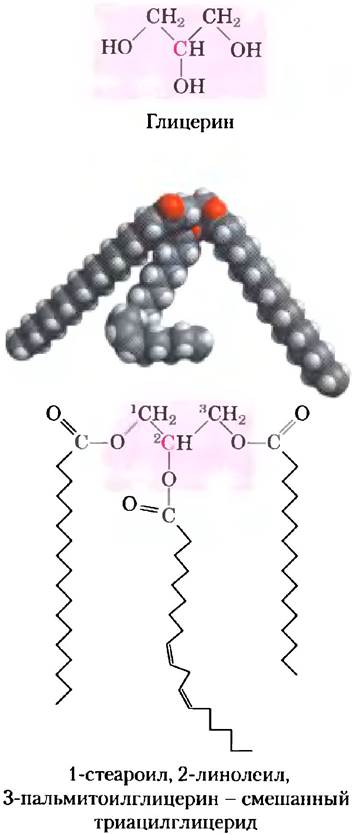
Because the polar hydroxyl groups of glycerol and the polar carboxyl groups of fatty acids are bound in ester linkages, triacylglycerols are nonpolar, hydrophobic molecules that are essentially insoluble in water. Lipids have a lower density than water, which explains why oil-and-water mixtures (such as an oil-and-vinegar salad dressing) are biphasic: the less dense oil floats On the surface of the water.
Triacylglycerols Provide Energy Storage and Thermal Insulation
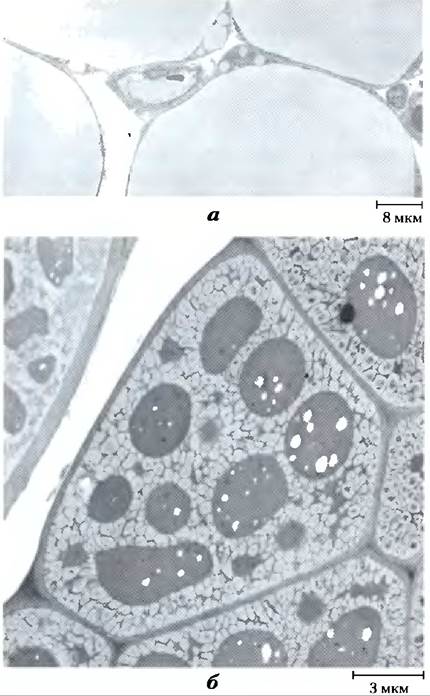
In most Eukaryotic Cells, triacylglycerols coalesce into a distinct phase of microscopic oil droplets in the aqueous Cytosol, thereby functioning as a depot for metabolic "fuel" (fat stores). Vertebrates possess specialized cells known as adipocytes, or fat cells, which store large amounts of triacylglycerols as fat droplets that virtually fill the entire Cell (Fig. 10-4a). Triacylglycerols are also stored as oils in the seeds of many plant species, providing energy for biosynthesis during seed germination (Fig. 10-4b). Adipocytes and germinating seeds contain lipases—enzymes that catalyze the Hydrolysis of stored triacylglycerols, releasing fatty acids for export to Tissues requiring energy.
Fig. 10-4. Fat depots in cells. (a) Cytology/practical/72.html">Cross section of four adipocytes from a guinea pig. Giant lipid droplets practically fill the cells. Cross sections of several capillaries are also visible. (b) Cross section of a cotyledon cell from an Arabidopsis seed. The large dark structures are protein bodies surrounded by oils contained within lightly stained oil bodies.
When used as stored fuel, triacylglycerols have two significant advantages over Polysaccharides such as Glycogen and starch. First, because the carbon atoms in fatty acids are more reduced than those in sugars, oxidation of triacylglycerols yields more than twice as much energy per gram as The oxidation of CARBOHYDRATES. Second, because triacylglycerols are hydrophobic and therefore unhydrated, an Organism carrying fat as fuel is not burdened by the extra weight of water of Hydration associated with stored polysaccharides (2 g of water per gram of polysaccharide). In humans, adipose tissue (consisting predominantly of adipocytes) is located subcutaneously, in the Abdominal cavity, and
in the Mammary Glands. In moderately obese individuals, adipocytes store 15 to 20 kg of triacylglycerols, allowing them to meet their energy needs for months by depleting their fat reserves. In contrast, the human body can store less than a day's energy supply in the form of glycogen. Carbohydrates (such as glycogen and glucose) do have certain advantages as rapid sources of metabolic energy; moreover, carbohydrates are readily soluble in water.
In some animals, subcutaneous triacylglycerols serve not only as energy reserves but also as thermal insulation. Seals, walruses, penguins, and other warm-blooded polar animals are generously padded with triacylglycerols. In hibernating animals (such as bears), massive fat reserves accumulated prior to hibernation serve a dual purpose—as an energy depot and for thermal insulation (see Box 17-1). The low density of triacylglycerols forms The basis of another remarkable function of these compounds. Sperm whales can alter their buoyancy in waters of varying density thanks to their reserves of triacylglycerols and waxes, which is particularly important during deep dives into cold water (Box 10-1).
Partial Hydrogenation of Cooking Oil Produces Trans Fatty Acids
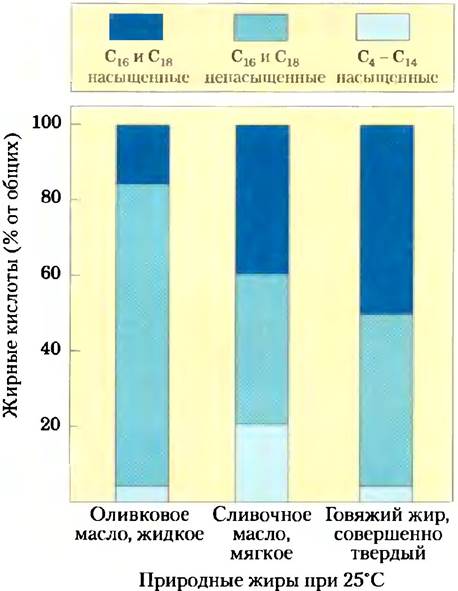
■ Most natural fats are found in vegetable oils, dairy products, and animal fats; natural fats are complex mixtures of simple and mixed triacylglycerols. The fatty acids in natural fats vary in carbon chain length and degree of unsaturation (Fig. 10-5). Vegetable oils, such as corn and olive oil, consist mainly of triacylglycerols with unsaturated fatty acids and are therefore liquid at room temperature. In industry, they are converted into solid fats by catalytic hydrogenation, in which some of the double bonds are reduced to single bonds, while others are converted into trans-double bonds. Triacylglycerols containing exclusively saturated fatty acids, such as tristearin—the primary component of beef tallow—are white solids at room temperature.
Sperm Whales: Fatty Heads of the Deep
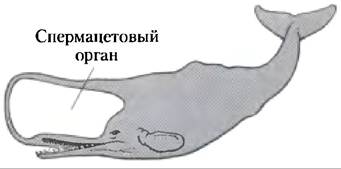
The Study of sperm whales has revealed yet another role of triacylglycerols in nature. The HEAD of a sperm whale is enormous, accounting for more than one-third of its total body mass. About 90% of the head's mass is made up of the spermaceti organ, a fatty mass containing up to 3,600 kg (nearly 4 metric tons!) of spermaceti oil—a mixture of triacylglycerols and waxes rich in unsaturated fatty acids. This mixture is liquid at the whale's normal body temperature (about 37 °С), but begins to crystallize around 31 °С and solidifies when the temperature drops by a few more degrees.
Inferences regarding the possible biological function of spermaceti oil have been drawn from the anatomy and feeding behavior of the sperm whale. These marine mammals feed almost exclusively on squid at great depths. In search of food, they dive to depths of 1,000 m or more, with a record dive of 3,000 m. At these depths, they face no competition in hunting squid; the sperm whale remains motionless, waiting for schooling prey to swim by.
To maintain a given depth without constant swimming motions, a marine animal must have a density equal to that of the surrounding water. The buoyancy of sperm whales changes in accordance with environmental density—from The surface of the tropical ocean to great depths, where the water is much colder and consequently denser. The key to this mechanism lies in the freezing point of spermaceti oil. When the oil temperature drops by a few degrees during a deep dive, it solidifies (crystallizes) and becomes denser. Thus, the whale's buoyancy changes to match the density of the seawater. Rapid cooling of the oil during the dive is facilitated by various physiological mechanisms. Upon returning to the surface, the solidified spermaceti oil warms and melts, decreasing its density to match that of the upper water layer. In other words, we observe a striking anatomical and biochemical adaptation in the sperm whale. The triacylglycerols and waxes synthesized by the sperm whale contain fatty acids with the exact chain length and degree of unsaturation required to provide spermaceti oil with the appropriate melting point for the animal's deep-diving lifestyle.
Unfortunately for the sperm whale population, spermaceti oil was once considered the finest lamp oil and continues to hold commercial value as a lubricant. Centuries of intensive hunting have led to sperm whales now being listed as an endangered species.
When lipid-rich products are exposed to atmospheric oxygen for too long, they can spoil and become rancid. The unpleasant taste and odor associated with this spoilage result from the oxidative Cleavage of double bonds in unsaturated fatty acids, yielding aldehydes and shorter-chain carboxylic acids, which are consequently more volatile. To improve the shelf life of cooking oils and enhance their stability at the high temperatures required for frying, commercial vegetable oils undergo partial hydrogenation. This process converts many cis-double bonds into single bonds, raising the melting point of the fats so that they are solid at room temperature (for instance, margarine is produced from vegetable fats in this manner). However, partial hydrogenation is accompanied by an undesirable side effect: some cis-double bonds are isomerized into trans-double bonds. It is now well established that consuming large amounts of trans fatty acids (often referred to simply as trans fats) increases the risk of cardiovascular disease; conversely, avoiding such fats in the diet significantly lowers the risk of CORONARY HEART DISEASE. Dietary intake of trans fatty acids elevates Blood levels of triglycerides and low-density Lipoproteins ("bad" Cholesterol) while lowering high-density lipoprotein ("good" cholesterol) levels. These changes alone are sufficient to increase cardiovascular risk. But the detrimental effects of trans fats do not end there; they appear to exacerbate inflammatory processes in the body, providing an additional factor that increases
the probability of developing heart disease. For more details on The properties of low- and high-density cholesterol (LDL and HDL), see ch. 21.
Fig. 10-5. Fatty acid composition of three dietary fats. Olive oil, butter, and beef fat consist of mixtures of triacylglycerols that vary in their fatty acid composition. The melting points of these fats, and consequently their physical state at room temperature (25 °С), depend directly on their constituent fatty acids. Olive oil is characterized by a high content of long-chain (С16 and С18) unsaturated fatty acids, which keep it liquid at 25 °С. A higher content of long-chain (С16 and С18) saturated fatty acids in butter raises the melting point, making the butter soft at room temperature. Beef fat, with an even higher content of long-chain saturated fatty acids, is completely solid.
Many fast foods are deep-fried in partially hydrogenated vegetable oils containing high amounts of trans fatty acids (see Table 10-2). Due to the adverse health effects of trans fatty acids, some countries (such as Denmark) and individual U.S. cities (New York, Philadelphia) have banned The Use of partially hydrogenated oils in restaurants. French fries prepared in Danish fast-food restaurants are virtually free of trans fatty acids, whereas the same product prepared in the U.S. contains from 5 to 10 g of trans fat per serving. The harmful effects of trans fatty acids are known to manifest at a consumption of 2 to 7 g per day (20 to 60 calories based on a 2,000-calorie daily diet; note that the unit "calorie" used in nutrition corresponds to a kilocalorie in chemistry and biochemistry, so 2,000 calories equals 2,000 kcal). Thus, a single serving of French fries at an American restaurant can contain this very high amount of trans fatty acids! Many other ready-to-eat foods, baked goods, and snacks from supermarkets also contain substantial amounts of trans fatty acids. ■
Table 10-2. Trans fatty acids in some common snacks and fast foods

All data are for foods prepared with partially hydrogenated vegetable oil in the U.S. in 2002.
Waxes serve as energy stores and water repellents
Natural waxes are esters of long-chain (С11–С36) saturated and unsaturated fatty acids with long-chain (С16–С30) alcohols (Fig. 10-6). The melting points of waxes (60–100 °С) are generally higher than those of triacylglycerols. In plankton—free-swimming microorganisms representing the lowest trophic level in the marine food chain—waxes are the primary form of metabolic fuel storage.
Fig. 10-6. Biological wax. (a) Triacontanyl palmitate, the main component of beeswax, is an ester of palmitic acid and the alcohol triacontanol. (b) Honeycombs, constructed from beeswax, are solid at 25 °С and completely impermeable to water. The term "wax" is derived from the Old English word weax, meaning the material of beehives.
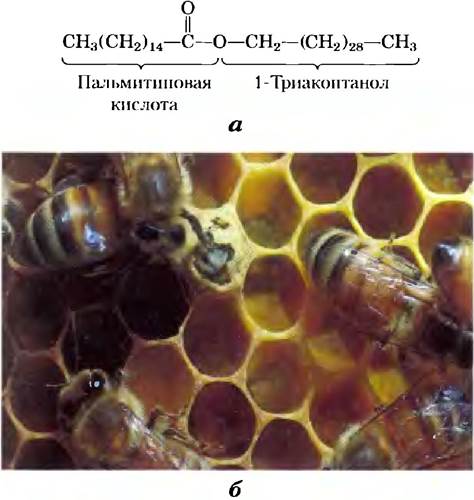
Waxes also perform numerous other functions due to their firm consistency and water-repellent properties. In vertebrates, specialized Skin glands secrete waxes to protect the skin and Hair, keeping them soft, pliable, and water-resistant. Birds, especially waterfowl, secrete waxes from their uropygial (preen) glands to maintain the water-repellent properties of their feathers. When exposed to sunlight, the leaves of holly, rhododendrons, poison ivy, and many tropical plants are coated with a thick layer of wax that prevents excessive water loss and protects against parasites.
Biological waxes find A wide variety of Applications in the pharmaceutical, cosmetic, and other industries. Lanolin (from sheep's wool), beeswax (Fig. 10-6), carnauba wax (from the Brazilian palm), and wax extracted from spermaceti oil (from whales, see Box 10-1) are widely used in the manufacture of lotions, ointments, and polishes.
Summary of Section 10.1 Storage Lipids
■ Lipids are water-insoluble cellular components of diverse structure that can be extracted with nonpolar Solvents.
■ Almost all fatty acids (the hydrocarbon components of many lipids) have an even number of carbon atoms (typically 12 to 24); they can be saturated or unsaturated, with the double bonds almost always in the cis configuration.
■ Triacylglycerols contain three fatty acid residues esterified to the three hydroxyl groups of glycerol. Simple triacylglycerols contain fatty acids of only one type; mixed triacylglycerols contain two or three types. Triacylglycerols are primarily storage fats and are found in many foods.
■ The partial hydrogenation of vegetable oils in the food industry converts some cis double bonds into the trans configuration. Dietary trans fatty acids increase the risk of cardiovascular disease.
Last update: 06/08/2026
Editorial and Educational Adaptation: This material has been compiled based on the primary/original source text. The project team performed an editorial review, corrected technical inaccuracies, structured sections, and adapted the content for an educational format.
What was processed:
- elimination of formatting defects (OCR errors, structural breaks, corrupted characters);
- editorial organization of content;
- standardization of terminology in accordance with academic sources;
- verification of factual statements against the original source text.
All mentions of the author, publication year, and origin of the primary text have been preserved in accordance with the source.