Biochemistry and Molecular Biology - Belyasova N.A. 2002
Metabolism. Processes Requiring Energy Input
Metabolism of Nitrogen-Containing Compounds
Amino Acid Biosynthesis
The biosynthetic pathways of Proteinogenic Amino Acids are quite complex and multifaceted—the same amino acid can be synthesized through various routes—and they may differ significantly among organisms. Nevertheless, these processes share a considerable number of common patterns, and for convenience, all 20 proteinogenic Amino acids can be divided into five biosynthetic families. Amino acids belonging to the same family typically share common precursors that are formed in the TCA cycle, Glycolysis, or the Pentose Phosphate Pathways.
Non-Essential Amino Acids are synthesized via relatively simple reactions, whereas the biosynthetic pathways of essential Amino acids are highly complex. For white rats, the essential amino acids include valine, isoleucine, leucine, Threonine, Methionine, Lysine, phenylalanine, Tryptophan, Histidine, and Arginine. Eight of these Ten amino acids are also not synthesized by The Human Body, while whether histidine and arginine are essential for humans remains a subject of debate.
Biosynthesis of the glutamate family. This family includes glutamate, glutamine, Proline, and arginine. The first Two amino acids are formed from a-ketoglutarate, with their amino groups originating from ammonia molecules (Fig. 16.3). Proline is synthesized from glutamate in four reactions: the g-carboxyl group of glutamate reacts with ATP to form an acyl phosphate. The latter is reduced with NADPH to an aldehyde, and then undergoes spontaneous dehydration to form a cyclic compound, pyrroline-carboxylate. This product is reduced in the presence of NADPH to yield proline (Fig. 16.4).
The synthesis of arginine (Fig. 16.5) also starts from glutamate, which is first acetylated at its amino group and then subjected to the phosphorylation and semialdehyde formation reactions described above. However, N-acetylglutamate y-semialdehyde does not cyclize as it does in the proline biosynthetic pathway; instead, it undergoes Transamination involving glutamate (Glu). This reaction yields a-ketoglutarate (KG) and N-acetylornithine. The latter is deacetylated to form Ornithine. Ornithine is subsequently converted into arginine through a series of Reactions of the Urea Cycle.
Biosynthesis of the aspartate family. The aspartate family includes aspartate, asparagine, lysine, threonine, isoleucine, and methionine. The last Five amino acids in this group are synthesized from aspartate, which, in turn, is formed from oxaloacetate—an intermediate of the TCA cycle—via a transamination reaction, with glutamate acting as the amino group donor (Fig. 16.6).
Aspartate serves as a precursor for the synthesis of asparagine. In many Bacteria, direct amination of aspartate can occur in an ATP-dependent reaction mediated by asparagine synthetase (16.2).
Class="center">
Fig. 16.4. Biosynthesis of proline (details in text)

Fig. 16.5. Biosynthesis of arginine (details in text)
Aspartate + NH3 + ATP → Asparagine + AMP + PPi (16.2)
Mammalian Cells utilize a different reaction (Fig. 16.6), in which glutamine serves as the amino group donor during The formation of asparagine.

Fig. 16.6. Biosynthesis of aspartate and asparagine (details in text)
Lysine, methionine, and threonine are synthesized from aspartate derivatives (Fig. 16.7), whereas isoleucine is synthesized from threonine.
In bacterial and plant cells, lysine is synthesized via the aldol Condensation of aspartate semialdehyde and Pyruvate, followed by reduction, addition of a succinate residue, transamination involving glutamate, intramolecular rearrangement, and decarboxylation. Fungal cells utilize a different biosynthetic pathway for lysine, starting from a-ketoglutarate and acetyl-CoA.
The carbon Skeleton of methionine is derived from homoserine, the sulfur atom originates from Cysteine, and N-methyltetrahydrofolic acid serves as the methyl group donor.
Threonine provides four of the six carbon atoms in the isoleucine molecule. In the first step of synthesis, threonine is deaminated to form 2-ketobutyrate, then interacts with pyruvate, and undergoes structural rearrangements and a transamination reaction in which glutamate serves as the amino group donor.
Biosynthesis of the pyruvate family. Alanine, valine, and leucine are synthesized from pyruvate.
Alanine is formed via a transamination reaction where glutamate acts as the amino group donor (Fig. 16.8).
The synthesis of valine and leucine shares several common steps and begins with the formation of acetolactate. This metabolite is formed from two pyruvate molecules: one is decarboxylated, and the resulting active acetate is transferred to the second molecule (Fig. 16.8). This reaction is catalyzed by acetolactate synthase in the presence of thiamine pyrophosphate. 2-Acetolactate is reduced to dihydroxyisovalerate, accompanied by the migration of a methyl group. Dihydroxyisovalerate is then dehydrated to 2-ketoisovalerate. This product can either be converted into valine through a Transamination reaction involving glutamate, or condense with acetyl-CoA and undergo a series of reactions (isomerization, reduction, decarboxylation, and transamination) to form leucine. Glutamate also serves as the amino group donor in the formation of leucine (Fig. 16.8).
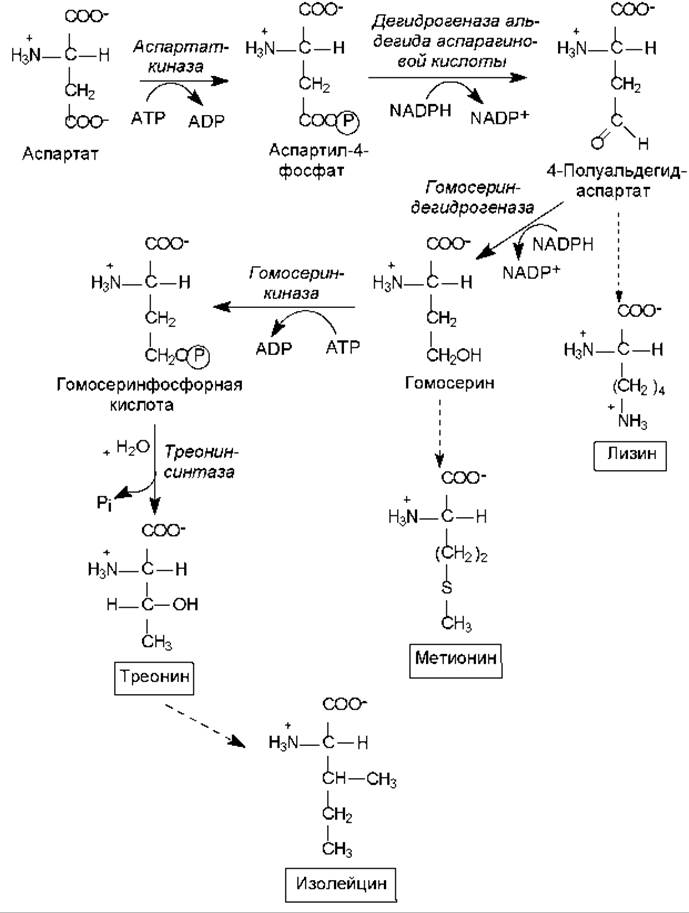
Fig. 16.7. Biosynthesis of threonine. Schematic pathways for The biosynthesis of methionine, lysine, and isoleucine (dashed arrows)
Biosynthesis of the Serine family. This family includes serine, cysteine, and Glycine. The precursor for these amino acids is 3-phosphoglycerate, an intermediate of glycolysis.

Fig. 16.8. Biosynthesis of alanine, valine, and leucine. Glu — glutamate; KG — a-ketoglutarate; dashed arrows represent multiple synthesis steps (details in the text)
3-Phosphoglycerate is oxidized to 3-phosphohydroxypyruvate, then aminated via glutamate to 3-phosphoserine, and finally dephosphorylated to serine (Fig. 16.9). An alternative pathway also exists where the removal of the phosphate group occurs prior to the oxidation reaction:
3-Phosphoglycerate → Glycerate → Hydroxypyruvate → Serine
Serine serves as a precursor for the synthesis of glycine and cysteine. During glycine formation, the ß-carbon atom of the serine side chain is accepted by a single-carbon carrier—the cofactor tetrahydrofolate—in a reaction catalyzed by serine hydroxymethyltransferase (Fig. 16.9). An alternative pathway for glycine synthesis also exists, utilizing CO2, NH4+, and methylenetetrahydrofolate, which is catalyzed by glycine synthase.

Fig. 16.9. Biosynthesis of serine, cysteine, and glycine. Dashed arrows indicate the multi-step conversion of methionine to homocysteine; the dashed line in the cystathionine molecule indicates the bond cleaved by cystathionine-y-lyase
The conversion of serine into cysteine involves replacing the oxygen atom of the side chain with a sulfur atom, for which methionine serves as the donor. Initially, through a series of ATP-dependent reactions yielding its activated form (S-adenosylmethionine), methionine loses its sulfur-bound methyl group and is converted into homocysteine:
L-methionine + ATP + Methyl group acceptor →
→ Homocysteine + Adenosine + PPi + Pi + Methylated acceptor
Homocysteine then reacts with serine to form cystathionine, which is cleaved by cystathionine-y-lyase into cysteine and a-ketobutyrate (Fig. 16.9).
In some microorganisms, an alternative pathway for cysteine synthesis exists in which hydrogen sulfide serves as the sulfur donor. In this case, serine is first acetylated by acetyl-CoA (catalyzed by serine transacetylase), and then acetylserine reacts with hydrogen sulfide in the presence of O-acetylserine sulfhydrylase:
Acetylserine + H2S → Cysteine + Acetate
BIOSYNTHESIS OF AMINO Acids of the pentose family. The amino acids belonging to this family (histidine, tryptophan, phenylalanine, and Tyrosine) are synthesized with the participation of a five-carbon intermediate of the Pentose Phosphate Pathway, ribose-5-phosphate, which is why they are grouped into the pentose family. Figure 16.10 illustrates the conversion pathways of ribose-5-phosphate that lead to the Formation of the compounds from which these amino acids are synthesized.
The biosynthesis of histidine is quite complex and proceeds with the involvement of 5-phosphoribosyl-1-pyrophosphate, ATP, and glutamine. Figure 16.10 shows the Water/144.html">Origin of the carbon and nitrogen atoms within the histidine molecule: one nitrogen atom of the imidazole ring is derived from the amide group of glutamine, another nitrogen atom and one of the ring carbon atoms originate from ATP, while the remaining carbon atoms trace their origin to 5-phosphoribosyl-1-pyrophosphate.
The biosynthesis of aromatic amino acids begins with the condensation of erythrose-4-phosphate and phosphoenolpyruvate. The resulting seven-carbon compound (7-phospho-2-keto-3-deoxy-D-arabinoheptulosonate) undergoes dephosphorylation, cyclization, dehydration, and NADPH-dependent reduction to form shikimate. Shikimate undergoes another condensation with phosphoenolpyruvate, and following the elimination of a phosphate group, is converted into chorismate (Fig. 16.11). Chorismate serves as the primary precursor for the tryptophan biosynthesis pathway shown in Fig. 16.11.
Chorismate is also used for the synthesis of phenylalanine; thus, at the stage of its formation, the biosynthetic Pathways of the two essential aromatic amino acids—tryptophan and phenylalanine—diverge (hence the name chorismate, derived from the Greek word meaning "fork").
Phenylalanine is produced via three consecutive reactions: the isomerization of chorismate to prephenate, the dehydration and decarboxylation of prephenate to phenylpyruvate, and the transamination of phenylpyruvate involving glutamate.
The non-essential amino acid tyrosine can be synthesized from phenylalanine via its hydroxylation by phenylalanine-4-monooxygenase, as well as from prephenic acid following its decarboxylation and amination.

Fig. 16.10. General scheme of the biosynthesis of histidine, tryptophan, phenylalanine, and tyrosine. Dashed arrows denote multi-step processes

Fig. 16.11. Tryptophan biosynthesis pathway. Dashed arrows denote multi-step processes
Patterns of Amino acid biosynthesis. An Overview of the biosynthetic pathways of proteinogenic amino acids reveals the following fundamental principles: 1) the carbon skeletons of amino acids are derived from glycolytic intermediates (3-phosphoglycerate, phosphoenolpyruvate, pyruvate), pentose phosphate pathway intermediates (ribose-5-phosphate and erythrose-4-phosphate), and TCA cycle intermediates (oxaloacetate and a-ketoglutarate); 2) glutamate serves as the primary amino group donor for most proteinogenic amino acids, and glutamine less frequently; reactions in which an amino acid's amino group is transferred to a keto acid are termed "transamination reactions"; 3) the biosynthesis of many amino acids occurs in "families" sharing common precursors, and many amino acids themselves serve as substrates for the synthesis of others; 4) many stages of amino acid biosynthesis require an energy input and are accompanied by ATP Hydrolysis (in the synthesis of histidine, proline, methionine, asparagine, glutamine, and arginine); furthermore, energy from activated Molecules Participating in the synthesis is utilized, and intermediates that could otherwise be used for cellular energy storage are diverted from catabolic and amphibolic processes; 5) numerous steps in amino acid biosynthesis require reducing equivalents (NADH and NADPH) that could otherwise be oxidized in the Respiratory Chain to yield energy.
Thus, amino acid biosynthesis is a metabolically expensive process for The Cell. It is hardly surprising, therefore, that this process is subject to highly complex regulation in every Organism or cell (Chapter 19). On the one hand, this regulation is dictated by the complexity and branching nature of proteinogenic amino acid biosynthesis itself, and on the other hand, it ensures strict conservation of cellular resources (energy, reducing equivalents, and building blocks). It is also logical that in the presence of exogenous amino acids, microbial cells, for instance, bypass endogenous synthesis and utilize readily available external forms.
Last update: 06/08/2026
Editorial and Educational Adaptation: This material has been compiled based on the primary/original source text. The project team performed an editorial review, corrected technical inaccuracies, structured sections, and adapted the content for an educational format.
What was processed:
- elimination of formatting defects (OCR errors, structural breaks, corrupted characters);
- editorial organization of content;
- standardization of terminology in accordance with academic sources;
- verification of factual statements against the original source text.
All mentions of the author, publication year, and origin of the primary text have been preserved in accordance with the source.