Biochemistry of Amino Acids - A. Majster 1961
General Biochemistry and Physiology of Amino Acid Metabolism
Transamination
Transamination reaction involving ω-amino acids and aldehyde acids
Currently, A number of Transamination reactions involving ω-Amino Acids and aldehyde acids are known. The Glycine-Ornithine transamination reaction is unique in that one of the substrates and one of the products of this reaction are aldehydes [288]:
Class="center">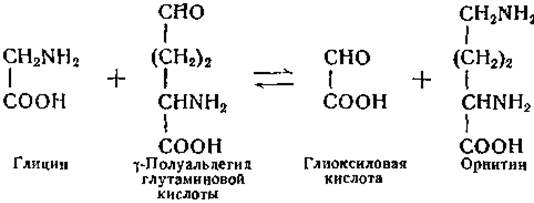
Glycine is also of interest because it Functions simultaneously as an α-Amino Acid and an ω-amino acid. The reversible conversion of glyoxylic acid into glycine has been demonstrated in in vivo experiments with animals (p. 319). In vitro studies have shown that glutamine, asparagine, glutamic acid, and aspartic acid can act as amino group Donors in transamination reactions with glyoxylic acid, with aminodicarboxylic acids being less active than their amides [289, 298]. There is Evidence indicating the formation of glutamic acid from glycine and α-ketoglutaric acid [277, 280], although this reaction proceeds with difficulty in this direction; the appearance of glyoxylic acid as a product of this reaction was not established. It is noteworthy that even in the non-enzymatic transamination reaction

the equilibrium position favors The formation of glycine; The change in Free energy for this reaction is approximately +2000 cal. This value is significantly larger than those found for the Alanine-α-ketoglutarate and aspartate-α-ketoglutarate reactions [299].
Transamination reactions between ornithine and Pyruvate, as well as between ornithine and α-ketoglutarate, have been detected in the Liver [277, 288, 300] and in Neurospora crassa [301]. The reactions proceed most rapidly between ornithine and pyruvic, α-ketoglutaric, α-ketobutyric, or glyoxylic acids, According to the following general equation:

During The interconversions of Proline, ornithine, and glutamic acid, the common intermediate is glutamic acid γ-semialdehyde. This compound was first obtained by Vogel and Davis [302], who discovered that it serves as a precursor of proline. The transamination reaction between ornithine and keto acids goes almost to completion both in The Liver and in Neurospora. The reaction equilibrium is shifted toward the formation of glutamic acid γ-semialdehyde, possibly because the reaction is complicated by The conversion of the aldehyde into other products.
Another transamination reaction involving ornithine was discovered in Escherichia coli while studying The Biosynthesis of this amino acid (p. 344). Vogel obtained data indicating the conversion of N-acetylglutamic acid into the corresponding γ-semialdehyde. As a result of transamination, this compound is converted into α-N-acetylornithine; the transamination reaction was successfully demonstrated in experiments with Cell-free E. coli extracts in the presence of glutamic acid and Pyridoxal phosphate [303, 304]. Transamination of the α-amino group of ornithine occurs when the δ-amino group is substituted [128, 288].
Transamination between γ-aminobutyric acid and α-ketoglutarate, first described by Bessman and coworkers [305], serves as another example of ω-amino group transfer. In addition to γ-aminobutyric acid [306], β-Alanine [305, 307], δ-aminovaleric acid [308, 309], and α,γ-diaminoglutaric acid [308] also participate in transamination reactions. The reaction between γ-aminobutyric acid and α-ketoglutaric acid has been thoroughly investigated. It was found that the product of this reaction is succinic semialdehyde; the reaction is reversible:
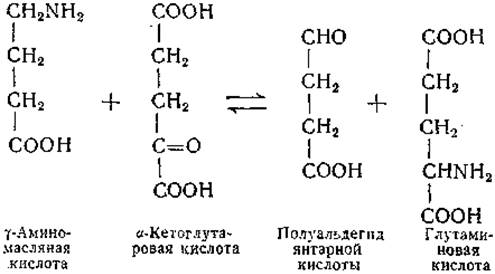
The substances formed as a result of the transamination of α,γ-diaminoglutaric acid (not yet found in natural sources), β-alanine, and δ-aminovaleric acid have not been identified. There are indications that δ-aminovaleric acid, which is a decarboxylation product of α-keto-ε-aminocaproic acid, may arise during the degradation of Lysine [309]. For glutaric semialdehyde—the putative product of δ-aminovaleric acid transamination reactions—oxidation to glutaric acid and subsequently to α-ketoglutaric acid is possible (p. 434).
Last update: 06/08/2026
Editorial and Educational Adaptation: This material has been compiled based on the primary/original source text. The project team performed an editorial review, corrected technical inaccuracies, structured sections, and adapted the content for an educational format.
What was processed:
- elimination of formatting defects (OCR errors, structural breaks, corrupted characters);
- editorial organization of content;
- standardization of terminology in accordance with academic sources;
- verification of factual statements against the original source text.
All mentions of the author, publication year, and origin of the primary text have been preserved in accordance with the source.