Biochemistry and Molecular Biology - Belyasova N.A. 2002
Metabolism. Processes Requiring Energy Input
Features of Biosynthesis. Carbohydrate Biosynthesis
Patterns of Monosaccharide Metabolism and Biosynthesis
Glucose-6-phosphate can be considered a key intermediate in Carbohydrate METABOLISM. This compound can be formed from exogenous glucose via its phosphorylation during membrane transport or immediately afterward. In addition, glucose-6-phosphate is produced in the Cells of autotrophic organisms capable of CO2 fixation, during Gluconeogenesis from glyceraldehyde-3-phosphate (Fig. 13.5). Other sources of glucose-6-phosphate include Pyruvate (generated through most carbohydrate Catabolic pathways), certain TCA cycle intermediates, the carbon skeletons of glycogenic Amino Acids, lactate (the product of Lactic acid Fermentation), and glycerol (formed during lipid degradation). All these substances can enter gluconeogenesis, the Synthesis of glucose from non-carbohydrate precursors. Furthermore, in PLANT CELLS AND many microorganisms, glucose can be synthesized from acetyl-CoA, a breakdown product of Fatty acids. This pathway utilizes two specific Enzymes of The Glyoxylate cycle that are absent in higher animal cells. These enzymes (isocitrate lyase and malate synthase) participate in The conversion of acetyl-CoA into succinate, which is subsequently converted into oxaloacetate (Fig. 11.7) and enters gluconeogenesis. Finally, Reserve Polysaccharides serve as yet another source of glucose and, consequently, of glucose-6-phosphate.
Glucose-6-phosphate is utilized within cells in the following ways. First, it serves as a substrate for various catabolic pathways that generate energy, reducing equivalents, and building blocks (Chapter 9). Second, glucose-6-phosphate can undergo isomerization to glucose-1-phosphate, acting as a substrate for The Biosynthesis of Glycogen or other storage and structural polysaccharides. Glucose-6-phosphate can also be dephosphorylated to yield glucose, which can then be transformed within cells into other Monosaccharides such as galactose, mannose, fructose, and glucuronic acid. These compounds take part in The formation of complex Cell-wall polysaccharides and other cellular structures.
Most of the aforementioned pathways for monosaccharide formation and utilization have already been covered in previous sections. Here, we will focus on one of the central pathways for generating this key carbohydrate metabolite—glucose-6-phosphate—namely, gluconeogenesis.
Gluconeogenesis. This process occurs across all kingdoms of living organisms, but it is of paramount importance for the cells of higher animals. The reason is that embryonic Tissues, the Brain, Testes, and erythrocytes rely exclusively on D-glucose as a carbon source. When dietary CARBOHYDRATES are scarce, glycogen breakdown is stimulated in the Liver, but even this source may prove insufficient (the human brain consumes over 120 g of glucose per day). Under such conditions, glucose is synthesized in the body from non-carbohydrate precursors via gluconeogenesis. In animals, gluconeogenesis is most active in the cells of The Liver and Kidneys.
The reactions of gluconeogenesis largely mirror the reverse reactions of Glycolysis, and many of them are catalyzed by the same enzymes involved in The Glycolytic Pathway (Fig. 14.1).
Thus, glycolysis contains three virtually irreversible reactions, which are bypassed in gluconeogenesis by specific alternative pathways. The first bypass involves the conversion of pyruvate into phosphoenolpyruvate. The direct conversion of pyruvate to phosphoenolpyruvate requires more energy than can be provided by ATP Hydrolysis alone; therefore, this step is accomplished through a sequence of reactions. First, pyruvate—derived predominantly in the Cytoplasm (from lactate, amino acids, or glycolysis)—is transported into the Mitochondria, where it is carboxylated to oxaloacetate (Fig. 14.2). This reaction is catalyzed by pyruvate carboxylase, which utilizes biotin as a cofactor. This anaplerotic reaction and The properties of the enzyme are described in Section 11.2.
Class="center">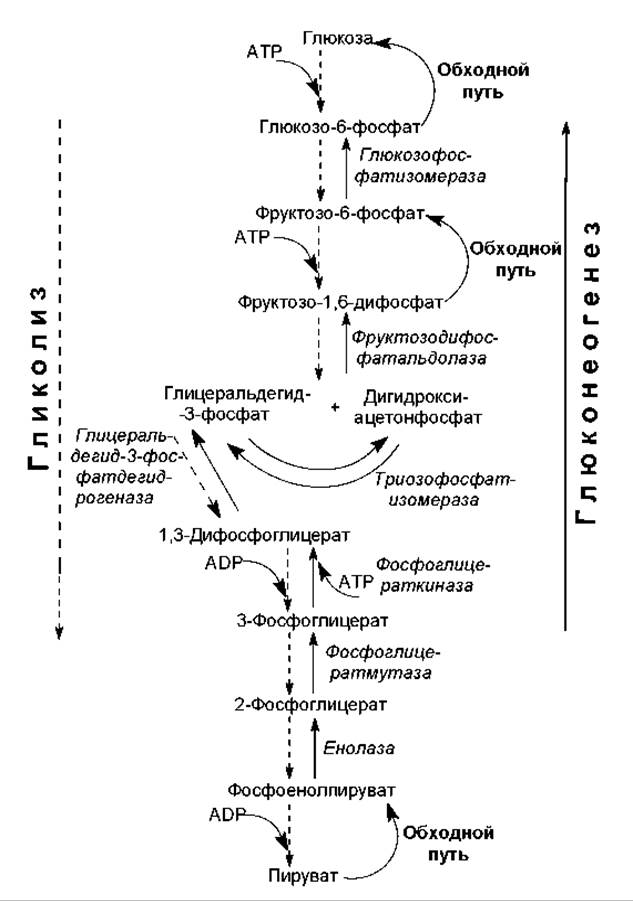
Fig. 14.1. Reaction sequences for glycolysis (dashed arrows) and gluconeogenesis (solid arrows). The names of enzymes common to both pathways are indicated. Steps where the two processes diverge are designated as bypass pathways in gluconeogenesis
Within the mitochondria, oxaloacetate is reduced to malate (by mitochondrial malate dehydrogenase), which is then transported into the cytoplasm via specific carriers. In the cytoplasm, malate is re-oxidized to oxaloacetate (by cytoplasmic malate dehydrogenase), which is subsequently decarboxylated to phosphoenolpyruvate (PEP) by a GTP-dependent phosphoenolpyruvate carboxykinase.
The second bypass in gluconeogenesis is the conversion of fructose diphosphate into fructose-6-phosphate (Fig. 14.2). In glycolysis, the Phosphofructokinase reaction, accompanied by ATP hydrolysis, is irreversible. Gluconeogenesis employs a different enzyme, fructose diphosphatase, which catalyzes the virtually irreversible removal of the phosphate group from the first carbon atom. Like pyruvate carboxylase, fructose diphosphatase is an allosteric enzyme. Its activity is inhibited by AMP and activated by ATP.
The third bypass—the dephosphorylation of glucose-6-phosphate—cannot be achieved by a direct Reversal of the hexokinase reaction. This reaction is catalyzed by glucose-6-phosphatease, which is localized on the inner surface of the smooth Endoplasmic reticulum (ER) membranes. Consequently, for this reaction to take place, glucose-6-phosphate is transported into the ER, where it is dephosphorylated to free glucose (Fig. 14.2). It is worth noting that glucose-6-phosphatease is absent in tissues such as Skeletal Muscle and the brain; therefore, these Organs cannot supply free glucose to the bloodstream.
The overall equation for gluconeogenesis is as follows:
2Pyruvate + 4ATP + 2GTP + 2NADH + 2H+ + 4H2O →
→ Glucose + 2NAD+ + 4ADP + 2GDP + 6Pi
As this balance shows, the synthesis of a single glucose molecule via gluconeogenesis consumes six high-energy phosphate bonds as well as two molecules of NADH. Importantly, The rate of glucose synthesis along this pathway is regulated by enzymes that do not participate in glycolysis. Furthermore, gluconeogenesis proceeds most intensively when cellular levels of fuel molecules, particularly acetyl-CoA, are elevated, alongside an adequate supply of ATP.
Glycerol enters the gluconeogenic pathway at the level of dihydroxyacetone phosphate, into which it is converted following phosphorylation (mediated by ATP) and dehydrogenation.
Amino acids enter the pathway via metabolites such as pyruvate and oxaloacetate, which are formed through the rearrangement of their carbon skeletons. Before entering gluconeogenesis, lactate must first be oxidized to pyruvate.
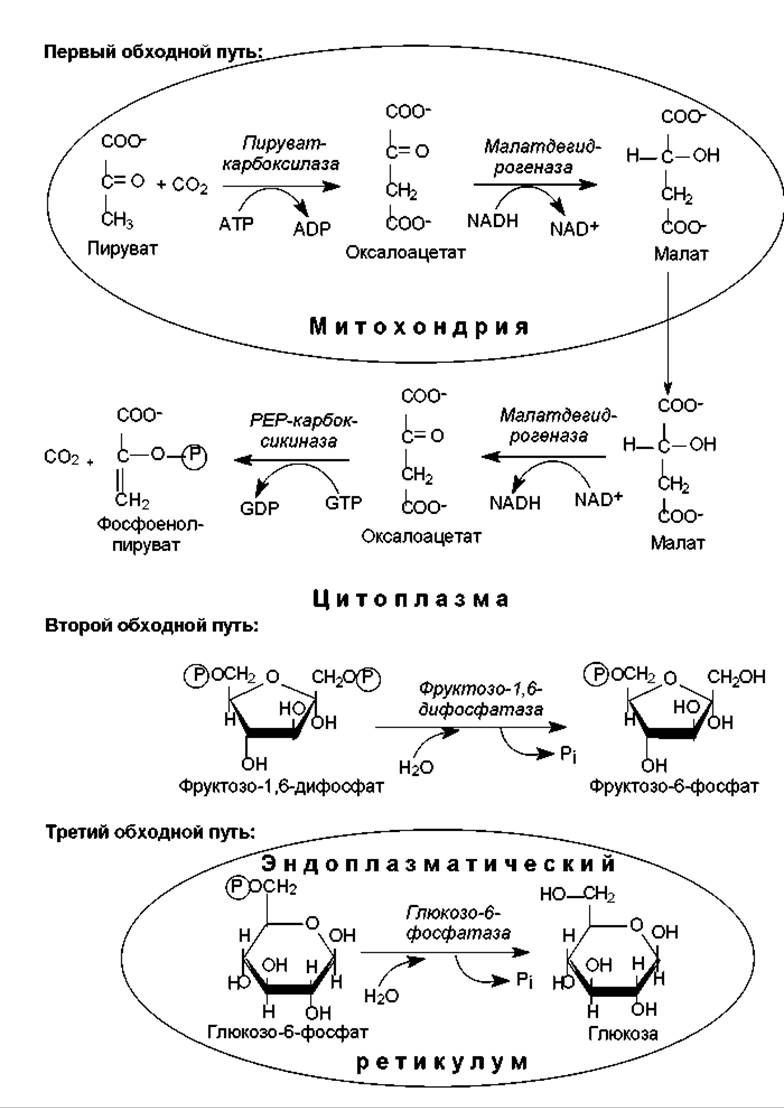
Fig. 14.2. Reactions of the bypass pathways in gluconeogenesis
Last update: 06/08/2026
Editorial and Educational Adaptation: This material has been compiled based on the primary/original source text. The project team performed an editorial review, corrected technical inaccuracies, structured sections, and adapted the content for an educational format.
What was processed:
- elimination of formatting defects (OCR errors, structural breaks, corrupted characters);
- editorial organization of content;
- standardization of terminology in accordance with academic sources;
- verification of factual statements against the original source text.
All mentions of the author, publication year, and origin of the primary text have been preserved in accordance with the source.