Practical Protein Chemistry - A. Darbre 1989
Analysis of Amino Acid Phenylthiohydantoins
Analytical Methods
High-Performance Liquid Chromatography
In the late 1970s and early 1980s, there was an explosive growth in publications concerning the HPLC of PTH-Amino Acid Derivatives, with different laboratories employing A wide variety of instruments, columns, and buffer systems. Consequently, beginners often find it challenging to select the optimal Separation conditions. This section outlines the systems with which we have firsthand experience. The remarks and caveats pertaining to these and other systems will help readers make an informed choice regarding their chromatographic setup.
13.2.1.1. Equipment. A large number of commercial amino acid analyzer models are available either as modular kits or as integrated single-unit systems. It is often possible to assemble a chromatograph using modules produced by different manufacturers. While this allows for a reasonable compromise between instrument cost and performance, inexperienced analysts should avoid this approach. The basic requirements for an analytical system can be summarized as follows:
1) The solvent delivery system must be capable of generating linear gradients at flow rates of 0.1–2.75 mL/min and pressures of 0.3–35.0 MPa. Column efficiency increases with smaller particle sizes, which in turn leads to higher operating pressures (at a constant column length); therefore, it is prudent to select a system designed for high-pressure operation. Solvents used for gradient elution can be premixed and delivered to the column by a single pump (typically featuring multiple pump heads). Alternatively, systems comprising multiple pumps—each delivering a specific solvent to a mixing chamber—have been described. In both cases, an electronic programmer is required to establish the gradient; frequently, the gradient profile can be selected from a set of preset curves with varying steepness. It should be noted that achieving high reproducibility in the HPLC separation of PTH-amino acid derivatives can be quite difficult, with gradient optimization playing a critical role. The performance of the system can be easily evaluated by performing several separations under identical conditions. Provision should be made for Setting and maintaining an isocratic elution mode at various Stages of the analysis, particularly at the end of gradient separation. Using an electronic programmer, the system automatically returns to its initial state at the Conclusion of each analytical cycle. When operating with a system consisting of aqueous buffer A and organic solvent B*, it is necessary to be able to briefly increase the concentration of component B in the eluent to 100% between analyses (for C8 columns, see Section 13.2.1.5); this ensures thorough column washing and helps extend its operational lifespan. As with all chromatographic techniques, the column acts as the primary separation medium and is decisive in achieving high resolution. When an efficient column is used, there is no need to program the flow rate or employ complex gradient profiles with intermediate isocratic holds, although having these capabilities available for use when necessary is advantageous.
2) An injector is required that permits Sample application onto the column without causing a pressure drop or, consequently, any fluctuation in the flow rate. The injector allows anywhere from one to several hundred microliters of the sample solution to be applied with an accuracy of ±1%. Many operators quickly recognize the advantages of automated injectors, which fully justify the high cost of these modules.
3) To optimize Temperature-dependent separations, the column compartment (thermostat) must be capable of maintaining temperatures within the 20–65 °C range.
4) Eluate absorbance should be monitored at a wavelength of 254 nm using low-volume flow Cells (10 µL or less) capable of withstanding backpressures up to 3.5 atm. It is also useful to employ a secondary detection channel (at 313 nm) to monitor modified Ser and Thr derivatives generated during automated sequence analysis. The flow Cell designs implemented by certain manufacturers help minimize refractive index artifacts associated with gradient elution. As column resolving power increases, analysis times become shorter. Because smaller column diameters reduce the residence time of eluted components within the flow cell, high-speed analyses require detectors capable of operating with short response times (time constants). The baseline noise and drift of top-tier (spectro)photometers allow for a practical sensitivity of 0.001 aufs (absorbance units full scale) at a satisfactory signal-to-noise ratio.
* Typically a pure organic solvent (acetonitrile, methanol, etc.). — Translator's Note.
When working with 1.0–0.01 nmol of peptide, a range up to 0.005 aufs is generally sufficient, but lower sample quantities necessitate a more sensitive detector. Microscale analyses require the optimization of all instrument components and Separation parameters alongside high-purity solvents, as baseline drift increases dramatically under high-sensitivity elution conditions. Additional purification of solvents, buffers, and Water may prove necessary.
5) A data acquisition and recording system is essential for identifying and quantifying PTH-amino acid derivatives. Several types of integrators with varying capabilities are commercially available. In most cases, external standard calibration is performed prior to Cleavage product separation, allowing specific peak areas (in nanomoles) and retention time windows for peak identification to be evaluated. Modern integrators can process complex baselines and accurately determine the areas of unresolved peaks. To ensure reliable calculations for peaks of differing shapes, distinct peak width and noise threshold parameters are applied to different segments of the chromatogram. Operating chromatographs at the picomole level frequently pushes instrument specifications to their limits, making a system with ample performance reserves a necessity. Affordable single-channel integrators that record data on thermal paper are currently available. Some integrators can be interfaced directly with computers to store raw or preprocessed data streamed straight from the detector. An interface utilizing a 12- to 16-bit analog-to-digital converter (ADC) can be employed, or a standard interface (such as IEEE, RS232, or a 16-bit general-purpose interface) may be used. In such setups, a relatively low data acquisition rate (10–25 points/s) is sufficient; however, users must either purchase or develop their own integration software for the given computer. Following data collection, the computer can perform signal smoothing and baseline subtraction to enhance the signal-to-noise ratio.
The research described in this chapter utilized a Waters system comprising a WISP autosampler (Model 710B), two pumps (Model 6000), a detector (Model 440, operating at 254 and 313 nm), and a thermostated column compartment. For analyses conducted at sensitivities of 0.002 and 0.001 aufs, an Altex detector (Model 160) featuring automatic baseline resetting after each run was employed. The analog output (10 mV scale) was connected to a Waters data handling system (Model 730). Pump operation was controlled via a Waters programmer (Model 720). Data Recording and Processing were performed using the aforementioned system. For direct data acquisition, the detector was coupled to an ADC which interfaced with a Hewlett-Packard computer (Model 9845/204) via an HPIB interface. More recently, multi-channel systems from Nelson Analytical combined with Hewlett-Packard computers (Model 9816) have also been adopted.
13.2.1.3. Chromatographic Solvents. The optical purity of water, salt solutions, and organic solvents is of paramount importance. Buffers must be sterile and free from particulate matter. A Millipore cartridge filtration system is well-suited for water purification (Section 8.3). Organic solvents of acceptable quality are supplied by Rathburn Chemicals, BDH, Burdick and Jackson, Fisons, and Merck. As analytical sensitivity increases, impurity peaks and baseline drift assume progressively greater significance. When necessary, the water used for buffer preparation can be further purified by passing it through a coarse C18 sorbent column, such as Waters Sep-Pak cartridges. Organic solvents should be filtered through high-grade activated charcoal and distilled using a Widmer column or a spinning-band distillation apparatus. However, in inexperienced hands, this Procedure is more likely to contaminate than purify the solvents and is generally not cost-effective in terms of time and purification efficiency. Rathburn acetonitrile (Grade S), used in our laboratory without further pretreatment for gradient separations, typically exhibits a baseline drift of 0.005–0.001 aufs.
Contaminants present in Reagents and solvents used for sequence analysis constitute an independent factor affecting analytical sensitivity. When required, reagents can be purified According to the Procedures described in reference [8].
The quality of acetic acid and sodium acetate is unproblematic provided that high-purity commercial reagents are used. Solvents are degassed by sparging with a vigorous stream of helium for 2–3 minutes; helium is continuously bubbled through the aqueous buffers throughout the operation of the delivery pumps. Alternative degassing Methods employed in our laboratory have yielded less reliable results, although any protocol recommended by instrument manufacturers, combined with careful daily buffer preparation, will ensure reproducibility. We prepare a 1 M stock buffer and sterilize it by filtration. Buffers for chromatographic elution are prepared every two days by diluting the stock solution. It is impossible to completely prevent the accidental Introduction and proliferation of microorganisms in acetate buffers; therefore, to inhibit bacterial and fungal growth, buffer A contains a small amount of acetonitrile (refer to C8 column separations in Section 13.2.1.5).
13.2.1.3. Chromatographic Columns. Separation performance on columns continues to advance thanks to stricter manufacturing controls and the introduction of more efficient stationary phases with increasingly smaller particle sizes. Currently, Three types of reversed-phase packings are used for the analysis of PTH-amino acid derivatives: octyl (C8), octadecyl (C18), and cyanopropyl (CN). Several manufacturers offer columns packed with these stationary phases, varying in particle type and size (3–10 µm). These Supports differ in hydrocarbon surface coverage and the degree of endcapping (blocking of residual silanol groups). Over recent years, we have tested numerous columns from various manufacturers and observed significant improvements in separation reproducibility. Nevertheless, pronounced differences remain in the separation of certain pairs of PTH-Amino Acids on columns from different makers, despite being nominally packed with the same type of stationary phase. In many instances, a standard 18-component mixture can be resolved almost completely (with the exception of a single pair). Significant tailing is occasionally observed for PTH-Arg and PTH-His. We believe that the only practical solution to this chromatographic challenge is empirical testing of different columns. In our view, Dupont Zorbax C8 columns are the most suitable in terms of PTH-amino acid separation reproducibility and column lifetime. When performing ~2,000 analyses on these columns, the day-to-day retention time reproducibility for PTH-amino acid derivatives is 0.01 min. In our experience, the only other column type yielding satisfactory results for the Chromatography of basic PTH-amino acids is the IBM cyanopropyl column.
13.2.1.4. Preparation of Standard Solutions of PTH-Amino Acid Derivatives. Dry PTH derivatives (Pierce) are dissolved in acetonitrile or methanol to a concentration of ~7.5 nmol/µL. Duplicate aliquots are taken and diluted for absorbance measurements at 269 nm. Using the known molar extinction coefficients (Table 13.1), the exact concentration of the solutions can be determined, and each solution is subsequently diluted to 5 pmol/µL. PTH-Arg and PTH-His require special handling: the hydrochlorides of these compounds are converted into soluble trifluoroacetates by adding 20% TFA, after which the solution is evaporated under a stream of nitrogen. The dried derivatives thus obtained are then redissolved in acetonitrile and diluted to the desired concentration as described above. A mixed standard containing equal amounts of each PTH derivative is prepared (for separations on C8 columns, the norleucine PTH derivative is also added), and the solution is diluted to achieve the required concentration of PTH-amino acids in a suitable volume (e.g., 50 pmol in 10 µL). Solutions of individual derivatives remain stable when stored at —20 °C for several months, whereas mixtures are stable for several weeks under the same conditions. The preparation of standard solutions for PTH-Ser and PTH-Thr involves specific procedures and is discussed separately below.
13.2.1.5. Separation of PTH-Amino Acid Derivatives by Reversed-Phase HPLC. Most of the numerous methodologies published for PTH derivative analysis offer only minor advantages over the original separation protocol introduced in 1977 [20], which utilized an octadecyl (C18) stationary phase, acetate buffers, and acetonitrile. The sole major difficulty involved the chromatography of PTH-Arg and PTH-His, which eluted as considerably broader bands compared to other PTH-amino acids. Modern columns packed with smaller particle sizes and possessing higher theoretical plate numbers provide significantly greater separation efficiency; however, analyzing PTH-Arg and PTH-His remains challenging on C18 phases. The severity of this issue depends on the concentration of residual silanol (acidic) groups present on the silica support following modification. Substantial improvements in separation performance can be achieved by utilizing C8 (Dupont) and CN (IBM) columns. Dupont columns (Zorbax C8) are particularly well-suited for resolving PTH-amino acids, likely due to the high degree of endcapping of residual silanol groups on the support material. This chapter presents various protocols sourced from literature and subsequently modified in our laboratory.
Class="center">Table 13.1. Molecular weights and molar extinction coefficients of PTH-amino acid derivatives
|
PTH derivative |
Molecular weight |
ε269 |
|
PTH-Ala |
206 |
16 000 |
|
PTH-Asn |
249 |
17 200 |
|
PTH-Asp |
250 |
16 100 |
|
PTH-Arg·HCl |
328 |
15 900 |
|
PTH-Glu |
264 |
15 900 |
|
PTH-Gln |
263 |
17 000 |
|
PTH-Gly |
192 |
14 900 |
|
PTH-His·HCl |
309 |
15 500 |
|
PTH-Ile |
248 |
17 000 |
|
PTH-Leu |
248 |
16 700 |
|
PTH-N-ε-PTC-Lys |
398 |
29 000 |
|
PTH-Met |
266 |
17 100 |
|
PTH-Phe |
282 |
15 500 |
|
PTH-Pro |
232 |
14 300 |
|
PTH-CM-Cys |
297 |
16 600 |
|
PTH-Trp |
321 |
19 700 |
|
PTH-Tyr |
298 |
15 600 |
|
PTH-Val |
234 |
16 500 |
Separation on C8 stationary-phase columns.
Buffers. A 1 M sodium acetate stock solution is adjusted to pH 4.1 with acetic acid. Two buffers, A and B, differing in their acetonitrile content, are employed. Both buffers (A and B) contain 0.008–0.02 M acetate; buffer A contains 10% acetonitrile, and buffer B contains 80%. Solutions are degassed with helium. The column is maintained at a constant temperature of 43 °C, with an eluent flow rate of 2 mL/min.
Column. Zorbax C8, 4.6 × 250 mm (Dupont). A pre-heating coil consisting of tubing at least 600 mm in length is connected between the injector and the column and placed within the column thermostat to pre-heat the buffer.
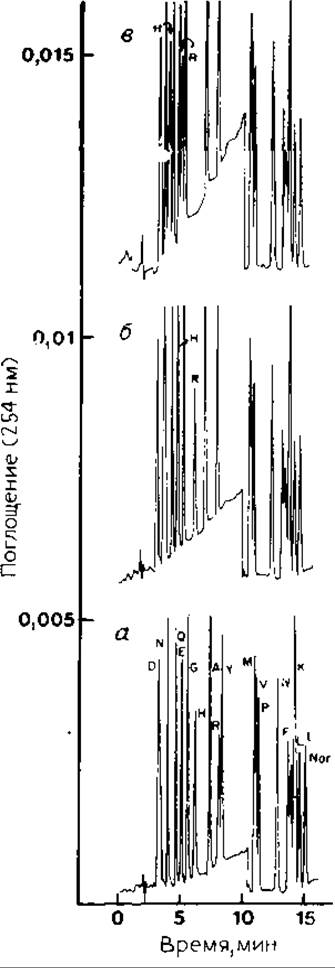
FIG. 13.1. HPLC of PTH-amino acid derivatives on a Zorbax C8 column. Effect of buffer salt concentration on the separation of Arg and His derivatives. Separation conditions are described in Section 13.2.1.5. Sodium acetate concentration (mol/L): a — 0.005, b — 0.01, c — 0.02. Amino acids are designated by their single-letter codes; Nor denotes the norleucine PTH derivative.
Analytical Conditions. To evaluate initial separation conditions, a linear gradient of buffer B from 20% to 40% over 8 minutes can be applied. The results of such a separation are illustrated in Fig. 13.1a. The elution positions of PTH-Arg and PTH-His depend on the salt concentration in the buffers; as shown in Fig. 13.1b and c, varying the salt concentration shifts these peaks relative to those of other amino acid derivatives. The separation of hydrophobic amino acid derivatives is influenced by the final concentration of buffer B at the end of the gradient. Conducting 2–3 runs with varying final buffer concentrations allows for optimization, where a 1% concentration change can be decisive. Once chromatographic parameters are optimized, operating conditions can remain unchanged for several weeks. Analytical precision then depends primarily on the reproducibility of buffer preparation. As the column ages, the salt concentration in the buffers should be increased to maintain the original retention times of PTH-Arg and PTH-His on the chromatogram. It may also be necessary to optimize the elution conditions for these two compounds relative to other PTH derivatives and byproducts generated during Sequencer reactions. Figure 13.2 displays elution profiles obtained from a C8 column for PTH-amino acid derivatives generated in a gas-phase sequencer.
Separation on C18 stationary-phase columns. Columns packed with C18 phases—produced by manufacturers such as Dupont (Zorbax ODS), Waters (C18 µBondapak), and Altex (Ultrasphere ODS)—are most commonly employed for the analysis of PTH derivatives.
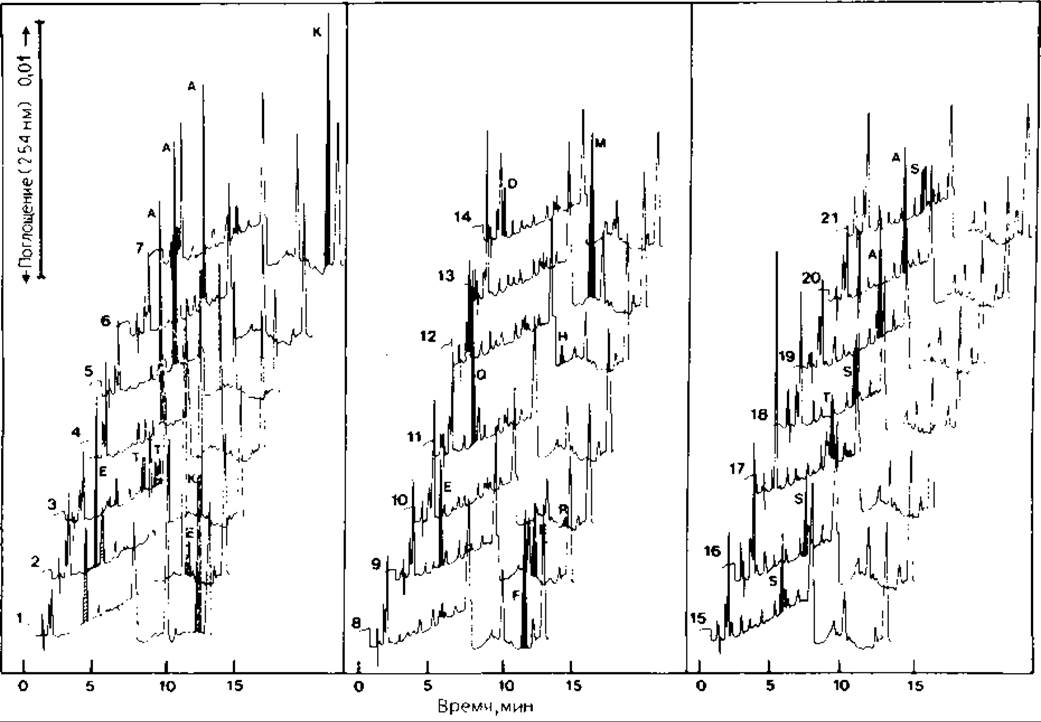
FIG. 13.2. HPLC of products from the 21st cycle of Edman Degradation of Ribonuclease (gas-phase sequencer). Chromatography conditions are described in Section 13.2.1.5 (0.0025 M sodium acetate). Impurity peak designations are given in the caption to Fig. 13.3.
Detailed descriptions of procedures for these columns can be obtained from the manufacturers and found in the journals Analytical Biochemistry and Journal of Chromatography. Because the parameters of columns produced by different manufacturers vary significantly, this has led to a vast number of publications describing countless variations in separation conditions. Recently, both the synthesis conditions for supports and the Column packing methods have been significantly improved, offering hope for increased inter-laboratory reproducibility of results. The methodology described in reference [20] still forms The basis of routine automated analysis. Good results are obtained using sodium acetate buffers (pH 4.0–4.5) at a concentration of 0.001–0.04 mol/L, with acetonitrile or methanol as organic modifiers, as well as an organic solvent gradient from 20% to 40% at a temperature of 40–45 °C. However, Structure/149.html">The problem of peak tailing for PTH-Arg and PTH-His remains. At eluent flow rates up to 2.5 mL/min, the analysis can be completed in less than 20 min. Acetonitrile is preferable to methanol or ethanol due to its lower Background level and lower viscosity at high solvent concentrations in the buffer. By changing the salt concentration in the buffer, one can influence the chromatographic behavior of PTH-Arg and PTH-His and their position relative to other PTH-amino acid derivatives.
The separation of PTH-derivatives is influenced by temperature, eluent flow rate, organic solvent concentration, and gradient profile. When optimizing separation conditions on a new column, it is helpful to perform analyses at four different temperatures (e.g., 25, 35, 45, and 55 °C); to optimize the separation of hydrophobic amino acid derivatives, the final acetonitrile concentration and gradient steepness should be adjusted. Pre-heating the buffer via a connecting capillary placed between the injector and the column is of vital importance. If necessary, The Effect of pH should be investigated. Examples of using C18 phase columns described in the literature include:
1) Zorbax ODS column (Dupont); sodium acetate–acetonitrile system [5, 13, 20];
2) μBondapak column (Waters); sodium acetate–methanol [19, 17];
3) Ultrasphere ODS column (Altex); sodium acetate–acetonitrile with THF additive [16].
Separation on CN-phase columns.
Buffers. The starting 1 M sodium acetate is adjusted to pH 5.7 with acetic acid. Buffer A is 0.015–0.04 M sodium acetate containing 15% Buffer B, which in turn consists of methanol (50%) and acetonitrile (50%). Buffers are degassed with helium, and elution is carried out at 32 °C at a flow rate of 1 mL/min. To optimize separation, the buffer composition is varied as described below.
Column. Cyanopropyl column (IBM), 4.6 × 250 mm. Conditions for the complete separation of a mixture of standard PTH-amino acid derivatives on Zorbax CN (Dupont) [10] and CN (IBM) [8] columns have been published. The main advantage of cyanopropyl columns over C18 phase columns is the better peak shape for PTH-Arg and PTH-His, longer column lifetime (number of sample injections), and higher sensitivity (peak height-to-PTH amount ratio). We have tested C8, C18, and cyanopropyl columns since 1982 and found that, regarding the peak shape of PTH-Arg and PTH-His, C8 and cyanopropyl columns have an advantage over C18 columns. Based on our experience, the lifetimes of C8 and cyanopropyl columns (in terms of injection numbers) are comparable. We do not have sufficient experience with Zorbax ODS columns to draw Conclusions about their operational lifespan.
Optimization of separation on cyanopropyl columns is carried out by varying the salt concentration to position the PTH-Arg and PTH-His peaks between the peaks of other amino acid PTH-derivatives. Increasing the salt concentration shortens the elution time of these compounds. It should be borne in mind that the presence of Edman reaction side products may dictate specific requirements for the elution positioning of PTH-Arg and PTH-His. As the column ages, the salt concentration must be increased to maintain constant retention times for the basic amino acid derivatives. To optimize the separation of the PTH-derivatives of Tyr, Val, Pro, and Met, The ratio of acetonitrile to methanol in Buffer B should be altered. Increasing the methanol concentration improves the separation of Pro and Met derivatives, whereas decreasing it improves the separation of PTH-Tyr and PTH-Val. To optimize the separation of Asn, Ser, Thr, Gln, and Gly derivatives, the initial concentration and steepness of the Buffer B gradient should be modified. If a gradient programmer is available, multi-step gradients similar to those described in reference [8] can be maintained to achieve optimal separation. When replicating these gradients, differences in mixer volumes between various instrument systems must be taken into account.
Separation of PTH-amino acid derivatives on phenylalkyl columns. Efficient but time-consuming separations on μBondapak columns (Waters) have been described [6].
13.2.1.6. Analysis of PTH-amino acid derivatives in Edman degradation products. When analyzing amounts greater than 1 nmol of starting peptide, the identification of standard PTH-amino acid derivatives obtained during manual or automated Edman sequencing is unambiguous. When working with sample quantities >1 nmol, impurities derived from sequencer reagents generally do not interfere with HPLC analysis.
PTH-Arg and PTH-His. To convert anilinothiazolinones into PTH-amino acid derivatives, trifluoroacetic acid (TFA) is preferred over HCl. Purification of TFA may be necessary (Treatment with chromic acid followed by distillation over dithiothreitol to obtain pure, peroxide-free TFA) [8]. Conversion is performed using 20% TFA at 55 °C for 20 min. Afterward, the acid is removed under a stream of nitrogen, and the sample is dissolved in acetonitrile. In this procedure, PTH-Arg and PTH-His are analyzed as trifluoroacetate salts rather than hydrochlorides. This technique requires the preparation of standards in the form of trifluoroacetates (Section 13.2.1.4). The elution times of these PTH derivatives are optimized by adjusting the salt concentration in the buffer.
PTH-Asp and PTH-Glu. These PTH-derivatives exhibit relatively short retention times, and quantitative analysis can be complicated either by The formation of multiple peaks or by co-elution with dithiothreitol, which is added to sequencer reagents and solvents as an antioxidant. In the case of gas-phase analysis, it has been shown that this is negligible when using a C8 phase column (Fig. 13.2). To increase the retention times of acidic amino acid PTH-derivatives, they can be esterified [8].
Procedure. Prepare a 1 M solution of acetyl chloride in thoroughly chilled methanol (see Section 8.17.1.1). Add 50 μL of this solution to the sample and incubate the reaction mixture for 20 min. The reagent is removed by evaporation under a stream of nitrogen, and the sample is dissolved in acetonitrile. The positions of the methyl ester peaks of Asp and Glu derivatives are shown in Fig. 13.3. Analyzing PTH derivatives as methyl esters improves the precision of quantitative analysis because these esters elute in a region with a low background level from Edman reaction impurities. If a different elution position for the target PTH peaks relative to impurity peaks is desired, the ethyl esters of the corresponding PTH derivatives can be synthesized instead.
PTH-Ser and PTH-Thr. The analysis of these PTH derivatives is best carried out with certain precautions (adding antioxidants such as dithiothreitol to all solvents, distilling TFA or heptafluorobutyric acid over dithiothreitol). It is important to perform conversion with aqueous acid immediately after collecting the cleaved ATZs in the fraction collector. Alternatively, adding the ATZ solution in chlorobutane to a TFA solution in the converter followed by rapid drying can help increase the recovery yield of these amino acid PTH derivatives. For rapid execution, an automated converter is best utilized.

FIG. 13.3. HPLC of the methyl esters of PTH-Asp and PTH-Glu. HPLC conditions are given in Section 13.2.1.5; Esterification conditions in Section 13.2.1.6. a — separation of a standard mixture of amino acid PTH-derivatives (40 pmol, scale 0.003 AUFS); b — the same mixture containing methyl esters; c and d — separation of products from the 2nd cycle of Edman degradation (ribonuclease, gas-phase sequencer, 0.005 AUFS); c — direct determination of PTH-Glu; d — Analysis of the PTH-Glu methyl ester. Prior to analysis, a norleucine PTH-derivative (PTH-Nor) was added to each sample. Typical impurity peaks (dithiothreitol), FITC–dimethylamine interaction side products, and FITC degradation products are indicated. To scavenge amine-reactive impurities, Gly-Gly is added, yielding PTH-Gly.
Commercial preparations of PTH-Ser and PTH-Thr may not be identical to the corresponding derivatives cleaved on a sequencer. The most reliable approach for determining retention times and performing quantitative analysis of Ser and Thr derivatives is to analyze a protein of known structure containing Ser and Thr (e.g., Ser-3 in sperm whale Myoglobin, Thr-3 in bovine ribonuclease; see Fig. 13.2). Taking into account the yields of amino acids located before and after Ser and Thr residues, a correction factor for the degradation of these amino acid PTH derivatives can be determined. These same Proteins can be used to optimize sequencer operating conditions and increase the yield of amino acid PTH derivatives (Fig. 13.2).
The reliability of detecting PTH-Ser and PTH-Thr can be enhanced by monitoring their dehydro-derivatives at a wavelength of 314 nm. For sequencer cleavage products, the absorbance at 314 nm varies considerably because not only dehydro-derivatives are formed, but also adducts resulting from The addition of dithiothreitol. According to our data, PTH-Thr obtained on a gas-phase sequencer yields two to four peaks, two of which elute before and after PTH-Tyr on a C8 column (Fig. 13.2). PTH-Ser obtained under the same conditions elutes immediately before the Ala derivative (Fig. 13.2). Substances eluting at these positions do not absorb at 314 nm. Liquid-phase, solid-phase, and gas-phase sequencers yield different results. The optimal solution in these cases is, as mentioned previously, the analysis of a standard protein.
PTH-Cys. The identification strategy for Cys residues depends on The Nature of the chemical modification applied to the sulfhydryl group of the Cysteine residue prior to sequencer analysis. For quantitative estimation of cysteine content, it is most convenient to use the radiolabeled [14C]-carboxymethyl derivative obtained by reduction followed by alkylation of the sample with [14C]-iodoacetamide. All cleaved residues are subsequently checked for radioactivity. Alternatively, the elution time of the corresponding cysteine derivative can be determined and its content quantified to provide a chromatographic estimate of Cys. The PTH-derivative of cysteic acid can also be analyzed; however, it elutes very rapidly, and in the presence of numerous Other Compounds co-eluting from the column, the quantity of the cysteic acid PTH-derivative is difficult to assess accurately (especially in a quantitative manner).
13.2.1.7. High-sensitivity analysis. When analyzing samples containing <1 nmol of polypeptide, the presence of foreign compounds originating from reagents, solvents, or even the sample itself can cause significant difficulties in identification. In-house purified reagents should be further purified, and commercial reagents must be checked for purity. Purification procedures are described in References [7, 8].
Mono- and diphenylthiourea are common impurities generated during the Edman reaction in gas-phase sequencers via the interaction of FITC with dimethylamine. Additionally, extraneous peaks in the chromatograms are contributed by Polybrene and impurities present in the organic solvents and the buffer used during the carbamoylation step.
Last update: 06/08/2026
Editorial and Educational Adaptation: This material has been compiled based on the primary/original source text. The project team performed an editorial review, corrected technical inaccuracies, structured sections, and adapted the content for an educational format.
What was processed:
- elimination of formatting defects (OCR errors, structural breaks, corrupted characters);
- editorial organization of content;
- standardization of terminology in accordance with academic sources;
- verification of factual statements against the original source text.
All mentions of the author, publication year, and origin of the primary text have been preserved in accordance with the source.