Practical Protein Chemistry - A. Darbre 1989
Microscale amino acid sequence analysis using a gas-phase peptide-protein sequencer
Sequencer
Sequencer Operation
17.2.3.1. Sample application. Prior to sample application, the Reactor (Fig. 17.2) is disassembled. To do this, loosen screw 7 and retaining ring 8, and remove the reactor assembly from base 9. Unscrew aluminum cap 3 and remove both Glass cylinders 7 from holder 6. Discard the used discs (glass fiber filter and Teflon filter). Wash the glass cylinders sequentially with Water, 1 M acetic acid, water, 1 M sodium hydroxide, water, and HPLC-grade methanol. Place a new glass filter into the end recess of the upper cylinder, and apply 0.025 ml of an aqueous solution of Polybrene (60 mg/ml) and glycylglycine (1 μM/ml) to it. Then, dry the filter in vacuo. Place a new Teflon filter between the two end surfaces of the cylinders that form the reaction chamber, reassemble the reactor, and carry out at least four Cleavage cycles. Following this preliminary chemical Treatment of the glass filter, disassemble the reactor and remove the upper cylinder carrying the filter. Leaving the filter in the conical recess, invert the cylinder so that the filter faces upward, apply the polypeptide solution to the filter in 0.025-ml aliquots, and dry the filter. Reassemble the reactor and begin the Amino Acid Sequence analysis on the sequencer.
Class="center">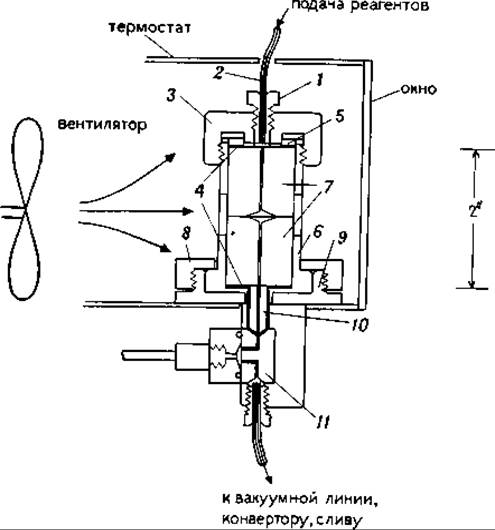
FIG. 17.2. Assembled reactor.
1 — upper seal; 2 — Teflon line; 3 — aluminum cap; 4 — Teflon gasket; 5 — seal; 6 — guide sleeve (stainless steel); 7 — glass cylinder (Pyrex); 8 — retaining ring; 9 — reactor base; 10 — lower seal; 11 — valve block.
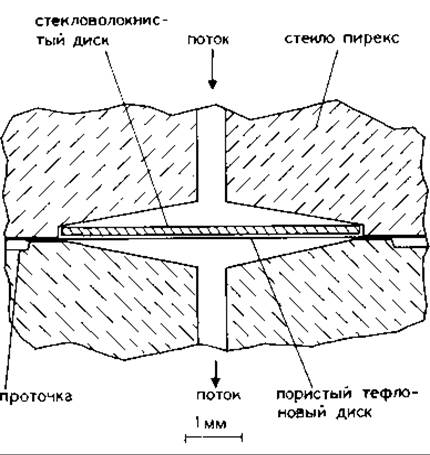
FIG. 17.3. Reaction chamber (magnified view).
Table 17.1. Comparison of reagent and solvent consumption for a single Edman Degradation cycle on liquid-phase (LP) and gas-phase (GP) sequenators
|
LP-sequenator (reagent/solvent) |
Volume, ml |
GP-sequenator (reagent/solvent) |
Volume, ml |
|
|
R1 |
FITC in heptane a |
0.4 |
15% FITC in n-heptane b |
0.05 |
|
R2 |
Quadrol – TFA (pH 9.0) in water – n-propanol (4:3) |
0.7 |
15% aqueous trimethylamine c |
5 cm3/min (in an argon stream) |
|
R3 |
HFBA |
0.5 |
TFA containing 0.01% dithiothreitol d |
5 cm3/min (in an argon stream) |
|
R4 |
25% aqueous TFA (consumption not specified) |
0.5e |
25% aqueous TFA containing 0.01% dithiothreitol |
0.05 |
|
S1 |
Benzene |
7 |
Benzene f |
1.1 |
|
S2 |
Ethyl acetate containing 0.05% acetic acid and 0.002% dithiothreitol |
16 |
Ethyl acetate containing 0.05% acetic acid and 0.002% dithiothreitol |
1.2 |
|
S3 |
1-Chlorobutane containing 0.001% dithiothreitol |
7 |
1-Chlorobutane containing 0.001% dithiothreitol |
1.2 |
|
S4 |
Acetonitrile containing 0.001% dithiothreitol |
4 |
Acetonitrile containing 0.001% dithiothreitol g |
0.3h |
Currently, the operation program has been modified as follows: a 5% solution; b 5% solution; c 12.5% solution; d delivered in liquid form rather than as vapor (9 μl); e added by the translator; f benzene replaced with n-heptane; g 20% aqueous acetonitrile. — Transl. note. Converter washing is not included in this volume.
Table 17.2. Gas-phase sequencer operation program
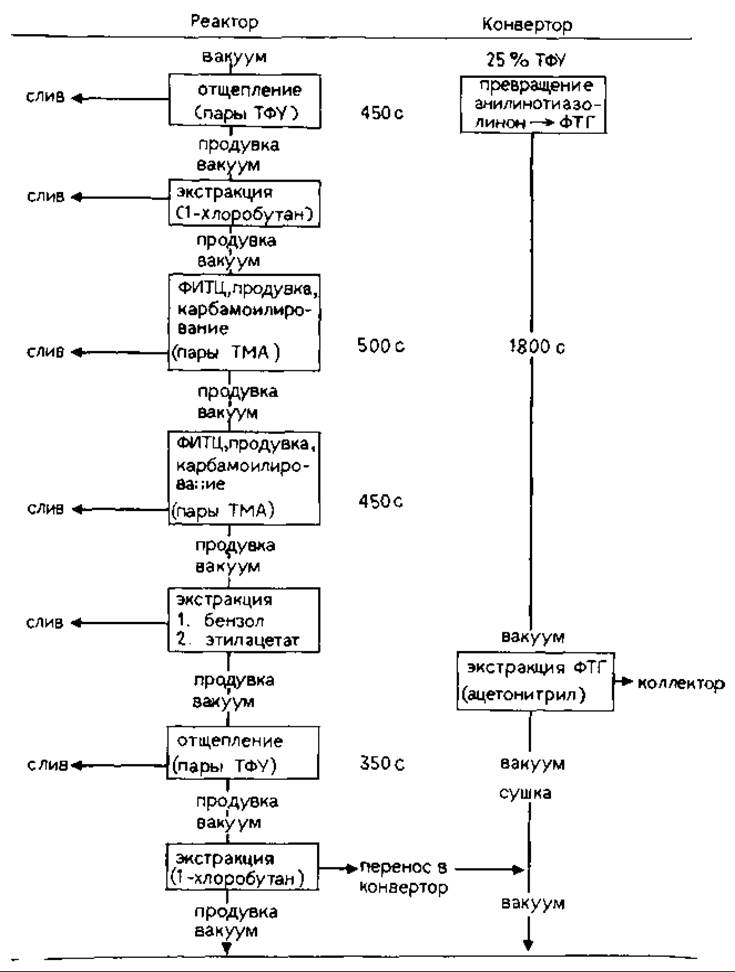
17.2.3.2. Sequencer Operation Program. The sequence of operations performed on the sequencer is generally similar to that described previously [4] and is outlined in Table 17.2. Recently, the following modifications have been introduced into the program:
1) the flow rate of ethyl acetate was decreased (1.2 ml is added over a total extraction time of 250 s); HPLC Analysis of the sequencer eluate fraction (sensitivity scale 0.005 absorbance units) showed that this modification virtually eliminates the appearance of Edman degradation side products absorbing at 254 nm;
2) the total cleavage reaction time at 42 °C was increased (from 650 to 800 s).
17.2.3.3. Operational Performance. To evaluate the performance of the instrument, the yields of PTH-Amino Acid Derivatives (repetitive yields) were determined by HPLC for various amounts of sperm whale apomyoglobin [4]. For samples containing 10 nmol to 5 pmol of Myoglobin (Fig. 17.4), the yields were: 98% (10 nmol), 96% (500 pmol), 94% (50 pmol), and 92% (5 pmol). The decrease in repetitive yield observed upon decreasing the applied sample amount is most likely due to trace amounts of oxidizing agents present in the Reagents and the sequencer itself. At the 10-nmol level, the sequence of the first 90 residues of myoglobin can be determined; at the 5-pmol level, partial sequence data for 22 Amino Acids were obtained (Fig. 17.5). The residues not identified at the 5-pmol level include amino acid derivatives that are less soluble in 1-chlorobutane than others (e.g., PTH-His and PTH-Arg) and the most labile amino acid derivatives (Ser, Thr, and Trp).
The performance of the sequencer with respect to short hydrophobic Peptides was evaluated using the human angiotensin II octapeptide as an example (Fig. 17.6). Analyzing both 5 nmol (5 μg of starting material) and 500 pmol (0.5 μg), the authors identified all eight cleaved amino acid derivatives. When working with 50 pmol of the same sample, only the last two residues (Pro and Phe) were not detected. The corresponding HPLC chromatograms are shown in Fig. 17.7.
Last update: 06/08/2026
Editorial and Educational Adaptation: This material has been compiled based on the primary/original source text. The project team performed an editorial review, corrected technical inaccuracies, structured sections, and adapted the content for an educational format.
What was processed:
- elimination of formatting defects (OCR errors, structural breaks, corrupted characters);
- editorial organization of content;
- standardization of terminology in accordance with academic sources;
- verification of factual statements against the original source text.
All mentions of the author, publication year, and origin of the primary text have been preserved in accordance with the source.