Biological Chemistry - Berezov T. T., Korovkin B. F. 1998
Protein Chemistry
Amino Acid Composition of Proteins
Classification of Amino Acids
All Naturally Occurring Amino Acids share a common property: amphotericity (from the Greek amphoteros meaning both), meaning that each amino acid contains at least one acidic and one basic group. The general structural framework of α-Amino acids can be represented as follows:
Class="center">
As seen from the general formula, Amino acids differ from one another in the Chemical Nature of their R-groups (side chains), which consist of a group of atoms attached to the α-carbon atom and do not participate in peptide bond formation during Protein Synthesis. Nearly all α-amino and α-carboxyl groups are involved in forming peptide bonds within the protein molecule, thereby losing the acid-base properties characteristic of free amino acids. Consequently, the vast diversity of Structural and functional features in protein molecules stems directly from the chemical nature and PHYSICOCHEMICAL PROPERTIES OF amino acid side chains. It is precisely thanks to these side chains that Proteins possess unique Functions not found in other Biopolymers, along with distinct chemical individuality.
The Classification of amino acids is primarily based on the Chemical Structure of their side chains, although other principles have also been proposed. Amino acids are distinguished as aromatic or aliphatic, as well as those containing sulfur or hydroxyl groups. Often, classification relies on the net charge of The amino acid. If the side chain is neutral (meaning the amino acid contains only one amino and one carboxyl group), it is referred to as a neutral amino acid. If an amino acid contains an excess of either amino or carboxyl groups, it is classified as a basic or acidic amino acid, respectively.
The modern rational classification of amino acids is based on the polarity of their side chains (R-groups), specifically their ability to interact with Water at physiological pH values (close to pH 7.0). There are 5 distinct classes of amino acids categorized by their side chains: 1) nonpolar (hydrophobic); 2) polar (hydrophilic); 3) aromatic (largely nonpolar); 4) negatively charged; and 5) positively charged. The presented classification of amino acids (Table 1.3) provides their names, accepted English and Russian Abbreviations, single-letter symbols used in domestic and international literature, as well as their isoelectric point (pI) values and molecular weights (M). The structural formulas for all 20 standard Proteinogenic Amino Acids are also provided separately.
Table 1.3. Classification of amino acids based on side-chain polarity
Amino acids |
Accepted abbreviations and single-letter symbols |
M/pI |
Average content in proteins, % |
||
Eng. |
symbol |
Rus. |
|||
I. Nonpolar R-groups |
Gly |
G |
Гли |
75/5.97 |
7.5 |
Ala |
A |
Ала |
89/6.02 |
9.0 |
|
Valine |
Val |
V |
Вал |
117/5.97 |
6.9 |
Leucine |
Leu |
L |
Лей |
131/5.97 |
7.5 |
Isoleucine |
Ile |
I |
Иле |
131/5.97 |
4.6 |
Pro |
P |
Про |
115/6.10 |
4.6 |
|
II. Polar, uncharged R-groups |
Ser |
S |
Сер |
105/5.68 |
7.1 |
Thr |
T |
Тре |
119/6.53 |
6.0 |
|
Cys |
C |
Цис |
121/5.02 |
2.8 |
|
Met |
M |
Мет |
149/5.75 |
1.7 |
|
Asparagine |
Asn |
N |
Асн |
132/5.41 |
4.4 |
Glutamine |
Gln |
Q |
Глн |
146/5.65 |
3.9 |
III. Aromatic R-groups Phenylalanine |
Phe |
F |
Фен |
165/5.98 |
3.5 |
Tyr |
Y |
Тир |
181/5.65 |
3.5 |
|
Trp |
W |
Трп |
204/5.88 |
1.1 |
|
IV. Negatively charged R-groups Aspartic acid |
Asp |
D |
Асп |
133/2.97 |
5.5 |
Glutamic acid |
Glu |
E |
Глу |
147/3.22 |
6.2 |
V. Positively charged R-groups |
Lys |
K |
Лиз |
146/9.74 |
7.0 |
Arg |
R |
Арг |
174/10.76 |
4.7 |
|
His |
H |
Гис |
155/7.59 |
2.1 |
|

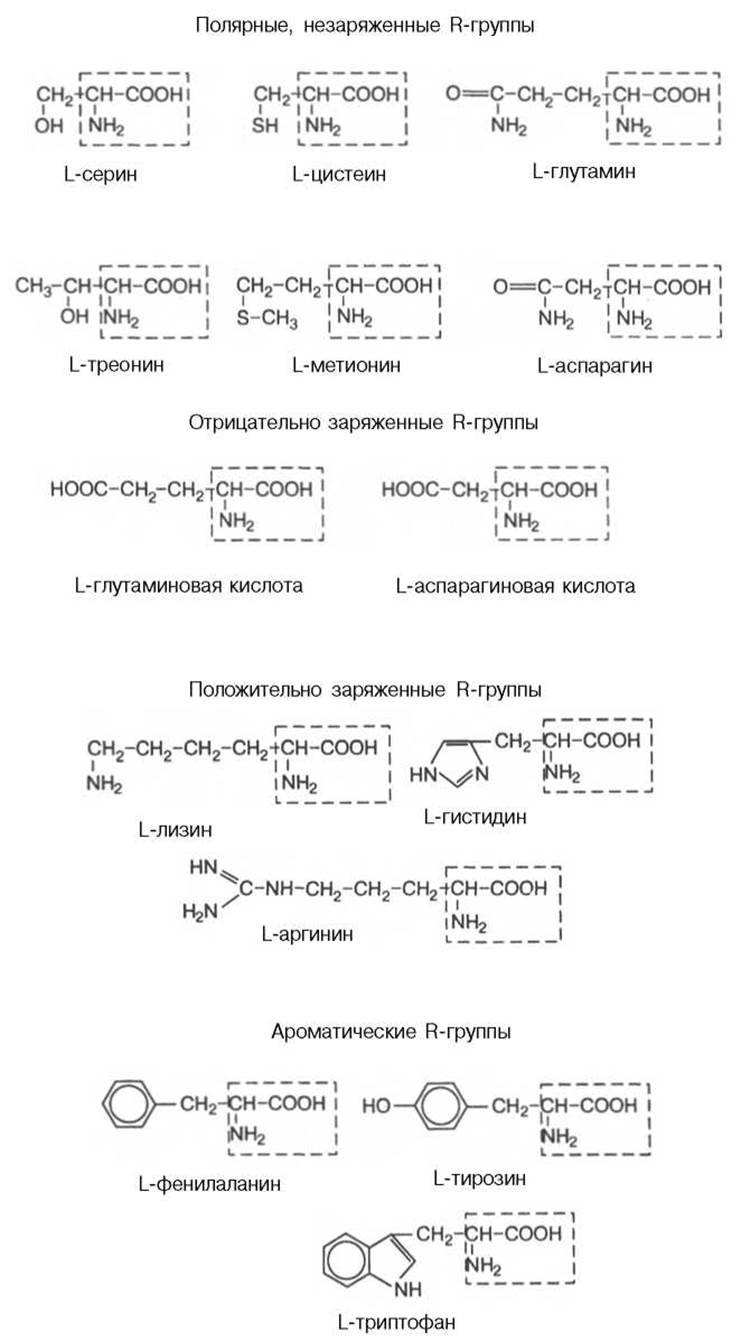
The listed amino acids occur in various quantitative ratios and sequences across thousands of proteins, although certain individual proteins do not contain the full Complement of all these amino acids. In addition to the 20 standard amino acids found in most natural proteins, specific Amino Acid Derivatives have been discovered in certain proteins *: hydroxyproline, hydroxylysine, diiodotyrosine, phosphoserine, and phosphothreonine (the latter two are discussed in Chapter 2):

The first Two amino acids are constituents of Collagen, a Connective Tissue protein, whereas diiodotyrosine serves as the structural basis of THYROID Hormones. Furthermore, ε-N-methyllysine has been identified in the Muscle protein Myosin; γ-carboxyglutamate is a component of prothrombin (a Blood clotting protein); and selenocysteine, in which the OH group of serine is replaced by selenium (Se), has been discovered in Glutathione peroxidase:

Besides those mentioned above, A number of α-amino acids perform vital metabolic functions despite not being incorporated into proteins, notably Ornithine, citrulline, homoserine, homocysteine, cysteine sulfinic acid, dihydroxyphenylalanine, etc.
Last update: 06/08/2026
Editorial and Educational Adaptation: This material has been compiled based on the primary/original source text. The project team performed an editorial review, corrected technical inaccuracies, structured sections, and adapted the content for an educational format.
What was processed:
- elimination of formatting defects (OCR errors, structural breaks, corrupted characters);
- editorial organization of content;
- standardization of terminology in accordance with academic sources;
- verification of factual statements against the original source text.
All mentions of the author, publication year, and origin of the primary text have been preserved in accordance with the source.