Biological Chemistry - Berezov T. T., Korovkin B. F. 1998
Protein Chemistry
Amino Acid Composition of Proteins
Although the first amino acid, Glycine, was isolated as early as 1820 by H. Braconnot from an acid hydrolysate of gelatin, the complete Amino Acid Composition of Proteins was not deciphered until the 1930s. A major contribution to this was made by the work of N.N. Lyubavin, who established in 1871 that proteins are broken down into Amino Acids under the action of digestive Enzymes.
Two important Conclusions were drawn: 1) proteins are composed of amino acids; 2) the Chemical composition of Proteins, and specifically their amino acid makeup, can be studied using Hydrolysis Methods.
To study The amino acid composition of proteins, a combination of acid (HCl), alkaline [Ba(OH)2], and, less frequently, Enzymatic hydrolysis is used, or one of these methods alone. It has been established that the hydrolysis of pure, impurity-free protein liberates 20 different a-amino acids. All Other Amino Acids discovered in animal, plant, and microbial Tissues (over 300) exist in nature either in a free state or as short Peptides or complexes with other organic substances.
a-Amino acids are carboxylic acid derivatives in which one hydrogen atom at the a-carbon is replaced by an amino group (—NH2), for example:
Class="center">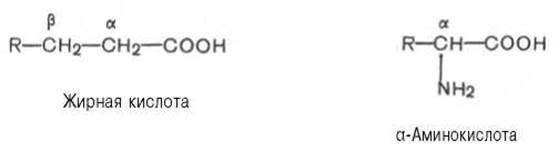
* In Northrop's laboratory in 1930–1931, Pepsin, Chymotrypsin, and Trypsin were for the first time isolated in a chemically individual and crystalline state.
** Acid and alkaline Hydrolysis of Proteins results in the almost complete destruction of Tryptophan and Cysteine, which is why Special Methods have been developed for their determination.
It should be emphasized that all amino acids found in natural proteins are a-amino acids, although the amino group in free aminocarboxylic acids can occupy ß-, y-, δ-, and ε-positions, as will be seen below.
Last update: 06/08/2026
Editorial and Educational Adaptation: This material has been compiled based on the primary/original source text. The project team performed an editorial review, corrected technical inaccuracies, structured sections, and adapted the content for an educational format.
What was processed:
- elimination of formatting defects (OCR errors, structural breaks, corrupted characters);
- editorial organization of content;
- standardization of terminology in accordance with academic sources;
- verification of factual statements against the original source text.
All mentions of the author, publication year, and origin of the primary text have been preserved in accordance with the source.