Molecular Biology of the Cell - Volume 1 - Alberts B., Bray D., Lewis J., Raff M., Roberts K., Watson J. 1994
Molecular Organization of Cells
Energy Conversion: Mitochondria and Chloroplasts
Evolution of Electron Transport Chains
The Structure, function, and evolution of Cells and organisms are largely tied to their Energy Requirements. As we have already seen, the mechanisms for utilizing such diverse Energy Sources as light and glucose oxidation are fundamentally the same. Evidently, An Efficient Pathway for ATP synthesis emerged early in evolution and has undergone little modification since then. How did the Key Components of the electron-transport chain—ATP synthase, redox-driven proton pumps, and Photosystems—first arise? Hypothesizing about evolutionary events is inherently difficult. However, clues can be found both in the various primitive electron-transport chains preserved in certain modern Bacteria and in the geological record concerning conditions on Earth billions of years ago.
7.4.1. The earliest cells likely synthesized ATP through Fermentation pathways [41]
As discussed in Chapter 1, the first living cells are thought to have appeared approximately 3.5×10⁹ years ago, when the Earth was over 109 years old. Because molecular oxygen was absent from the environment and organic molecules produced by geochemical processes were abundant, the earliest metabolic pathways for ATP synthesis were presumably similar to present-day forms of fermentation.
Class="center">Cell/cell.files/image503.jpg" width="321"/>
Fig. 7-56. Schemes of two Types of fermentation (end products are highlighted in color). A. Two NAD+ molecules consumed per molecule of glucose oxidized in Glycolysis are regenerated by transferring a hydride ion from NADH to Pyruvate, yielding two molecules of lactic acid. Lactic acid is then exported from The Cell. B. Two NAD+ molecules consumed per molecule of glucose during glycolysis are regenerated by sequentially transferring hydride ions from two NADH molecules to derivatives of pyruvate, producing succinic acid. For each molecule of succinic acid exported from the cell, one pyruvate molecule (highlighted in color) remains inside for subsequent biosynthetic processes. In both cases (A and B), regenerating NAD+ and sustaining glycolysis under anaerobic
conditions requires The excretion of an organic acid.
During fermentation, ATP is generated via substrate-level phosphorylation (Section 2.2.2), which harnesses The energy released during the partial oxidation of hydrogen-rich organic molecules such as glucose. In the absence of oxygen to act as a hydrogen acceptor, the hydrogen liberated by oxidation must be transferred (via NADH or NADPH) to another organic molecule (or another part of the same molecule), which is thereby reduced. One or more of the organic End products of fermentation are excreted into the environment as metabolic waste, whereas others, such as pyruvate, are utilized by the cell for Biosynthesis.
Different organisms excrete various end products, most commonly organic acids (carbon compounds containing a -COOH group). Prominent among bacterial fermentation products are lactic acid (which also accumulates during anaerobic glycolysis in mammalian cells; see Section 2.2.2), as well as formic, acetic, propionic, butyric, and succinic acids. Figure 7-56 illustrates Two Types of fermentation found in modern bacteria.
7-28
7.4.2. The evolution of an energy-storing electron-transport chain enabled anaerobic bacteria to utilize nonfermentable Organic compounds as an energy source [42]
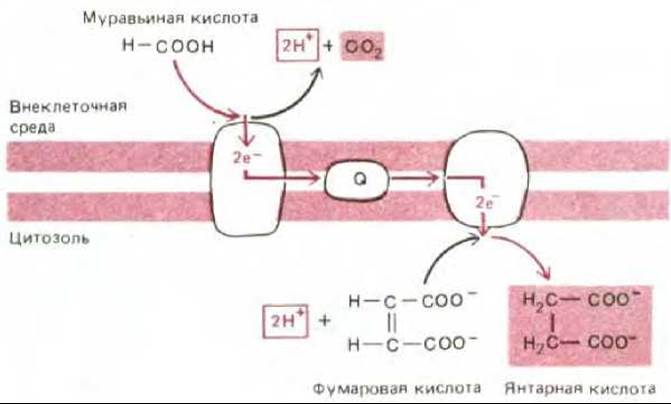
Fig. 7-57. In certain modern bacteria that grow anaerobically, including E. coli, The oxidation of formic acid by fumarate is mediated by an electron-transport chain located in The Plasma Membrane. As shown, this process yields succinate and CO2. Note that protons are consumed inside the cell and produced outside, which is equivalent to pumping protons out of the cell. Thus, this membrane-bound electron-transport system can generate an electrochemical proton gradient across the plasma membrane. The Redox Potential of the formic acid-CO2 pair is -420 mV, whereas that of the fumarate-succinate pair is +30 mV. Early fermentation processes must have provided not only ATP but also the reducing equivalents (NADH and NADPH) required for biosynthesis; indeed, many Major Metabolic Pathways likely arose when fermentation was the sole energy source. However, over time, the METABOLIC ACTIVITY OF prokaryotes would have altered the environment, leading to new biochemical pathways. The accumulation of fermentation byproducts could have driven the following evolutionary stages:
environment, and this led to The Emergence of new biochemical pathways. The accumulation of fermentation byproducts could have led to the following changes:
Stage 1. Due to the continuous release of acids, the ambient pH dropped, necessitating transmembrane pumps to extrude H+ ions from the cell to prevent death from excessive acidification. It is entirely possible that one of these pumps utilized the energy of ATP Hydrolysis and thus served as a precursor to modern ATP synthase.
Stage 2. Simultaneously with the accumulation of nonfermentable organic acids—which drove the evolution of an ATP-driven proton pump—supplies of fermentable substrates began to dwindle, threatening the energy source needed for metabolite transport and other vital processes. Under these conditions, Selection favored bacteria capable of extruding H+ ions without coupling the process to ATP hydrolysis, thereby conserving ATP for other cellular needs. This selective pressure may have spawned the earliest membrane-bound Proteins capable of harnessing electron transfer between molecules of different redox potentials to power proton translocation across the plasma membrane. Some of these proteins could have found suitable electron Donors and acceptors among the accumulated nonfermentable organic acids. Numerous such electron-transport proteins are found in living bacteria today; for example, some bacteria growing on formate-containing media pump protons using the relatively modest redox energy released by transferring electrons from formate to fumarate (Fig. 7-57). Other bacteria evolved similar electron-transport machinery dedicated exclusively to the Oxidation and reduction of inorganic substrates (see, for example, Fig. 7-59).
Stage 3. Eventually, certain bacteria developed such an efficient electron-transport chain that they stored more energy than was strictly necessary to maintain intracellular pH. The resulting rapid proton extrusion generated a large electrochemical gradient, which drove protons back into the cell through ATP-driven pumps, reversing their direction of operation and forcing them to function as ATP synthases. Because such bacteria required far fewer dwindling fermentable nutrients, they rapidly outcompeted their neighbors.
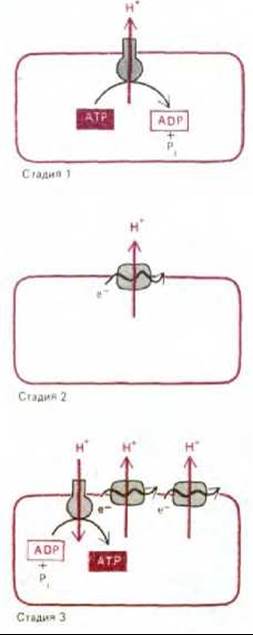
Fig. 7-58. Proposed evolution of Oxidative Phosphorylation mechanisms.
These three hypothetical stages in the evolution of oxidative phosphorylation mechanisms are diagrammed in Fig. 7-58.
7.4.3. Photosynthetic bacteria overcame a major crisis in Cell Evolution by tapping into an inexhaustible source of reducing power
Although the evolutionary steps just described solved The problem of maintaining both a neutral intracellular milieu and adequate energy reserves, another formidable challenge remained. The depletion of fermentable organic reserves meant that an alternative carbon source had to be found for synthesizing the sugars that serve as precursors for so many essential cellular molecules. Carbon dioxide, abundant in the atmosphere, was a potential carbon source; however, converting CO2 into organic molecules such as CARBOHYDRATES requires reducing the bound carbon with a potent hydrogen donor (such as NADH or NADPH) capable of supplying the energy-rich electrons needed to build a -CH2O- unit from CO2 (see Fig. 7-43). Early in cell evolution, large amounts of such reducing agents were generated by fermentation. However, as fermentable substrates declined and membrane-bound ATP synthase became the primary engine of ATP production, reserves of NADH and other reductants would have inevitably dried up. Thus, cells faced an urgent need to find a new source of strong reducing agents.
In environments devoid of fermentable molecules, the primary electron donors became organic acids produced via anaerobic Carbohydrate METABOLISM, inorganic molecules such as hydrogen sulfide (H2S) generated geochemically, and Water. Yet the reducing capacity of all these compounds is too low to drive carbon dioxide fixation directly. The initial emergence of strong electron donors was probably linked to utilizing the electrochemical proton gradient across the plasma membrane to drive a reverse flow of electrons, a mechanism that likely gave rise to membrane-bound enzyme complexes resembling NADH dehydrogenase (Fig. 7-59). However, the major evolutionary breakthrough in Energy Metabolism occurred with the appearance of photochemical reaction centers capable of directly synthesizing molecules such as NADPH. These centers are thought to have first appeared more than 3 billion years ago in the ancestors of green sulfur bacteria. Modern green sulfur bacteria harness radiant energy to transfer a hydrogen atom (as an electron and a proton) from hydrogen sulfide to NADP+, thereby generating the reducing power required for carbon fixation (Fig. 7-60). Because the electrons extracted from H2S have a much more negative redox potential than those in water molecules (-230 mV and +820 mV, respectively), a single light quantum absorbed by the bacteria's single photosystem is sufficient to reach the redox potential required to produce NADPH via a relatively simple electron-transport chain.
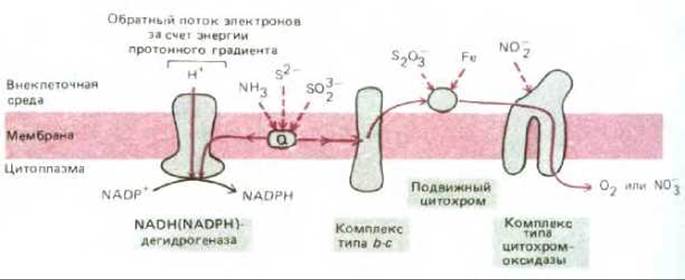
Fig. 7-59. Selected electron-transfer pathways in modern bacteria, where the ATP and reducing power required for growth are derived entirely from the energy of oxidizing inorganic molecules, such as iron, nitrogen, sulfur, and ammonia compounds. Some species can grow anaerobically by substituting nitrate as the terminal electron acceptor. Other species employ a carbon-fixation cycle and synthesize organic molecules exclusively from CO2. A "forward" electron flow drives proton extrusion from the cell, and the energy of the resulting proton gradient is harnessed by ATP synthase to produce ATP (not shown). NADPH required for carbon fixation is generated via a "reverse" electron flow (see also Fig. 7-51B).
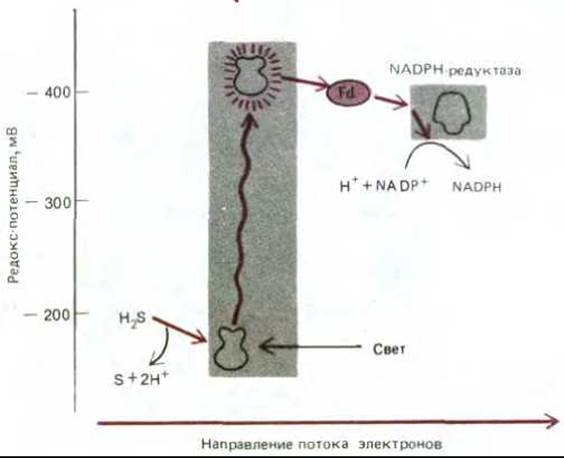
Fig. 7-60. Electron flow in a relatively primitive noncyclic photosynthetic pathway in modern green sulfur bacteria. The photosystem of green bacteria is similar to Photosystem I of plants and cyanobacteria in that it also utilizes a series of iron-sulfur centers that serve as primary electron acceptors and then pass their high-energy electrons to ferredoxin (Fd).
7.4.4. The first atmospheric oxygen was likely the product of more complex photosynthetic Electron Transport Chains in cyanobacteria [44]
At the next stage, believed to have begun about 3 billion years ago with the appearance of cyanobacteria, organisms capable of utilizing water as a hydrogen source for $\text{CO}_2$ reduction emerged. This led to The Development of a second photosystem operating in series with the first, making it possible to bridge the large redox potential gap between $\text{H}_2\text{O}$ and NADPH. Structural homologies between modern photosystems suggest that Two Photosystems fused here, one originating from green bacteria (photosystem I) and the other from purple bacteria (Photosystem II). This evolutionary step had far-reaching biological consequences. For the first time, organisms arose with minimal dependence on environmental chemicals, allowing them to spread and evolve along pathways inaccessible to more primitive photosynthetic bacteria, which required $\text{H}_2\text{S}$ and organic acids as electron donors. As a result, large quantities of reduced organic material synthesized by living cells accumulated. Furthermore, molecular oxygen began to enter the atmosphere for the first time.
Oxygen is highly toxic because it can inactivate Enzymes through oxidation. For example, many presently existing anaerobic bacteria rapidly perish upon contact with air. Therefore, organisms on the ancient Earth had to develop defense mechanisms against increasing concentrations of $\text{O}_2$ in their environment. Organisms that appeared at later evolutionary stages possess numerous mechanisms protecting their enzymes from the detrimental effects of oxygen.
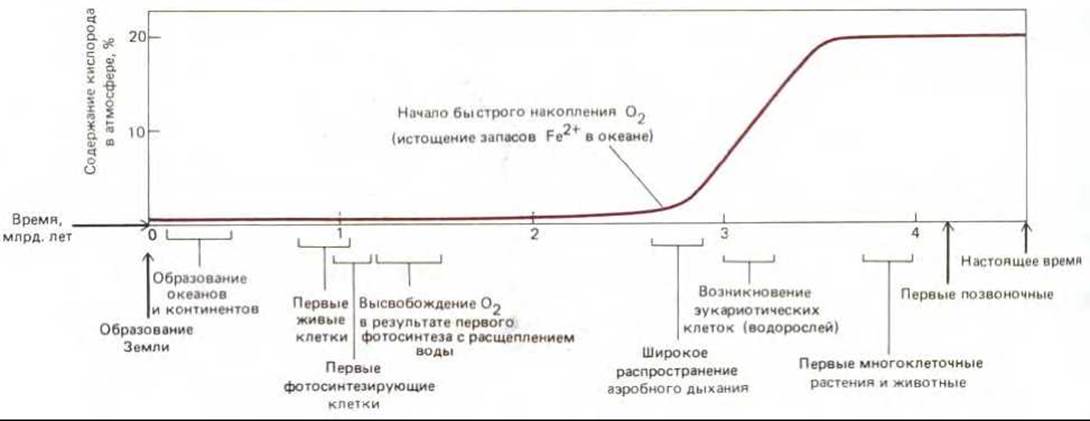
Fig. 7-61. The relationship between atmospheric oxygen levels and some of the most important hypothetical stages in the evolution of life on Earth. Geological evidence indicates that more than a billion years elapsed between the emergence of cyanobacteria (which appear to have been the first oxygen-producing organisms) and the onset of a rapid increase in atmospheric oxygen concentration. This "lag" is primarily explained by the presence of a vast reservoir of dissolved ferrous ($ ext{Fe}^{2+}$) iron ions in the ocean, which reacted with the released oxygen, leading to The formation of massive iron oxide deposits.
Initially, the level of atmospheric oxygen rose very slowly. Primitive seas contained large quantities of ferrous iron ($ ext{Fe}^{2+}$) ions, and almost all the oxygen released by early photosynthetic bacteria was consumed in converting $ ext{Fe}^{2+}$ to $ ext{Fe}^{3+}$, resulting in the precipitation of massive amounts of iron oxides. Extensive "banded iron formations," which began to form approximately 2.7 billion years ago, help date the intensive proliferation of cyanobacteria. About 2 billion years ago, the reserves of ferrous iron were depleted, and the deposition of iron-rich sediments ceased. Geological data indicate that atmospheric oxygen levels then began to rise, reaching modern levels sometime between 0.5 and 1.5 billion years ago (Fig. 7-61).
The presence of oxygen enabled the emergence of bacteria capable of synthesizing ATP via aerobic metabolism; these organisms could harness the large amount of energy released during the complete breakdown of carbohydrates and other reduced organic molecules into $\text{CO}_2$ and $\text{H}_2\text{O}$. The modification of certain components of preexisting electron transport complexes led to the formation of cytochrome c oxidase, enabling electrons extracted from organic and inorganic substrates to be transferred to $\text{O}_2$ as the terminal electron acceptor. Many modern purple photosynthetic bacteria can switch their metabolism between Photosynthesis and Respiration depending on whether light or oxygen is more readily available; such a switch involves remarkably minor alterations in their Electron Transport Chain.
As organic material accumulated through photosynthesis, some photosynthetic bacteria (including precursors of *E. coli*) lost The ability to survive solely on radiant energy and shifted entirely to respiratory metabolism. Mitochondria are thought to have first appeared 1.5 billion years ago when such "respiring" bacteria became endosymbionts within primitive Eukaryotic cells (see Section 7.5.16). Later, descendants of early aerobic eukaryotic cells engulfed a photosynthetic bacterium via endocytosis, which became the precursor to Chloroplasts. However, the uniqueness of chloroplasts across various Algae points to the independent evolution of chloroplasts in different groups of organisms. Figure 7-62 illustrates some of the putative evolutionary pathways discussed above.
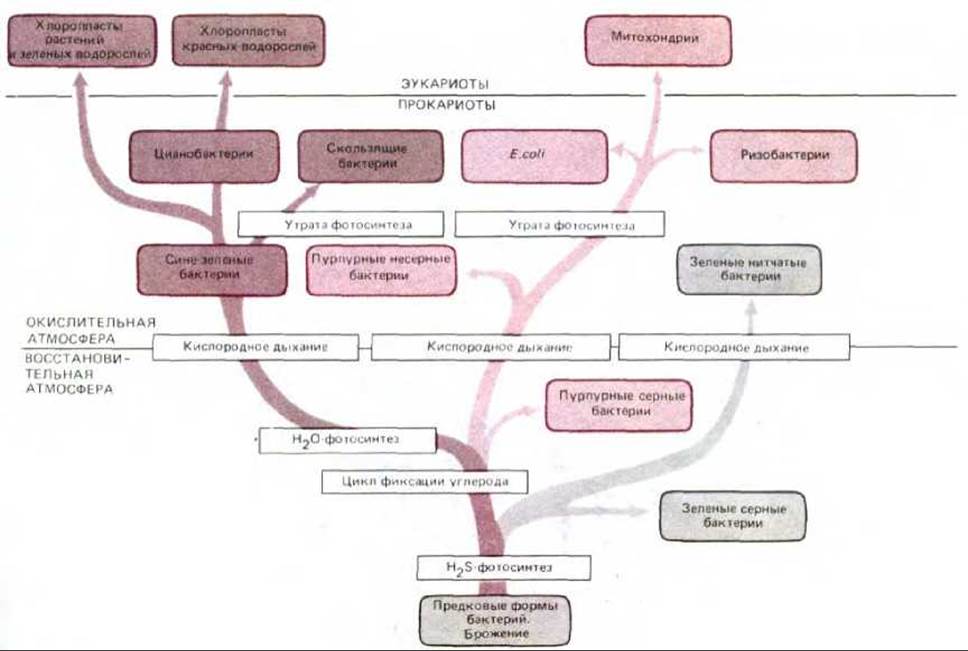
Fig. 7-62. Phylogenetic Tree of the putative evolution of mitochondria, chloroplasts, and their bacterial ancestors. Oxygen respiration is thought to have begun developing approximately 2 billion years ago. As seen in the figure, this type of respiration likely arose independently in three lineages of photosynthetic prokaryotes: green, purple, and blue-green bacteria. It appears that a form of aerobic purple bacteria that lost the ability to photosynthesize gave rise to mitochondria, whereas several distinct blue-green bacteria served as the ancestors of chloroplasts. Detailed nucleotide sequence analyses indicate that mitochondria most likely originated from bacteria resembling modern rhizobia, agrobacteria, and rickettsiae—three related groups whose members form intimate associations with modern eukaryotic cells (see Sections 20.3.2 and 20.3.3).
Evolution is inherently conservative—everything new is built upon a foundation of what already exists. For example, certain segments of The electron transport chain utilized by anaerobic bacteria three billion years ago likely became incorporated, in modified form, into the corresponding chains of Mitochondria and chloroplasts in higher eukaryotes. A striking example is the Homology between the Structure and function of enzyme complexes in the middle segment of the mitochondrial Respiratory Chain ($b\text{-}c_1$ complex) and specific segments of the electron transport chain in bacteria and chloroplasts (Fig. 7-63).
The earliest cells are believed to have been organisms resembling bacteria, living in an environment rich in reduced organic molecules generated by geochemical processes over hundreds of millions of years. These organisms likely derived almost all their ATP by converting reduced compounds into various organic acids, which were excreted into the environment as waste. Fermentation processes led to acidification of the environment, which may have prompted the emergence of the first membrane-bound proton pump, utilized to maintain a neutral internal cellular pH. The characteristics of modern bacteria indicate that both the electron transport-driven proton pump and the ATP hydrolysis-driven proton pump originated under these anaerobic conditions. Their functional reversibility allowed the ATP-dependent proton pump to act as an ATP synthase. Consequently, as more efficient electron transport chains evolved, the energy released during oxidation-reduction reactions between inorganic molecules could be harnessed for ATP synthesis.

Fig. 7-63. Comparative diagrams of the three electron transport chains examined in detail in this chapter. Bacteria and chloroplasts contain a membrane-bound enzyme complex highly similar to the mitochondrial $b\text{-}c_1$ complex. All these complexes accept electrons from quinone (Q) and pump protons across their respective membranes. Moreover, in *in vitro* reconstituted systems, various complexes can substitute for one another, and Amino Acid Sequence analysis of their protein components demonstrates that these proteins are evolutionarily related.
The proliferation of bacteria that relied on preformed organic molecules as sources of carbon and reducing equivalents could not be sustained indefinitely, as this supply was replenished very slowly by geochemical processes. The depletion of fermentable organic reserves likely drove the emergence of bacteria capable of synthesizing carbohydrates from $\text{CO}_2$. Utilizing preexisting segments of their electron transport chains, photosynthetic bacteria captured radiant energy using their single photosystem and directed it toward the synthesis of NADPH required for carbon fixation. The subsequent appearance of a more complex photosynthetic electron transport chain in cyanobacteria made it possible to use water as an electron donor for NADPH generation,
rather than relying on the rarer electron donors required by other photosynthetic bacteria. Consequently, the widespread expansion of life once again resulted in the accumulation of reduced organic substances. Oxygen released by cyanobacterial photosynthesis began to accumulate in the atmosphere approximately 2 billion years ago. With abundant oxygen and organic molecules available, electron transport chains adapted to transfer electrons from NADH to oxygen, and many bacteria developed efficient aerobic metabolism. This exact type of aerobic metabolism characterizes the mitochondria of eukaryotic cells, and compelling evidence now Supports the view that mitochondria and chloroplasts are descendants of aerobic bacteria engulfed by primitive eukaryotic cells via endocytosis.
Last update: 12/08/2026
Editorial and Educational Adaptation: This material has been compiled based on the primary/original source text. The project team performed an editorial review, corrected technical inaccuracies, structured sections, and adapted the content for an educational format.
What was processed:
- elimination of formatting defects (OCR errors, structural breaks, corrupted characters);
- editorial organization of content;
- standardization of terminology in accordance with academic sources;
- verification of factual statements against the original source text.
All mentions of the author, publication year, and origin of the primary text have been preserved in accordance with the source.