Principles of Biochemistry Volume 2 - A. Lehninger 1985
Bioenergetics and Metabolism
The Citric Acid Cycle
How did the very concept of the citric acid cycle originate?
This is a fair question, as such a cycle—involving The oxidation of two-carbon acetyl groups to CO2 via six-carbon citric acid—might seem excessively complex and therefore contrary to THE PRINCIPLE OF maximum economy inherent in the biochemical logic of a living Cell.
The existence of such a cycle for the Oxidation of Pyruvate in animal Tissues was first proposed in 1937 by Hans Krebs. The idea came to him while investigating The Effect of various organic acid anions on The rate of oxygen consumption by Suspensions of minced pigeon breast Muscle, which actively oxidized pyruvate. Breast muscle exhibits an extraordinarily high rate of Respiration, making it a particularly convenient model for studying oxidative activity. Shortly before Krebs's work, Albert Szent-Györgyi in Hungary discovered that certain four-carbon dicarboxylic organic acids present in animal tissues (succinic, fumaric, malic, and oxaloacetic) could enhance oxygen consumption by Muscle tissue. Krebs confirmed this observation and demonstrated that these organic acids also stimulate pyruvate oxidation. Furthermore, he found that pyruvate oxidation in muscle tissue is stimulated by six-carbon tricarboxylic acids—citric, cis-aconitic, and isocitric—as well as the five-carbon a-ketoglutaric acid. The structures of all these acids are shown in Fig. 16-7. Several other naturally occurring organic acids were also tested, but none showed similar activity. A striking feature of the stimulating effect of these active acids was that even a minute quantity of any of them was sufficient to drive the oxidation of a manifold larger amount of pyruvate.
Class="center">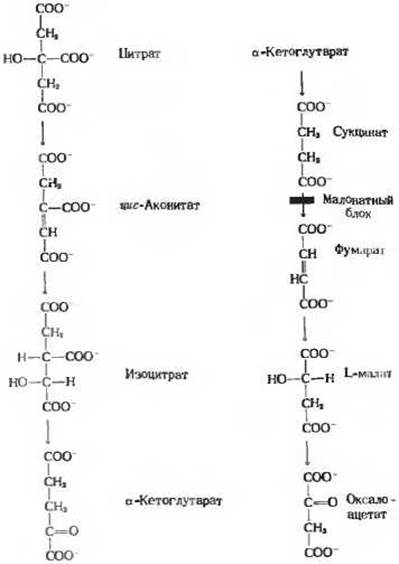
Fig. 16-7. Naturally occurring tricarboxylic and dicarboxylic acids capable of stimulating pyruvate oxidation in muscle tissue suspensions. Other naturally occurring organic acids, such as tartaric, oxalic, and ketoadipic, lack this ability. The active acids are shown in the sequence in which they appear in The Citric Acid Cycle. Only a single chemical modification occurs at each step. The step inhibited by malonate is indicated: in the presence of malonate, citrate is oxidized to succinate, which accumulates.
Another important observation made by Krebs concerned the effect of malonate (Fig. 16-8), a competitive inhibitor of succinate dehydrogenase (Section 9.13). He found that malonate inhibits the aerobic consumption of pyruvate by minced muscle suspensions regardless of which active acid is added to the suspension. This indicated that succinate and succinate dehydrogenase constitute an essential link in the chain of enzymatic reactions that comprise pyruvate oxidation. Krebs further found that when the aerobic consumption of pyruvate by a muscle suspension is inhibited by malonate, citrate, a-ketoglutarate, and succinate accumulate in the suspending medium. This implied that under normal conditions—that is, in the absence of malonate—citrate and a-ketoglutarate are converted into succinate.
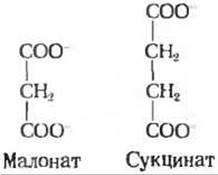
Fig. 16-8. Malonate, a competitive inhibitor of succinate dehydrogenase (see also Fig. 19-12). Note the structural similarity between malonate and succinate.
Based on these primary data and several other observations, Krebs concluded that all the active tri- and dicarboxylic acids listed above can be arranged in a logical chemical sequence, each step of which represents a simple chemical transformation catalyzed by a single specific enzyme (Fig. 16-7). Furthermore, because the incubation of pyruvate and oxaloacetate with minced muscle tissue led to the accumulation of citrate in the medium, Krebs deduced that this sequence is not linear but cyclic—meaning its beginning loops back to its end (Fig. 16-9). The missing link that would close the cycle had to be the reaction
Pyruvate + Oxaloacetate →
→ Citrate + CO2.
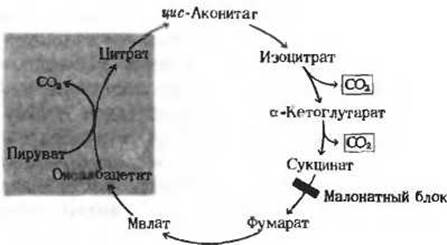
Fig. 16-9. Closing the cycle in the original proposed scheme. When Krebs discovered that pyruvate and oxaloacetate react to form citrate (reactions highlighted on a red Background), it became clear that the reaction sequence is cyclic in nature. Note that succinate accumulates during the malonate block when pyruvate and oxaloacetate are oxidized via citrate.
The simple experiments and logical deductions described above led Krebs to propose that the cycle, which he named The Citric Acid cycle, is the principal pathway of carbohydrate oxidation in muscle. In the years since its discovery, it has become evident that this cycle is not restricted to muscle alone. The citric acid cycle has been found in virtually all tissues of higher animals and plants, as well as in many aerobic microorganisms. For this momentous discovery, Krebs was awarded the Nobel Prize in 1953, which he shared with Fritz Lipmann, the "father" of the ATP cycle (Section 14.7).
The citric acid cycle is also referred to as The Tricarboxylic Acid Cycle—this alternative name arose because, for several years after Krebs postulated the cycle, there was some uncertainty as to which specific tricarboxylic acid (citrate or, for instance, isocitrate) is the primary product of the Condensation of pyruvate with oxaloacetate. This uncertainty, as we will see below, has now been resolved. It is currently well established that citrate is indeed the first tricarboxylic acid to be formed. Therefore, it is best to refer to this metabolic pathway as the citric acid cycle or simply the Krebs cycle.
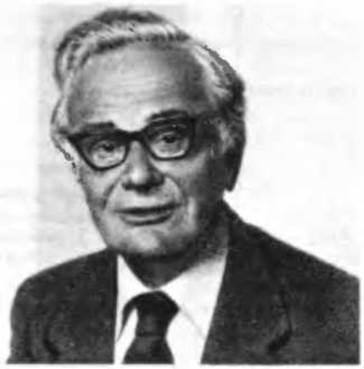
Fig. 16-10. Photograph of Sir Hans Krebs taken on the occasion of his eightieth birthday in August 1980. Krebs was born in Germany, where he also received his medical training. From 1926 to 1930, he worked in Berlin with Otto Warburg, who was himself one of the pioneers of modern biochemistry. In 1932, while serving as an assistant in the Faculty of Medicine at the University of Freiburg, Krebs, together with a medical student Kurt Henseleit, formulated the scheme for The Urea Cycle they had postulated (Ch. 19). In 1933, Krebs emigrated to England and began working at the University of Cambridge. He later moved to the University of Sheffield, where he conducted the bulk of his work on the citric acid cycle. In 1954, he assumed the headship of the Department of Biochemistry at Oxford. Following his retirement from that post in 1967, Krebs dedicated himself entirely to research again in the Department of Medicine at Oxford. He pursued studies on the dynamics and REGULATION OF METABOLISM, working very actively alongside several associates right up until his death in November 1981. Krebs frequently lectured at universities worldwide, and his lectures were immensely popular. The Discovery of the citric acid cycle is regarded as one of the most important Milestones in the history of metabolic biochemistry.
Eugene Kennedy and Albert Lehninger later demonstrated that all Reactions of the citric acid cycle take place within the Mitochondria of animal Cells. Not only were all the Enzymes and Coenzymes of the citric acid cycle found in isolated rat Liver mitochondria (Section 2.8); it also turned out that all the enzymes and Proteins required for The final stage of respiration—that is, Electron Transport and Oxidative Phosphorylation—are localized there as well. For this reason, mitochondria are rightfully termed the "power plants" of The Cell. Figure 16-11 illustrates the arrangement of the enzymes catalyzing the reactions of the citric acid cycle within the mitochondria.

Fig. 16-11. Localization of the citric acid cycle enzymes within mitochondria.
Last update: 06/08/2026
Editorial and Educational Adaptation: This material has been compiled based on the primary/original source text. The project team performed an editorial review, corrected technical inaccuracies, structured sections, and adapted the content for an educational format.
What was processed:
- elimination of formatting defects (OCR errors, structural breaks, corrupted characters);
- editorial organization of content;
- standardization of terminology in accordance with academic sources;
- verification of factual statements against the original source text.
All mentions of the author, publication year, and origin of the primary text have been preserved in accordance with the source.