Antibiotics (Properties, Application, Interactions) - M.P. Cherenko 1999
Electrical Injury
Electrical injury can be caused by atmospheric electricity (lightning) or an electric current. With advances in science, engineering, and industrial development, this type of injury is becoming increasingly common, although it accounts for 0.24% to 10.9% of all traumas.
Injuries caused by electric current have distinct features. Unlike mechanical, physical, and chemical agents, electricity affects The Human Body not only upon direct contact, but also through objects held in the hands. Furthermore, electric current can cause injury from a distance via an arc discharge. Typically, Electrical injuries affect healthy individuals and occur quite suddenly.
The severity of an electrical injury depends on the current (A), voltage (V), duration of exposure, and the overall condition of the body (fatigue, alcohol intoxication, exhaustion, age). Exhausted, fatigued individuals with chronic Nervous system disorders are more susceptible to this type of injury than healthy ones. The depth of tissue damage depends on Skin resistance along the path of the current: the lower the resistance, the greater the severity of the injury. Thin, damp skin is the most vulnerable, while coarse, dry skin is less sensitive. The type of current (direct or alternating) is also significant. For instance, a person in a bathtub may suffer a fatal Shock from a current that would cause no harm if it passed through dry skin. Cases of death have been reported at voltages as low as 38 V, whereas being struck by lightning at 5,000,000 V is not always fatal. Other critical factors include the duration of exposure and The pathway of the current through the body, with passage through The Heart being particularly dangerous. At voltages up to 500 V, direct current is less hazardous than alternating current; however, at higher voltages, direct current becomes more dangerous.
The state of the Central Nervous System can also influence the depth of the injury. If the body is "prepared" for contact with an electric current, the risk of injury is lower. Conversely, a sudden exposure to current can cause severe damage to the Organism.
The most sensitive areas to electric current are the face, palms, and perineal region, while the least sensitive are the lower back and ankle joints.
Electrical injuries occur in both occupational and domestic settings under various circumstances. Direct causes of injury include touching a live conductor, approaching a high-voltage conductor, or a short circuit occurring near the victim.
Electrical injuries can also be caused by objects that are not normally sources of electricity or conductors, but become live due to damaged insulation or contact with an electrical system. Consequently, low-voltage installations (telephones, telegraphs, etc.) can become dangerous if accidentally connected to the power mains.
In terms of electrical resistance, Tissues are ranked as follows: skin, tendons, bones, nerves, Muscles, and Blood. The skin, having the highest resistance, is injured most frequently because the current generates heat there, leading to tissue destruction and dehydration. Skin resistance at the contact point with a conductor ranges from 1,000 to 2,000,000 Ом. Under METABOLISM/18.html">The Influence of current, the skin breaks down, and its resistance drops significantly.
In electrical injuries, specific changes occur in the tissues due to the body becoming part of the electrical circuit, alongside non-specific changes resulting from thermal, chemical, and mechanical energy acting on the body.
Thermal effects depend on The conversion of electrical energy into heat, which can cause Burns of varying degrees—ranging from minimal marks ("signs") at the entry point of the current to tissue charring, exposed Muscle, and bone melting.
Chemical effects are caused by gases generated during electrolysis, which penetrate the subcutaneous tissue and muscles in a zigzag pattern.
Due to the conversion of electrical energy into mechanical energy, crater-like depressions with slightly raised edges form on the skin (at the current entry site), holes appear in bones, and body parts may occasionally be torn off.
Pathomorphological changes in electrical injuries can be local (at the site of current entry) and general. At the site of penetration, electrical marks ("current signs") appear on the skin. These vary in character from round or oval white-gray patches to areas of dry, dense skin, slightly raised above the surface with a central depression. Sometimes electrical marks resemble healing scab-covered wounds, abrasions, or hemorrhages.
At the exit site, "current signs" are observed less frequently.
Histological examination of these marks reveals elongation of the Cells in the Malpighian and osteoid layers of the epidermis, the epithelium of the Sebaceous Glands, and the endothelium of small skin vessels. Groups of cells are twisted into a spiral shape. The dermal papillae are flattened, Collagen fibers show increased affinity for silver, and nerve trunks exhibit fragmentation. Concurrently, conventional epidermal burns and tissue crushing are observed around the electrical mark.
Electric current-induced burns differ from thermal burns in that, even with significant local changes and prior to the onset of secondary inflammation, Hair is preserved in the skin, and there is no hyperemia or pain. In areas where the stratum corneum of the skin is thick (such as the heel), honeycomb-like cavities form along the path of the electrical loop, which is attributed to thermal action. Occasionally, due to the electrical Conversion of the conductor's metal into gas, impregnation of the skin with microscopic metal particles occurs (skin metallization). The affected areas turn yellow-brown (when impregnated with a copper conductor) or gray-brown (when impregnated with iron).
The thermal, chemical, and mechanical injuries described above are usually confined to the skin and subcutaneous tissue because the electrical current, encountering skin resistance, is significantly reduced. This is further facilitated by The formation of burns and scabs. Nevertheless, tissues along the path of the electrical loop can be damaged to a considerable depth.
Under the influence of electric current, destructive changes occur in the vascular walls, primarily within the endothelial cells.
Electric current passing through muscles causes them to contract. This explains why a victim is sometimes difficult to detach from the current source.
Hemorrhages, large zones of necrosis, and tissue tears frequently occur along the path of the current within Internal Organs. Foci of bone melting may also be observed in bones.
In electrical trauma, systemic changes are observed in various organs and tissues. In cases of sudden death, the blood in The Heart and Blood Vessels remains fluid and dark in color. Numerous petechial hemorrhages appear in the mucous and serous membranes, accompanied by characteristic congestion of internal organs and pulmonary emphysema. Convulsive muscle contractions can cause muscle tears. Dystrophic and necrobiotic processes develop in the Cerebral Cortex, subcortical nuclei, and Brainstem.
Class="center">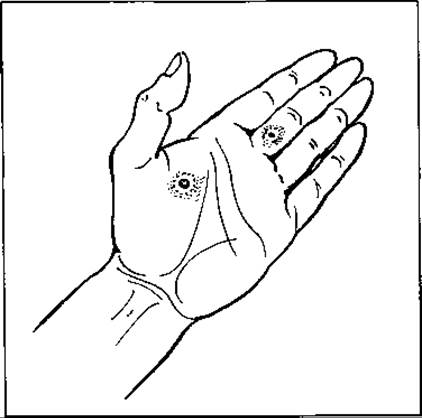
Fig. 61. Electrical current injury marks
There are no specific changes in internal organs unique solely to this type of trauma. However, when all pathomorphological changes across various organs and tissues are evaluated alongside clinical and laboratory data, they become specific to electrical injury.
Thus, electrical injury leads to increased vascular wall permeability, with plasma and formed elements leaking into adjacent tissues. Edema of various organs, pulmonary alveoli, the Pancreas, Gonads, etc., is present. Hyperemia of internal organs and isolated hemorrhages within them are also observed.
Prolonged exposure to electric current may cause rupture of pulmonary vessels, foci of necrosis in The Liver and Kidneys, perforation of hollow digestive organs, edema, necrosis, and autodigestion of the pancreas, as well as interstitial edema, hemorrhages, and myocardial fragmentation in the heart.
Polyglobulia, leukocytosis, and alterations in mineral, protein, pigment, and Carbohydrate Metabolism are frequently observed. Glucosuria is also common.
Clinical presentation of electrical injuries. The characteristic local manifestations of electrical shock are electrical marks (Fig. 61). In some cases, deep lesions with crater-like bases extending down to the bone can be observed.
In lightning strikes, local changes appear as so-called lightning marks—branching, hyperemic streaks on the skin that disappear upon pressure. These result from vascular wall paralysis and fade after some time.
Among the general symptoms of electrical trauma, attention is drawn to vasomotor Disorders of the cardiovascular, central, and autonomic nervous systems, along with the depression of all vital centers.
Mild cases present with fear, dizziness, lethargy, and similar symptoms.
Severe cases are characterized by shock, loss of consciousness, sudden cessation of breathing and heartbeat, signs of cardiac fibrillation, and potential clinical death.
Primary impairments of pulmonary gas exchange persist only during the action of the electric current and for a short period after its cessation. This is a consequence of the spasm of Respiratory Muscles and vocal cords, which prevents the patient from crying out or calling for help. The cause of apnea is damage to the Medulla Oblongata when the current loop encompasses the respiratory center.
When a current loop passes through the chest, Cardiac Activity is disrupted, manifesting as isolated extrasystoles up to ventricular fibrillation. According to experts, human cardiac fibrillation does not stop spontaneously and, without the assistance of a resuscitation team, can lead to death. The action of the current causes a persistent disturbance of Coronary Circulation, which in turn leads to myocardial Hypoxia, thereby exacerbating fibrillation.
In 80–90% of cases, lightning strike victims lose consciousness, although cardiac activity is disrupted to a lesser degree due to the high voltage in the discharge zone and its short duration. An exception is trauma to the HEAD. Respiratory disturbances in these cases occur secondarily, due to reflex cardiac arrest or As a result of damage to the respiratory apparatus (fracture of the Ribs or Sternum).
In severe electrical trauma involving prolonged exposure to the injuring agent, phenomena known as "apparent death" sometimes occur. Jellinek distinguishes four types of death from electrical injury: 1) sudden, instant death; 2) "delayed" death, where the victim's condition is satisfactory immediately after the trauma, but sudden death occurs after some time; 3) "interrupted" death, where the victim is successfully brought out of shock and "apparent death," but sudden death occurs some time after resuscitation; and 4) "protracted" death, where the victim, having recovered from the trauma, dies a few days later from cardiac paralysis.
Various authors interpret the cause of death from electrical trauma differently. Some attribute it to primary myocardial damage, while others point to primary pulmonary edema and cessation of Respiration, damage to the respiratory and vasomotor centers accompanied by depletion of peripheral vessels and congestion in the abdominal, thoracic, and cranial cavities.
Minor electrical injuries usually resolve on their own without leaving any changes. However, local and general complications may sometimes appear. Local complications include secondary infection (if the electrical injury is accompanied by a thermal burn), secondary hemorrhages due to vascular wall damage, and trophic disorders.
General complications manifest as secondary shock resulting from bodily intoxication, as well as psychiatric disorders ranging from mild to very severe. Post-traumatic electroencephalopathy, vestibular disorders, increased intracranial pressure, retrograde amnesia, and hypoxia of the Brain and heart tissues are occasionally observed. In milder cases, minor fatigue, depressed mood, irritability, and decreased memory or concentration persist for a long time. Some individuals retain Inner ear disorders (dizziness) and visual impairments.
Treatment of injuries resulting from electrical trauma involves providing first aid along with local and general therapy.
The primary objective in first aid is to disconnect the victim from the current source. This is sometimes quite difficult due to the patient's spasmodic muscle contractions. To achieve this, turn off the main switch, unscrew the fuse, or cut the wire using an axe or a shovel with a wooden handle. If this is impossible, pull the wire away from the victim, or the victim away from the wire, using a dry stick or cord. Extreme caution must be exercised: pull the wire away using a dry branch or cord; never cut two wires simultaneously to avoid a short circuit. Furthermore, do not cut wires in rooms containing flammable substances, as this may cause an explosion. Never free the victim from the current source with bare hands; rubber gloves must be used. Insulation is required not only from the current source but also from the ground. For this purpose, wear rubber galovers or stand on insulating material (a rubber mat, Glass, dry board, or a thick layer of fabric, paper, or cardboard). Remember that the victim's body also conducts electric current, so they should be handled by clothing that is dry and loose from the body.
In cases of high-voltage shock (from a high-voltage power line), grounding can be used (connecting live parts to the wire with the ground). This makes it possible to eliminate or significantly reduce the current in the circuit. If the patient has not lost consciousness, treatment for dizziness, collapse, or shock is administered according to standard guidelines. If the patient is unconscious, urgent resuscitation measures are required: in case of cardiac arrest, closed-chest cardiac massage; in case of respiratory arrest, artificial pulmonary ventilation using Mouth-to-mouth or mouth-to-Nose Methods. Artificial ventilation and cardiac massage should be continued during transportation of the patient to a hospital until spontaneous breathing is restored. When assistance is provided by an emergency physician, artificial ventilation is performed using manual devices, and 1 ml of a 1% lobeline solution or 1 ml of cytiton is administered subcutaneously. If spontaneous breathing does not resume within 30 minutes, tracheal intubation is performed, and artificial ventilation is continued with aspiration of contents from the tracheobronchial tree.
The patient must be provided with rest and put to bed. They should not be allowed to stand up, let alone continue working.
If closed-chest cardiac massage is ineffective, open-chest cardiac massage with thoracotomy is indicated. The presence of ventricular fibrillation detected on an Electrocardiogram indicates The Need for electrical defibrillation, performed simultaneously with artificial pulmonary ventilation.
Preparation for cardiac defibrillation does not require stopping closed- or open-chest cardiac massage and artificial ventilation. One defibrillator electrode is placed under the patient's left scapula, while the other is held by its insulated handle, waiting for the capacitor to charge (4000–4500 V). Afterward, the electrode is applied evenly and firmly to the cardiac region. Interrupted for one minute, cardiac massage and artificial ventilation are paused while defibrillation is performed. Its effect is manifested by the appearance of an independent pulse immediately after the discharge or after the continuation of massage.
Concurrently with the resuscitation measures described above, Oxygen therapy, intravenous administration of glucose with Vitamins and Insulin, cardiac medications, polarizing solutions, coronarolytic and antiarrhythmic agents (phenoptin, lidocaine), 10 ml of a 10% calcium chloride solution, and intravenous or intra-arterial blood transfusions are administered.
Resuscitation of the victim should be continued until spontaneous breathing and cardiac function are restored.
Local injuries do not require specialized treatment and should be managed conservatively. This is due to the fragility and increased brittleness of blood vessels near the injury site, the indistinct borders of necrotic tissue, the low tendency of wounds to suppurate, and the favorable course of the healing process. The injured area is treated with 70% ethyl alcohol and covered with a sterile dressing, allowing it to heal under a scab. If the lesions are extensive, deep, and accompanied by tissue carbonization, necrotomy or amputation is performed after the demarcation line appears.
Safety measures are of paramount importance for the Prevention of electrical injuries in the workplace. They are divided into technical and medical categories. The former involve the elimination of conditions that contribute to electric shock (compliance with safety regulations, proper maintenance of electrical equipment, tools, and protective clothing, and briefings); the latter consist of identifying factors predisposing to electrical injuries. Decreased mental reaction speed, reduced attention span, and repeated electrical injuries in the same worker raise concerns about their suitability for working with electrical appliances. Individuals with burns or hand abrasions should be considered temporarily disabled. Working with electrical appliances while intoxicated is strictly prohibited.
Last update: 08/08/2026
Editorial and Educational Adaptation: This material has been compiled based on the primary/original source text. The project team performed an editorial review, corrected technical inaccuracies, structured sections, and adapted the content for an educational format.
What was processed:
- elimination of formatting defects (OCR errors, structural breaks, corrupted characters);
- editorial organization of content;
- standardization of terminology in accordance with academic sources;
- verification of factual statements against the original source text.
All mentions of the author, publication year, and origin of the primary text have been preserved in accordance with the source.