Review of Medical Physiology - William F. Ganong 2002
Respiration
Adaptive changes in respiration in health and disease
Artificial ventilation
The application of artificial Respiration following the cessation of normal breathing to revive a victim of acute asphyxia due to drowning, carbon monoxide or other gas poisoning, electrocution, anesthesia mishaps, and other similar causes can be lifesaving. It should always be attempted, as breathing ceases before cardiac arrest occurs. Numerous emergency artificial respiration Methods exist; however, the method recommended today that provides adequate ventilation in all cases is the Mouth-to-mouth resuscitation technique. The advantages of this method include not only its ease of execution, but also the fact that it achieves sufficient lung expansion.
Mouth-to-Mouth Respiration
During this resuscitative Procedure, the rescuer must place the victim on a flat surface, open the mouth while supporting the victim's neck with one hand and lifting it, and place the other hand on the forehead to maintain the applied pressure. This extends the victim's neck and prevents the Tongue from falling back into the Pharynx. The rescuer's mouth should cover the victim's mouth, while the fingers of the hand on the forehead pinch the victim's nostrils closed (Fig. 37-13). At a rate of 12 breaths per minute, the rescuer inhales a volume of air twice the tidal volume, which enables passive exhalation by the victim thanks to the elastic recoil of the Lungs. Care must be taken to ensure the correct position of the neck: it must remain extended. Any gas that enters The Stomach may occasionally be expelled upward by abdominal pressure. For apneic individuals in whom a heartbeat cannot be detected, mouth-to-mouth breathing must be alternated with cardiac massage (see Chapter 28).
Class="center">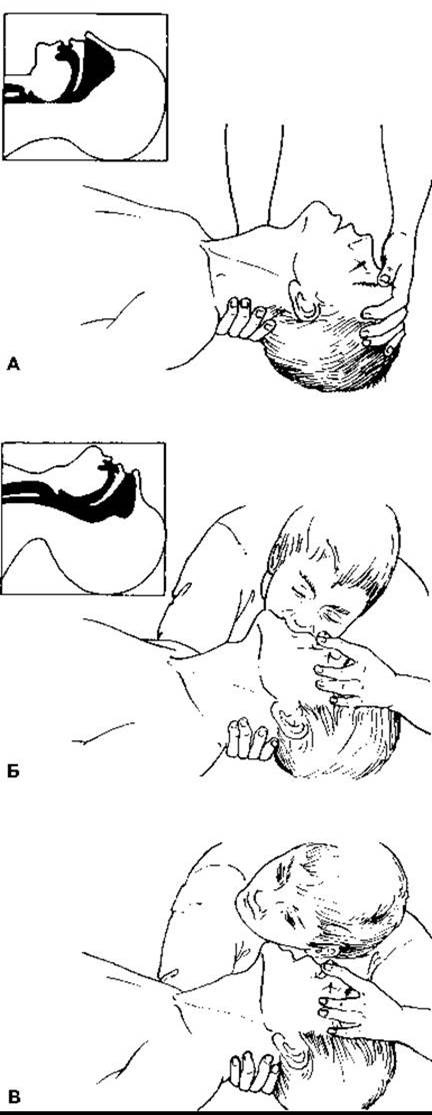
Fig. 37-13. Correct execution of mouth-to-mouth resuscitation. A: Open the airway by positioning the neck forward and hyperextending it. The inset illustrates airway obstruction when the neck is flexed at rest and its opening upon neck extension. B: Pinch the victim's nostrils closed with your fingers, seal your mouth tightly over the victim's, and blow forcefully. C: Allow the victim to exhale passively through the open mouth or Nose. The release of air can be heard and the expiratory airflow felt. Repeat B and C 12 times per minute (reproduced with permission from Schroeder SA, Krupp MA, Tierney LM Jr [editors]: Current Medical Diagnosis & Treatment 1990. McGraw-Hill, 1990).
Mechanical Ventilation
Mechanical ventilation is required for the treatment of chronic respiratory failure caused by inadequate ventilation. This is accomplished using airtight metal or plastic chambers designed to enclose the entire body except the HEAD, though modern versions are portable and cover only the Thorax. A motor-driven mechanism creates negative pressure directly around the chest at regular intervals, moving the chest wall in a manner similar to normal breathing. Intermittent positive-pressure ventilators are also used. Such devices generate intermittent increases in intrapulmonary pressure by pulsing air delivered through a face mask. Breathing against positive end-expiratory pressure helps manage pulmonary edema, likely because this condition recruits previously unventilated alveoli.
Certain difficulties arise when weaning patients from mechanical ventilators. Such individuals are often debilitated. Furthermore, when mechanical ventilation is prolonged, the Respiratory Muscles atrophy, and time is required to regain their strength.
Last update: 10/08/2026
Editorial and Educational Adaptation: This material has been compiled based on the primary/original source text. The project team performed an editorial review, corrected technical inaccuracies, structured sections, and adapted the content for an educational format.
What was processed:
- elimination of formatting defects (OCR errors, structural breaks, corrupted characters);
- editorial organization of content;
- standardization of terminology in accordance with academic sources;
- verification of factual statements against the original source text.
All mentions of the author, publication year, and origin of the primary text have been preserved in accordance with the source.