Review of Medical Physiology - William F. Ganong 2002
Respiration
Adaptive respiratory changes in health and disease
Effects of increased barometric pressure
Ambient pressure increases by 1 atmosphere for every 10 m of depth in the sea and every 10.4 m of depth in fresh Water. Consequently, at a depth of 31 m in the ocean, a diver experiences a pressure of 4 atmospheres. Workers who dig tunnels underwater are similarly at risk because the pressure in the chambers (caissons) where they work increases upon exiting the water.
The risk of exposure to increased barometric pressure is characteristic of specialists who support and assist deep-sea divers, as well as workers constructing underwater tunnels. However, the invention of the SCUBA (self-contained underwater breathing apparatus) transformed underwater diving from a commercial occupation into a sport. Because recreational diving is immensely popular, all physicians should be aware of its potential hazards.
Nitrogen Narcosis and High-Pressure Nervous Syndrome
A diver must breathe air or other gases under hyperbaric conditions to counterbalance the increased pressure on the chest wall and abdomen. The elimination of CO2 prevents its accumulation. Under increased pressure, 100% O2 induces symptoms of Central Nervous system oxygen toxicity (Table 37-2). Because the Toxic effects of breathing O2 (see above) are proportional to PO2, they can be prevented by reducing the O2 concentration in the gas mixture to 20% or less.
If a diver breathes compressed air, the elevation in PN2 can induce nitrogen narcosis—a condition also known as "rapture of the deep" (see Table 37-2). At pressures of 4 to 5 atmospheres (e.g., a depth of 30–40 m in the ocean), 80% N2 produces a genuine sense of euphoria. At even higher pressures, the symptoms resemble alcohol intoxication. Manual dexterity remains unimpaired, but intellectual function is compromised.
The problems of nitrogen narcosis can be avoided by breathing a gas mixture of O2 and helium, a practice commonly used by deep-sea divers. In addition, deep-sea diving can trigger high-pressure nervous syndrome (HPNS). This condition is characterized by tremors, dizziness, and the suppression of alpha activity on the EEG. Unlike nitrogen narcosis, intellectual Functions are relatively spared, whereas manual dexterity is impaired. The exact cause of HPNS remains incompletely understood, but it has been established that various gases that are physiologically inert at atmospheric pressure become anesthetic under hyperbaric conditions. This holds true for N2 as well as xenon, krypton, argon, neon, and helium. Their anesthetic potency parallels their lipid solubility and may affect nerve Cell membranes.
Decompression Sickness
If a diver breathing 80% N2 ascends to the surface, the elevated alveolar PN2 decreases. Nitrogen diffuses from the Tissues into the Lungs along a partial pressure gradient. Therefore, when the return to atmospheric pressure (decompression) is gradual, no detrimental effects are observed; however, if the ascent is rapid, N2 comes out of solution. Gas bubbles form in the tissues and Blood, causing the symptoms of decompression sickness (the bends, caisson disease). Tissue bubbles cause severe pain, particularly around the joints, along with neurological symptoms such as paresthesia and pruritus. Bubbles in the bloodstream, which occur in more severe cases, obstruct Arteries in the Brain AND SPINAL cord. Symptoms appear 10 to 30 minutes after the diver surfaces and tend to progress. Spinal Cord abnormalities are quite common, though Various Forms of paralysis and respiratory failure may also occur. Bubbles in pulmonary capillaries are responsible for dyspnea—which divers refer to as "the chokes"—while bubbles in the coronary arteries can cause myocardial damage.
Class="center">Table 37-2. Potential complications associated with exposure to increased barometric pressure
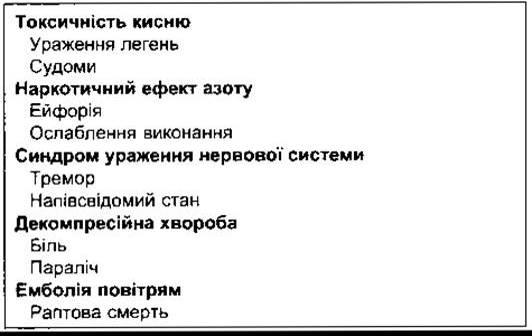
The Treatment for this condition is recompression in a hyperbaric chamber followed by controlled, gradual decompression. Recompression is frequently lifesaving. Full recovery is often difficult, and residual neurological deficits may persist due to irreversible damage to The Nervous System.
It should be noted that ascending in an airplane is equivalent to ascending from an underwater dive. Decompression during an ascent from sea level to 8,550 m in an unpressurized aircraft cabin (where pressure drops from 1 to 0.33 atmospheres) is identical to surfacing from a depth of 20 m in the ocean (where pressure drops from 3 to 1 atmosphere). Rapid ascent in either scenario can precipitate decompression sickness.
Air Embolism
If a diver breathing from a pressurized cylinder holds their breath while swimming underwater and suddenly ascends to the surface (which may happen during panic or other emergencies), the gas can expand rapidly with sufficient force to rupture the Pulmonary Veins. The resulting entry of air into the Blood Vessels causes an air embolism. Fatal air embolisms can occur during rapid ascents to the sea surface from a depth of as little as 5 m. The consequences of air in the Circulatory system are described in Chapter 30. Naturally, this hazard never occurs in breath-hold divers at the surface who dive and return while still holding their breath, regardless of the depth they reached.
Air embolism can also result from the rapid expansion of gas in the lungs when the external pressure drops abruptly from atmospheric to subatmospheric levels—for instance, if the hull of a pressurized aircraft or spacecraft cabin is breached at high altitude (explosive decompression).
Last update: 10/08/2026
Editorial and Educational Adaptation: This material has been compiled based on the primary/original source text. The project team performed an editorial review, corrected technical inaccuracies, structured sections, and adapted the content for an educational format.
What was processed:
- elimination of formatting defects (OCR errors, structural breaks, corrupted characters);
- editorial organization of content;
- standardization of terminology in accordance with academic sources;
- verification of factual statements against the original source text.
All mentions of the author, publication year, and origin of the primary text have been preserved in accordance with the source.