MEDICAL BIOLOGY, HUMAN ANATOMY, PHYSIOLOGY AND PATHOLOGY - Ya.I. Fedoniuk 2010
ANATOMY, PHYSIOLOGY, PATHOLOGY
SECTION 3. ANATOMICAL AND PHYSIOLOGICAL ASPECTS OF BODY FUNCTION SELF-REGULATION
ENDOCRINE GLANDS AND THEIR PATHOLOGY
ADRENAL GLANDS
1. STRUCTURE AND FUNCTIONS OF THE ADRENAL GLANDS
The Adrenal Glands (glandulae suprarenales) are located in the retroperitoneal space just above the upper pole of each Kidney, at the level of the 11th-12th thoracic vertebrae (Fig. 3.74). The mass of a single gland is 12-13 g. Externally, each Adrenal gland is covered by a fibrous capsule. The cortex lies directly beneath the fibrous capsule, while the medulla is located in the center of the adrenal gland.
Class="center">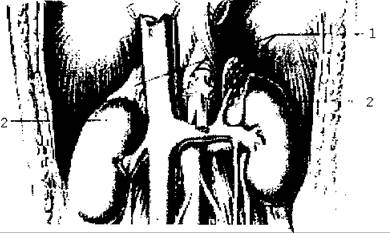
Fig. 3.74. Adrenal gland: 1 - adrenal gland; 2 - kidney.
The cortical and medullary layers of the adrenal glands can be viewed as distinct Endocrine glands that produce different Hormones, perform different Functions, and operate under different regulatory mechanisms.
Surgical removal of the adrenal glands leads to the rapid death of the animal.
The adrenal cortex consists of three zones: the zona glomerulosa, zona fasciculata, and zona reticularis, which produce three groups of hormones: mineralocorticoids, glucocorticoids, and Sex Hormones. Chemically, these are Steroids, and their synthesis requires Cholesterol and ascorbic acid.
Glucocorticoids include cortisone, corticosterone, and hydrocortisone. The Physiological effects of glucocorticoids are highly diverse. They regulate protein, fat, and Carbohydrate METABOLISM in the body, specifically promoting Protein Catabolism, mobilizing Lipids from adipose tissue, and exerting an antagonistic effect to Insulin.
Glucocorticoids are clinically used to treat patients with severe inflammatory conditions due to their ability to suppress The Development of the inflammatory process.
They also exhibit immunosuppressive properties by inhibiting antibody production. This effect is utilized in the Treatment of allergic disorders (such as Bronchial Asthma, rheumatism, and anaphylactic Shock). Furthermore, they act as adaptive hormones; by supporting muscular activity and Brain performance, they help the body adapt to adverse environmental stimuli (emotional stress, abrupt Temperature fluctuations, oxygen deprivation, etc.).
Mineralocorticoids (such as aldosterone) regulate the body's Water and Electrolyte balance. They enhance the reabsorption of Na+ and, consequently, water in the distal tubules of the renal nephrons, while facilitating the counter-transport of K+ and H+.
Aldosterone regulates Blood pressure by mediating its effects through increased vascular tone or expanded fluid volume.
Sex hormones (androgens, estrogens, and progesterone) promote the development of reproductive Organs and the appearance of secondary sexual characteristics during childhood. In males, these include the growth of facial and body Hair, voice deepening, and changes in body shape, psyche, and behavior. In females, they stimulate mammary gland development, localized body hair growth, and changes in body contours, psyche, and behavior.
Additionally, estrogens possess strong anti-atherosclerotic properties, whereas androgens stimulate Protein Synthesis, contributing to an increase in body and organ mass.
The Synthesis and Secretion of hormones by the adrenal cortex are regulated by the hypothalamic-pituitary system via the release of ACTH (adrenocorticotropic hormone).
Hypofunction of the adrenal cortex leads to bronze Skin disease (also known as Addison's disease).
The adrenal medulla produces catecholamines: adrenaline (80%) and noradrenaline (20%). The physiological effects of adrenaline resemble the action of the sympathetic Nervous system. Specifically, adrenaline increases Heart rate and stroke volume, elevates Cardiac Output, and enhances the conductivity and excitability of the myocardium. It constricts Blood Vessels everywhere except in The Heart, brain, and active skeletal Muscles, where it causes vasodilation. Arteriolar constriction results in elevated blood pressure. Adrenaline inhibits gastrointestinal secretion, motility, and absorption, while relaxing bronchial smooth Muscle to cause bronchodilation, which makes it effective in treating bronchial asthma. It also improves Skeletal Muscle performance by enhancing their trophic supply. A fatigued muscle recovers its working capacity much faster under The Influence of adrenaline.
Adrenaline causes contraction of the radial Muscles of the iris, thereby dilating the pupils. This explains why strong emotions (such as anger, fear, or joy) or intense pain cause human pupils to dilate, giving rise to the saying: "Fear has big eyes."
Adrenaline significantly impacts carbohydrate, lipid, and Protein metabolism. It promotes The conversion of hepatic Glycogen into glucose. During emotional stress, it can trigger adrenaline-induced hyperglycemia, characterized by an elevated Blood Glucose Level.
Adrenaline exerts a lipolytic effect, raising the concentration of Fatty acids in the blood, which are then utilized as an additional energy source for thermogenesis in the body. Basal metabolism can increase by up to 30% under the influence of adrenaline.
Last update: 08/08/2026
Editorial and Educational Adaptation: This material has been compiled based on the primary/original source text. The project team performed an editorial review, corrected technical inaccuracies, structured sections, and adapted the content for an educational format.
What was processed:
- elimination of formatting defects (OCR errors, structural breaks, corrupted characters);
- editorial organization of content;
- standardization of terminology in accordance with academic sources;
- verification of factual statements against the original source text.
All mentions of the author, publication year, and origin of the primary text have been preserved in accordance with the source.