Basics of Evolution - Korzh O.P. - 2006
Part III. PATHS OF LIFE EVOLUTION
Chapter 20. Main Stages of Multicellular Animal Evolution
20.4. Evolution of the Body Cavity
The primary body cavity emerges in Roundworms: mesenchyme disappears in them, and the space between the gut and the Skin-Muscle sac (gaps between Internal Organs) is occupied by the primary body cavity. This cavity is filled with fluid, whose considerable pressure acts as a Skeleton. Since circular Muscles are absent, these animals can perform only serpentine movements.
Pseudocoelomate worms are characterized by a constancy of the general body plan and Cell composition. Epidermal Cells are integrated into a syncytium, beneath which lies a single layer of longitudinal muscle fibers. The body is unsegmented; respiratory and circulatory systems are absent; the Digestive System features a hindgut and an anus. The excretory system is either absent or of the protonephridial type, and may be represented by cutaneous glands. The Nervous System is structured similarly to that of Flatworms (orthogon). Unlike flatworms, true roundworms are primarily dioecious animals. Despite a rather simple Organization, pseudocoelomates are very widespread organisms that are relatively well adapted to A wide variety of habitats. Many of them become parasitic forms, complicating their life cycle, and sometimes acquiring Hermaphroditism and Morphology/12.html">ALTERNATION OF GENERATIONS.
It is believed that this phylum is phylogenetically related to flatworms, as evidenced by the presence of certain Features of the latter in various classes of pseudocoelomates. The nervous system of nematodes is nearly identical to that of turbellarians. The Pharynx in primitive pseudocoelomate classes has the same Structure as that of rhabdocoel turbellarians. The Location OF THE Mouth at the anterior end of the body (as in all pseudocoelomates) is characteristic of Representatives of the order Rhabdocoela. The Reproductive System has no significant structural differences, except for hermaphroditism. Another common feature of round and flatworms should be considered the presence of ciliated body areas in primitive rotifers and gastrotriches.
The coelom is a secondary body cavity, which mainly consists of vesicles filled internally with coelomic fluid. With The Development of the coelom, the primary body cavity undergoes reduction and is displaced by the latter.
There are several theories regarding the Water/144.html">Origin of the coelom:
1. Schizocoel theory: the coelom of Annelids is an enhancement of the schizocoel of pseudocoelomate animals. This theory does not explain why, during Embryogenesis in many animals, the coelom is formed from the gut wall.
2. Myocoel theory (a variation of the previous one): the coelom arises as a body cavity within the muscle primordium, which is then filled with fluid. Therefore, according to this theory, the coelom initially performed a supportive function (Other Functions of the secondary body cavity are not explained).
3. Gonocoel theory suggests that the coelom originates from the Gonads of lower worms: the cavity of each coelomic
vesicle corresponds to the cavity of a turbellarian or nemertean gonad. Thus, the peritoneal epithelium is derived from the walls of the reproductive glands (it is further hypothesized that some Germ Cells transform into somatic cells, which, in our opinion, is rather questionable).
4. Enterocoel theory: the coelom originates from the gastrovascular cavity of Coelenterates and ctenophores, which can be considered distant ancestors of coelomate animals. It is this theory that is considered the most acceptable, as it explains the reproductive function of the coelom (incorporates the gonocoel theory) and is confirmed by the course of coelom development in certain animals, particularly deuterostomes.
Annelids are the first to exhibit true body metamerism, which can be traced in their external and internal structure, although primitive ciliated worms also possessed such features. The body segmentation of primitive annelids is homonomous, whereas specialized forms exhibit heteronomy.
Some scientists (in particular, V.N. Beklemishev) associate THE ORIGIN OF annelids with ctenophores, relying on the commonality of certain stages of their development. Other theories also exist, such as the "turbellarian" and "nemertean" theories.
Unspecialized polychaete forms are characterized by The process of cephalization: the first few segments form the HEAD region. One of the arromorphic features of annelids is The Emergence of bilobed outgrowths—parapodia—which function in locomotion and, in some forms, facilitate gas exchange (forming gills). These animals also develop a Circulatory system, which lacks a formed Heart yet and is primarily closed. Overall, these animals are characterized by the process of oligomerization of organs and structures, which is most profoundly traced in leeches.
The most numerous phylum in terms of species composition, and not only among animals, is the phylum Arthropoda, which numbers over 1.5 million species (it is theoretically assumed that the actual number of species exceeds several million). Its representatives have mastered all habitats on Earth, and a broad adaptive radiation is observed in every Class. Phylogenetically, Arthropods are derived from primitive annelids, yet they possess several significant arromorphic features.
The lateral body appendages of annelids (unsegmented parapodia) transform in arthropods into jointed appendages—arthropods!—which consist of several tubular segments connected by joints. They can transform into Sensory Organs (antennae), PARTS OF THE mouthparts (mandibles, maxillae, chelicerae, pedi-
palps, etc.), locomotory appendages (swimming and walking legs), or copulatory organs. It is precisely such appendages that enable the high adaptive capacity of arthropods.
The excretory system of these animals consists of modified coelomoducts (coxal glands) or Malpighian tubules. This allows representatives of this phylum to occupy various ecological niches much more effectively.
The formation of appendages built on THE PRINCIPLE OF levers, and a significant increase in the overall level of organization of arthropods, become possible precisely due to the formation of an external skeleton—the cuticle. This structure begins to play a special role after individual groups, particularly myriapods and insects, transition to a terrestrial lifestyle. In this case, The problem of water conservation by the Organism becomes acute. Therefore, a new, extremely thin outer layer emerges in the cuticle, consisting of waterproof wax-like and fat-like substances.
In most arthropods, the processes of cephalization continue—the head tagma consists of the acron and four (some believe five) segments. The Progressive development of the nervous system allows arthropods to transition to a fundamentally new level of development—social (observed in social insects).
These and other features have elevated the functional organization of arthropods so high that in terms of species diversity they significantly exceed all other animal groups and have formed a considerable number of specialized forms. However, the rigid external skeleton and high speed of movement largely limit the overall size of arthropods, the largest representatives of which were eurypterids (sea scorpions) about 1.8 m long.
The origin of the most numerous animal phylum remains largely a mystery. Most specialists agree that the ancestral group for arthropods should be considered some primitive polychaetes (Fig. 20.2), but regarding the detailed unfolding of events, at least two scenarios can be proposed.
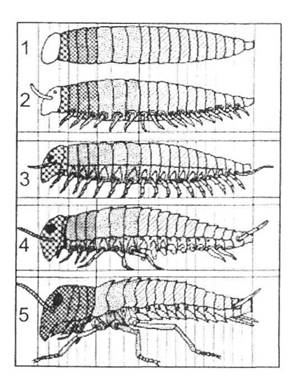
Fig. 20.2. Scheme of arthropod evolution from worm-like ancestors to insects according to R. Snodgrass's hypothesis (after M.S. Gilyarov, 1984):
1 - segmented Precambrian worm without appendages; 2 - myriapod-like form resembling the embryo of onychophorans, myriapods, and insects; 3 - myriapod-like form; 4 - transitional form from myriapods to lower insects; 5 - insects
According to one hypothesis, marine polychaetes transitioned to land, causing their parapodia to shift to the ventral side of the body and transform into unjointed legs (similar structures are found in Onychophora). Further adaptation to terrestrial conditions led to the development of jointed appendages, mouthparts, and other arthropod characteristics, giving rise to myriapods (Myriapoda) and subsequently insects (Insecta). In this scenario, other arthropods (Trilobitomorpha, Crustacea, Chelicerata) descended from annelids independently of the aforementioned groups.
Under an alternative scenario, polychaetes gave rise to trilobite-like forms whose appendages became segmented not due to a terrestrial lifestyle, but as an adaptation to benthic habitats. This limb structure was preserved in their descendants—the crustaceans—and, following the transition to land, in myriapods and insects as well. However, evidence suggests the independent Evolution of the tracheal system, limb formation, cephalization, and certain other features in some arthropod lineages. Therefore, it has been proposed to distinguish at least two phylogenetically independent branches among arthropods: Mandibulata and Namandibulata. Overall, the developmental characteristics of arthropods, even within small systematic groups (especially insects), exhibit such striking diversity that a rapid resolution to all problems concerning their phylogenetic relationships should not be expected.
Mollusca (Mollusks), one of the most widespread animal phyla, can also be classified among highly developed invertebrates. According to one hypothesis, they originated from annelids, a view supported by the Discovery of the mollusk Neopilina (Neopilina galatheae and other species), which retains primitive organizational traits linking them to annelids—namely, a well-developed coelom, and retained segmentation in the arrangement of nephridia, gills, and musculature. Later, these structures virtually disappeared in mollusks: their coelom underwent reduction (persisting only around The Heart and gonad cavities), and body segmentation was completely lost. The most distinctive feature of all mollusks is the development of a specialized organ, the FOOT, which facilitates crawling and swimming (in cephalopods, it is divided into several tentacles).
The ancestral group of mollusks evidently lacked a true shell (which emerged as early as the Ediacaran period), possessed a lower-profile body, and led a more active lifestyle compared to Neopilina. Two main mollusk branches, Aplacophora (Amphineura) and Conchifera, diverged from this hypothetical ancestor at a very early stage.
The vast majority of mollusks are aquatic, yet pulmonate gastropods successfully colonized land by developing protective mechanisms against desiccation, such as specialized mucus that seals the aperture of the shell. Cephalopods possess the most highly developed Brain of any mollusk group. In terms of nervous system complexity and the capacity for conditioned Reflexes, they are comparable to vertebrates.
Last update: 07/08/2026
Editorial and Educational Adaptation: This material has been compiled based on the primary/original source text. The project team performed an editorial review, corrected technical inaccuracies, structured sections, and adapted the content for an educational format.
What was processed:
- elimination of formatting defects (OCR errors, structural breaks, corrupted characters);
- editorial organization of content;
- standardization of terminology in accordance with academic sources;
- verification of factual statements against the original source text.
All mentions of the author, publication year, and origin of the primary text have been preserved in accordance with the source.