Basics of Evolution - Korzh O.P. - 2006
Part III. PATHS OF LIFE DEVELOPMENT
Chapter 20. Main Stages of Multicellular Animal Evolution
20.5. Origin of Deuterostomes
THE ORIGIN OF Chordates—the most highly organized phylum of deuterostomes—still generates a multitude of theories and hypotheses today. It is widely believed that we need to develop theories explaining the Water/144.html">Origin of the entire deuterostome group, rather than just individual phyla. Some scientists see the solution to this problem in deriving them from primitive Metazoa. However, the presence of shared organizational traits (such as the coelom, mesoderm, and similarities across nearly all Organ Systems) in both protostomes and deuterostomes indicates that these features could not have been acquired through convergence.
Several theories regarding The Emergence of chordates were already put forward in the 19th century. According to one of them, Annelids were considered the ancestors of this group, as both share bilateral Symmetry, body segmentation, a Central Nervous system consisting of a Brain and a longitudinal nerve cord, and a predominantly active lifestyle. Yet, in other respects, these animals are vastly different: segmentation in vertebrates is limited to a portion of the mesoderm, the nerve cord in annelids is located on the ventral side of the body whereas in vertebrates it is dorsal, and annelids lack a notochord and gill slits. To overcome these contradictions, proponents of this theory suggested that the animal underwent a dorsoventral flip, causing the organ systems to shift accordingly. However, imagining this as a reality is quite far-fetched.
Arachnids have also been proposed as the ancestors of vertebrates. This hypothesis was based on the morphological resemblance between the carapace of fossil eurypterids (which belong to arachnids) and the bony armor of certain fossil fish. Nevertheless, arachnids also possess a ventral nerve cord, meaning they too would have had to "flip over." This contradicts earlier assumptions, as the similarities between these animals are preserved only on the dorsal and ventral sides of the body and would disappear upon inversion. An additional problem is the jointed Structure of their appendages, which could not have transformed into fish fins (requiring the prior disappearance of these limbs). Furthermore, arachnids lack a notochord and gill slits. Thus, representatives of this group would first have had to lose all their characteristic features before turning into chordates. A modified version of this theory was proposed to resolve some of these contradictions, suggesting that the complex Digestive System of arachnids gave rise to The Nervous System of vertebrates, while a new digestive system subsequently emerged independently. However, there are no grounds to assume such a shift in Functions.
Today, two main viewpoints regarding the origin of deuterostomes are the most widespread. According to these, the animals descend from different ancestral forms, resulting in phylogenetic trees that are constructed in nearly opposite ways. Under one theory (favored by foreign specialists), the ancestor of deuterostomes was a sessile benthic form that fed on nutrient particles captured using lophophores (Fig. 20.3). Through The Development of specialized Organs, this ancestor gave rise to Echinoderms, which in turn spawned hemichordates. The development of chordate traits began with A change in feeding habits: food capture via lophophores was replaced by a filtration mechanism through gill slits (with the hemichordate group viewed as a side branch along this path).
Class="center">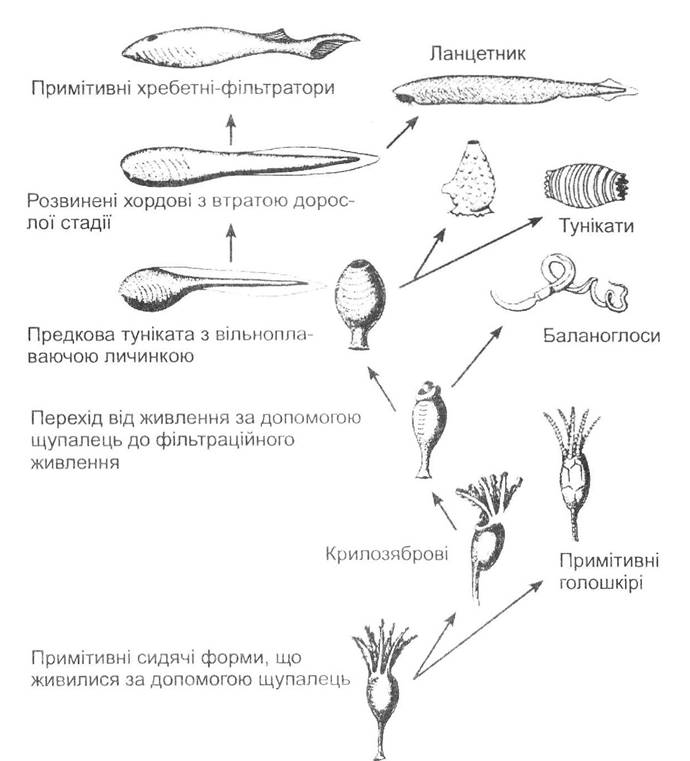
Fig. 20.3. Diagram of the hypothetical evolutionary pathway of vertebrates (after A. Romer and T. Parsons, 1992)
The further development and refinement of the Pharynx as a food-gathering apparatus led to the emergence of true tunicates (Tunicata), in which the adult animal is a specialized water-filtering device. At the same time, the larvae of these sessile animals are capable of free movement in search of a site for attachment and subsequent metamorphosis (serving a dispersal function). The appearance of such a larva gave rise to a motile lifestyle, opening up new opportunities for chordate animals. Conservative forms gave birth to modern tunicates, while progressive ones, through neoteny, transformed into amphioxus-like animals. The existence of appendicularians—which are indeed neotenic animals, though more advanced in their development than amphioxus—is considered confirmation of this idea.
In our view, this theory has certain contradictions. First, echinoderm larvae exhibit bilateral symmetry, meaning their radial symmetry is secondary. This indicates that they are highly specialized. Second, tunicates, unlike echinoderms, lack radial symmetry. Third, almost all tunicates possess a bilaterally symmetrical larva that is developmentally much more advanced than those of acraniates. Therefore, this theory cannot be considered a successful explanation for the origin of deuterostomes.
According to another hypothesis, developed by A.N. Severtsov, I.I. Schmalhausen, and others, vertebrates are derived from enteropneusts, of which *Balanoglossus* is a striking example.
The most important feature linking this animal to chordates is its respiratory apparatus (the pharynx contains several gill slits supported by an elastic lattice-like Skeleton). In addition, the gut is nearly a straight tube, the Circulatory system consists primarily of dorsal and ventral vessels, the nervous system bears some resemblance to that of vertebrates, and There is a structure that can be considered a rudimentary notochord. At the same time, certain features unite this group with annelid worms (Fig. 20.4).
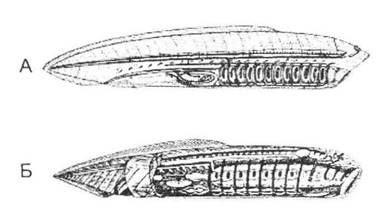
Fig. 20.4. Hypothetical ancestral forms of vertebrates (after A.N. Severtsov, 1945):
A – hypothetical ancestor of chordates; B – primitive craniate vertebrate
Since protostomes and deuterostomes diverged quite early in the course of evolution, their common ancestors should be considered primitive worms akin to turbellarians. More detailed information about their direct ancestors is currently unknown. Enteropneusts, echinoderms, and chordates split from a common trunk, with the former remaining virtually unchanged throughout evolution and staying as close as possible to the ancestral deuterostome forms.
The evolution of echinoderms is largely tied to their specialization (limited mobility), leading to the acquisition of radial symmetry, the loss of the coelom, and so on. The Transformation of a bilateral larva into a radially symmetric adult form is no longer characteristic of any other animal group. The majority of echinoderms are motile animals with their oral surface turned toward the substrate. However, sea lilies are sessile organisms (attached to the substrate by a stalk or cirri), with their Mouth located on the upper surface of the calyx. It is believed that all echinoderms originally fed on plankton and other small particles, which dictated their radial symmetry and low mobility. Later, some became predators and adopted a more active lifestyle.
None of the modern forms can be considered the direct ancestor of contemporary animals, and a fossil form that could have given rise to chordates has not yet been discovered.
If we venture an assumption, the hypothetical ancestor of chordates should be considered a representative of acraniates, which in their Organization approach modern amphioxus. It was they that gave rise to all other chordates, whereas tunicates and modern acraniates underwent significant specialization and simplification of their organs (representing evolutionary dead ends).
Last update: 07/08/2026
Editorial and Educational Adaptation: This material has been compiled based on the primary/original source text. The project team performed an editorial review, corrected technical inaccuracies, structured sections, and adapted the content for an educational format.
What was processed:
- elimination of formatting defects (OCR errors, structural breaks, corrupted characters);
- editorial organization of content;
- standardization of terminology in accordance with academic sources;
- verification of factual statements against the original source text.
All mentions of the author, publication year, and origin of the primary text have been preserved in accordance with the source.