LEHNINGER PRINCIPLES OF BIOCHEMISTRY - VOL. 1. THE FOUNDATIONS OF BIOCHEMISTRY: STRUCTURE AND CATALYSIS - 2011
PART I. STRUCTURE AND CATALYSIS
8. NUCLEOTIDES AND NUCLEIC ACIDS
8.4. Other Functions of Nucleotides
Beyond their role as monomers of Nucleic Acids, NUCLEOTIDES serve a variety of other vital cellular Functions: acting as energy carriers, components of enzyme Cofactors, and chemical signaling molecules.
Nucleotides Carry Chemical Energy in Cells
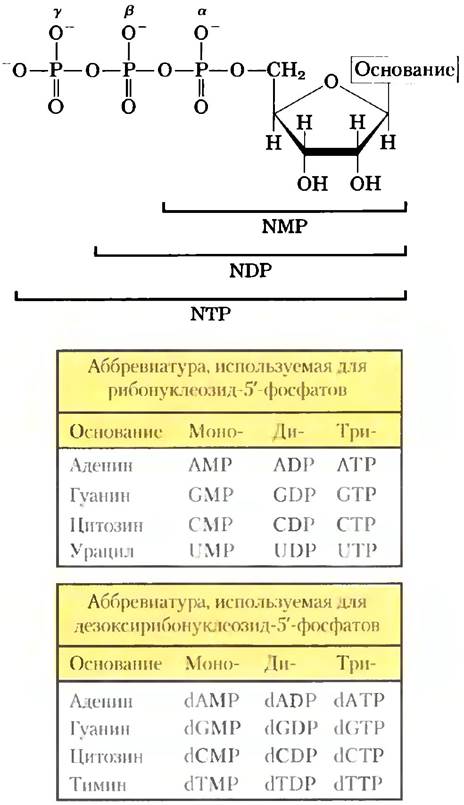
One or two additional phosphate groups can be attached to the phosphate group covalently linked to the 5'-hydroxyl group of a ribonucleotide. The resulting molecules are termed nucleoside mono-, di-, or triphosphates (Fig. 8-36). Starting from the ribose, the three phosphates are conventionally designated α, β, and γ. The Hydrolysis of nucleosidetriphosphates provides the chemical energy required to drive A wide variety of cellular reactions. Adenosine 5'-triphosphate (ATP) is most commonly used for this purpose in The Cell, but UTP, GTP, or CTP also serve as Energy Sources in specific reactions. Nucleosidetriphosphates are likewise utilized as activated precursors in the synthesis of DNA and RNA, as detailed in chapters 25 and 26.
Class="center">Fig. 8-36. Nucleoside phosphates. General Structure of nucleoside 5'-mono-, di-, and triphosphates (NMP, NDP, and NTP) and their standard Abbreviations. In deoxynucleoside phosphates (dNMP, dNDP, dNTP), the pentose sugar is 2'-deoxy-D-ribose.
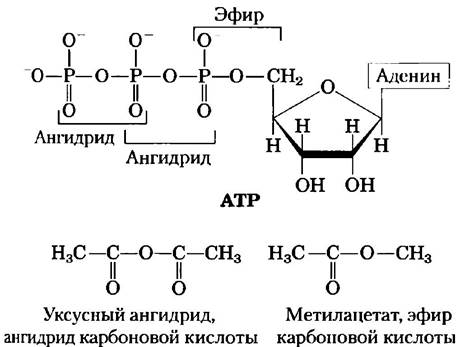
The release of energy during the hydrolysis of ATP and other nucleosidetriphosphates is attributable to The structure of the triphosphate group. Ribose and the α-phosphate are joined by an ester linkage, whereas the α and β, as well as β and γ phosphates, are linked by phosphoanhydride bonds (Fig. 8-37). Under standard conditions, the hydrolysis of the ester bond yields about 14 kJ/mol of energy, whereas the hydrolysis of each phosphoanhydride bond yields about 30 kJ/mol. ATP hydrolysis frequently plays a critical thermodynamic role in biosynthetic processes. When ATP hydrolysis is coupled with a reaction whose free-energy change is positive, it drives the overall process toward product formation (recall the relationship between the Equilibrium Constant and free-energy change (Equation 6-3 on p. 276)).
Fig. 8-37. Phosphoester and phosphoanhydride bonds in the ATP molecule. Hydrolysis of the anhydride bond releases more energy than hydrolysis of the ester bond. For comparison, a carboxylic acid anhydride and a carboxylic acid ester are also shown.
Adenine Nucleotides Are Components of Many Enzyme Cofactors
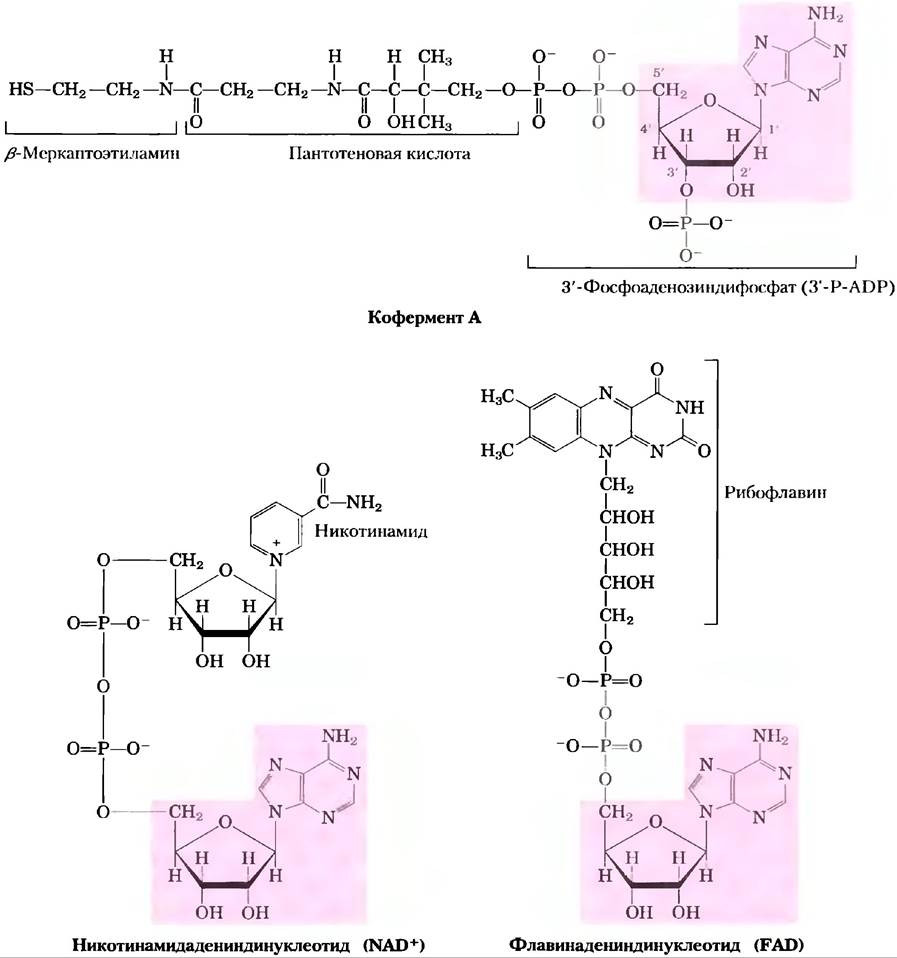
Adenosine is an integral part of several enzyme cofactors that participate in a broad spectrum of diverse reactions (Fig. 8-38). Structurally, these cofactors bear little resemblance to one another, except for the presence of a common adenosine moiety. In none of these cofactors does the adenosine portion directly participate in the chemical reaction itself, yet its removal drastically diminishes cofactor activity. For instance, the removal of the adenine nucleotide (3'-phosphoadenosine diphosphate) from acetoacetyl-CoA, a derivative of coenzyme A and acetoacetate, reduces its reactivity as a substrate for β-ketoacyl-CoA transferase (an enzyme involved in Lipid METABOLISM) by a factor of 106. Although the exact reason for the necessity of adenosine remains unclear, it is thought to influence the binding energy between the substrate (or cofactor) and the enzyme, which impacts both catalysis and the stabilization of the enzyme-substrate complex (Chapter 6). In the case of β-ketoacyl-CoA transferase, the nucleotide portion of coenzyme A acts as a "handle" that guides the substrate (acetoacetyl-CoA) into the Active Site. The nucleoside components of other nucleotide-containing cofactors serve similar anchoring functions.
Fig. 8-38. Selected Coenzymes containing adenosine. The adenosine group is highlighted with a pink box. Coenzyme A (CoA) functions as An acyl group carrier; the acyl group (such as acyl or acetoacetyl) is attached to CoA via a thioester bond to the β-mercaptoethylamine moiety. NAD+ participates in hydrogen transfer, whereas FAD, the active form of vitamin B2 (riboflavin), functions in electron transfer. Another adenosine-containing coenzyme is 5'-deoxyadenosylcobalamin, the active form of vitamin B12 (see Box 17-2), which is involved in intramolecular rearrangements between adjacent carbon atoms.
Why do these structures employ adenosine rather than some other large molecule? One plausible explanation is rooted in evolutionary economy. Adenosine is certainly not a unique compound in terms of contributing potential energy to intermolecular binding. The Importance of adenosine likely lies not so much in any unusual chemical properties as in the evolutionary advantage of utilizing a single compound to fulfill multiple tasks. Once ATP emerged as the universal source of chemical energy and ATP-synthesizing systems became more widespread than those for other nucleotides, the pervasive availability of adenosine led to its incorporation into various other molecules. This economy extends to protein architecture as well. A single protein domain with the requisite properties is sufficient for binding adenosine across a wide variety of Enzymes. Such a domain, termed the nucleotide-binding motif, is found in numerous enzymes that bind ATP and nucleotide cofactors.
Certain Nucleotides Can Function as Signaling Molecules
Cells respond to environmental conditions by perceiving signals from Hormones or other external chemical stimuli. The interaction between these extracellular chemical agents ("primary messengers") and cell-surface receptors invariably triggers the intracellular generation of second messengers, which in turn elicit adaptive intracellular changes (Chapter 12). Nucleotides frequently serve this role as second messengers (Fig. 8-39). One of the most ubiquitous is cyclic 3',5'-adenosine monophosphate (cyclic AMP, cAMP), which is synthesized from ATP in a reaction catalyzed by adenylate cyclase, an enzyme bound to the inner surface of The Plasma Membrane. Cyclic AMP exerts regulatory functions in virtually every cell type except plants. Cyclic 3',5'-guanosine monophosphate (cGMP) is also found in many cells and similarly performs regulatory roles.
Fig. 8-39. Three signaling nucleotides.

Another signaling nucleotide, ppGpp (Fig. 8-39), is produced in bacterial cells in response to a depressed rate of Protein Synthesis during amino acid starvation. This nucleotide inhibits the synthesis of rRNA and tRNA molecules (see Fig. 28-24) required for protein synthesis, thereby preventing the wasteful production of nucleic acids.
Summary of Section 8.4 Other Functions of Nucleotides
■ ATP plays a central role in chemical energy transfer processes within cells. Adenosine can also provide the energy required for chemical bond formation when incorporated into certain enzyme cofactors.
■ Cyclic AMP, produced from ATP in a reaction catalyzed by adenylate cyclase, acts as a classic second messenger synthesized by the cell in response to hormones and other external chemical signals.
Last update: 06/08/2026
Editorial and Educational Adaptation: This material has been compiled based on the primary/original source text. The project team performed an editorial review, corrected technical inaccuracies, structured sections, and adapted the content for an educational format.
What was processed:
- elimination of formatting defects (OCR errors, structural breaks, corrupted characters);
- editorial organization of content;
- standardization of terminology in accordance with academic sources;
- verification of factual statements against the original source text.
All mentions of the author, publication year, and origin of the primary text have been preserved in accordance with the source.