BIOCHEMISTRY - L. Stryer - 1984
VOLUME 1
PART I. CONFORMATION AND DYNAMICS
CHAPTER 8. ZYMOGEN ACTIVATION: DIGESTIVE ENZYMES AND BLOOD CLOTTING FACTORS
8.5. An acyl group is attached to an unusually reactive serine residue on the enzyme
The site of attachment of the acyl group to the enzyme was determined when the intermediate E-P2, which is stable at pH 3, was isolated in pure form. It turned out that the acyl group is attached to the oxygen atom of a specific Serine residue, namely serine-195. This serine residue exhibits an unusually high reactivity. It can be specifically labeled with an organic fluorophosphate, such as diisopropyl fluorophosphate (DIPF), which reacts exclusively with serine-195 to yield an inactive, highly stable diisopropylphosphoryl-enzyme complex (Fig. 8.11). The enhanced reactivity of serine-195 is clearly demonstrated by the fact that the other 27 serine residues in Chymotrypsin do not react with DIPF.
Class="center">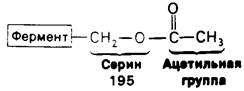
Fig. 8.11. Diisopropyl fluorophosphate (DIPF) inactivates chymotrypsin by forming a diisopropylphosphoryl derivative of serine-195

Chymotrypsin is not the only enzyme inactivated in the presence of DIPF. Many other Proteolytic Enzymes, such as Trypsin, Elastase, Thrombin, and subtilisin, react specifically with DIPF, completely losing their activity. As with chymotrypsin, the reaction of these enzymes with DIPF occurs at only a single serine residue. Hence, their common name is Serine proteinases. DIPF also reacts with a serine residue in acetylcholinesterase, an enzyme that plays a key role in the transmission of nerve impulses at certain synapses. As already mentioned in Chapter 6, the ability of DIPF to inactivate acetylcholinesterase underlies its use in insecticides and nerve gases.
8.6. The involvement of histidine-57 in catalysis is revealed by affinity labeling
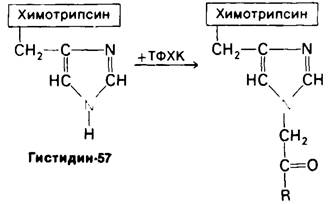
The involvement of a second amino acid residue in catalysis was established using an affinity label (or affinity labeling). The method consists of adding to chymotrypsin a substance that (1) specifically binds to the Active Site due to its similarity to the substrate, and then (2) forms a stable covalent bond with a nearby group on the enzyme. Such a substance is tosyl-L-phenylalanine chloromethyl ketone (TPCK), The Structure of which is shown in Fig. 8.12. The presence of the phenylalanine side chain in TPCK ensures its specific binding to chymotrypsin. The reactive group of TPCK is chloromethyl ketone. TPCK attacks chymotrypsin exclusively at Histidine-57, alkylating one of the nitrogen atoms of the histidine ring (Fig. 8.13). The TPCK derivative of chymotrypsin is devoid of enzymatic activity. There are three arguments in favor of the presence of histidine-57 in the Active Site of the enzyme. First, the affinity label is highly stereospecific: the D-isomer of TPCK is completely ineffective. Second, the presence of beta-phenylpropionate, a competitive inhibitor of chymotrypsin, inhibits the reaction with TPCK. Third, The rate of chymotrypsin inactivation upon addition of TPCK shows approximately the same pH dependence as the rate of catalysis.
Fig. 8.12. Structure of tosyl-L-phenylalanine chloromethyl ketone (TPCK), used as an affinity label for chymotrypsin (R-tosyl group)
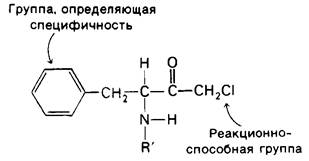
Fig. 8.13. Alkylation of histidine-57 in chymotrypsin by TPCK
8.7. A charge-relay system provides proton shuttling during catalysis
The catalytic activity of chymotrypsin is determined by the unusually high reactivity of serine-195. Under physiological conditions, the —CH2OH group
is normally inert. Why, then, does its reactivity increase so dramatically in the active site of chymotrypsin? This can be explained based on the results of X-ray crystallographic studies of the three-dimensional STRUCTURE OF THE enzyme. As could have been anticipated from the affinity labeling results, histidine-57 is located in close proximity to serine-195. The carboxyl group of the aspartate-102 side chain is also nearby (Fig. 8.14).
Fig. 8.14. Conformation of the charge-Relay system in chymotrypsin
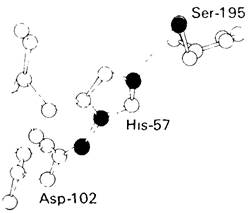
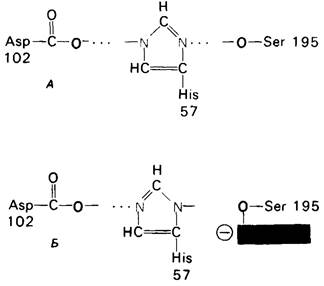
In essence, the catalytic power of chymotrypsin is due to the interaction of these three residues. Aspartate-102 forms a Hydrogen bond with histidine-57, which in turn is hydrogen-bonded to serine-195. These three residues constitute a charge-relay system. As shown in Section 8.9, this system plays a key role in catalysis due to its ability to bind a proton (Fig. 8.15). The carboxylate ion of aspartate-102, buried within the molecule, polarizes the imidazole ring of histidine-57, thereby increasing its ability to shuttle a proton. Furthermore, aspartate-102 and histidine-57 are positioned such that they accept the proton of the serine-195 hydroxyl group during the nucleophilic attack on the substrate by the oxygen atom.
Fig. 8.15. The charge-relay system in chymotrypsin: A - enzyme without substrate; B - upon addition of substrate, transient proton binding by aspartate-102 and histidine-57 occurs
Last update: 06/08/2026
Editorial and Educational Adaptation: This material has been compiled based on the primary/original source text. The project team performed an editorial review, corrected technical inaccuracies, structured sections, and adapted the content for an educational format.
What was processed:
- elimination of formatting defects (OCR errors, structural breaks, corrupted characters);
- editorial organization of content;
- standardization of terminology in accordance with academic sources;
- verification of factual statements against the original source text.
All mentions of the author, publication year, and origin of the primary text have been preserved in accordance with the source.