BOTANY, VOLUME 4 - ECOLOGY - 2007
13. PLANTS WITHIN THEIR HABITAT SPACE
13.6. Nutrient Budget
Plant nutrients, with the exception of those contained in Water and CO2, are divided into two groups: the so-called mineral nutrients, or elements originating directly from the parent inorganic material of the soil (or from atmospheric dust), and nitrogen, which originates from the atmosphere but ultimately ends up in the same soil solution as the actual mineral nutrients during nutrient cycling. Nitrogen in its soluble inorganic (mineral) form (NO-x and NH+4) is also frequently included in METABOLISM/2.html">THE CONCEPT OF mineral nutrients. In the event of a deficiency, any nutrient element can act as a factor limiting plant growth. Primarily, however, these are nitrogen and phosphorus, whose availability in nature is critical. Therefore, this section is primarily dedicated to The Role of these two elements in the ecosystem, especially nitrogen. The Significance of other plant nutrients and the chemical processes underlying The Nitrogen Cycle were discussed in sections 6.2, 6.6, and 9.2.
13.6.1. Availability of Soil Nutrients
The question of how many nutrients are actually available to an individual plant or an entire community pertains not to their content in the soil, but to their availability. Often, only a very small fraction of these substances is present in a form accessible to plants. In artificial substrates (or in hydroponics), availability often corresponds to the concentration of substances in the substrate solution, but this is not the case in systems with natural mineral nutrient cycling and natural growth. Under these conditions, a water Histology/2.html">EXTRACT FROM THE soil yields very little or no indication of actual nutrient availability. The Swedish scientist T. Ingestad proved through nutrient solution experiments that roots are able to extract nutrient salts from solutions of such low concentrations that they lie near the threshold of detection by Traditional Methods. Nevertheless, by continuously varying the quantities of nutrient salts consumed by the plant in the nutrient solution, it is possible to achieve nearly exponential plant growth despite such reduced concentrations.
Thus, extremely important ecological evidence was provided demonstrating that growth rate is determined by the nutrient addition rate, rather than by its concentration in the substrate above relatively low lower limit values. Ingestad demonstrated that using The rate of nutrient supply in a chemostat, one can "set" the growth rate, and if more nutrients are supplied than the plant is able to assimilate, the concentration in the solution increases. These relationships are not equally significant for all mineral nutrients, but the principle itself serves as a starting point for understanding nutrient cycling in nature and at the same time a source of misunderstandings arising when comparing agroecosystems and natural systems. In the former case, meeting demands (for practical reasons) is divided into separate phases, so excess fertilizers enter the soil solution and groundwater. In the latter case, nutrient supply and uptake (essentially biological production via microbial activity) are closely coupled; therefore, abundant growth can occur even when the soil solution is very poor in nutrients and an agricultural soil analysis method would reveal a deficiency of the latter. In experiments, for any given soil at constant moisture and Temperature, the microbe-mediated release of inorganic nitrogen compounds can be accounted for. In this process, the primary products of mineralization in slightly acidic or neutral, well-aerated soils are NO-3 ions, whereas in acidic moder or raw humus soils, NH-4 ions are particularly formed.
The prime example of the close coupling between nutrient release and uptake is the primary tropical rainforests of the Amazon region on ancient, heavily weathered soils, where the runoff water after heavy downpours is close to distilled water in quality. The system is tightly "coupled". Nutrient cycling is thus completely closed, which can be compensated for by potential "gaps" in the system, such as when soil mineral nutrients are enriched by dust particles carried from the Sahara, a fact only recently proven. The close link between mineral nutrient release and uptake is maintained by free-living and symbiotic microorganisms (mycorrhiza). To a certain extent, they act as the "glue" of the system. In a distinctly seasonal climate, this connection is intermittently disrupted because supply and demand are not synchronized. In such cases, neutral nutrient "pools" in the soil (Ion Exchange, complex formation, microbial biomass) play a major role.
The supply of the ecosystem with all elements except nitrogen is ultimately derived from the preserved reserves in the ROOT-penetrated subsoil and biomass, aside from atmospheric dust deposition. If the bulk of these is in the biomass, as in tropical forests, There is a very high risk that after a fire, the entire capital of the system's mineral nutrients—accumulated over millennia—could be lost. Nitrogen supply, by contrast, can be maintained via microbial Nitrogen Fixation from the air, the reserves of which are theoretically inexhaustible (see 9.2.1). However, nitrogen fixers require large quantities of phosphates, which is why phosphorus and nitrogen regimes are interconnected already in this sphere.
In aquatic bodies, the quantity, composition, and seasonal rhythm of development of benthic and planktonic plant organisms depend decisively on the nutrient content of the water, especially nitrogen and phosphorus.
Examples of nutrient-rich eutrophic water bodies with high productivity include: in marine regions—the so-called "green oceans" (especially off the western coasts of continents, such as Peru and West Africa, where winds push away nutrient-poor surface water layers and upwell nutrient-rich deep layers, or in Antarctic and Arctic seas with temperature-driven seasonal water movements), as well as coral reefs, coastal mangroves, tidal flats (watts), and river estuaries (alluvial floodplains) with a good supply of land-derived nutrients; in freshwater regions—lowland lakes with changing water temperatures, with spring and autumn water mixing, or rivers rich in suspended particles. These contrast with nutrient-poor meso- and oligotrophic water bodies with medium or low productivity, such as "blue oceans" without upwelling deep water layers (e.g., PARTS OF THE Mediterranean Sea or the central South Atlantic), cold mountain lakes, dystrophic bog waters (with a high humus content and a pH of 3.5 to 5.0), and cold mountain streams.
In water bodies with fluctuating water temperatures (e.g., in temperate seas and lakes), phytoplankton reaches peak values following spring water turnover due to a good nutrient supply (as well as favorable light and temperature regimes); these values then decline in summer due to nutrient depletion and rise somewhat again during the autumn water Circulation prior to the ESTABLISHMENT OF THE winter low level. As a result of CO2 assimilation, some autotrophic aquatic plants (macrophytes in alkaline freshwaters) form lime deposits (e.g., travertine, lake chalk), whereby poorly soluble calcium carbonate is formed instead of readily soluble calcium bicarbonate:
Са(НСO3)2 —> СаСO3 + Н2O + СO2.
In water bodies rich in organisms and with inadequate water mixing, oxygen-poor or completely oxygen-free deep layers or sapropel deposits often form as a consequence of heterotrophic decomposer activity, in which only a few specialized anaerobic species (especially Bacteria) can survive.
13.6.2. Sources and Sinks of Nitrogen
The nitrogen budget occupies a special place in the mineral nutrient budget. Plants contain roughly 10 times more nitrogen than phosphorus. Nitrogen reserves in Tissues are proportional to protein content. The amount of the latter is roughly calculated by multiplying the percentage of nitrogen by 6.25. Protein concentration in high-temperature-dried tissues ranges between 1% in wood samples and 25% in the leaves of fast-growing herbaceous plants. In the leaves of summer-green trees, its content ranges from 13 to 15% (2 to 2.5% nitrogen), while in evergreen leaves (needles) it is roughly half as much (Table 13.1). In the endosperm of cereal grains, the protein concentration is approximately 13% (i.e., about 2% nitrogen).
Because nitrogen is of fundamental importance in metabolism, nitrogen assays are most frequently performed in ecological studies. Until the late 1980s, the so-called Kjeldahl method predominated, which was based on Digestion in sulfuric acid at a high temperature (320 °C) followed by neutralization with NaOH, simultaneous distillation of the released ammonia, and subsequent titration in a weakly alkaline medium (total nitrogen = Kjeldahl nitrogen). Currently, physical methods (elemental analyzers) are predominantly used. The method of combustion at temperatures above 500 °C in pure oxygen is frequently employed, followed by gas analysis using helium as a carrier gas (e.g., CHN analyzers, which yield element quantities measured as a percentage of the high-temperature-dried sample). The operating cost for these physical methods amounts to a few milligrams of plant powder per analysis.
Class="center">Table 13.1. Nitrogen (N) concentration in leaves and specific leaf area (SLA) for major biomes
Plants / vegetation type |
N, % |
SLA, m2/kg |
Herbaceous plants: |
||
dicotyledonous field crops |
3,8 |
24 |
cereal grains |
3,4 |
25 |
temperate grasslands |
2,6 |
17 |
tropical grasslands Woody plants: |
1,1 |
|
seasonal tropical forest |
2,7 |
14 |
temperate deciduous forest |
2,0 |
12 |
tropical evergreen forest |
1,7 |
10 |
temperate evergreen forest |
1,3 |
6 |
subtropical broad-leaved evergreen forest |
1.1 |
4 |
sclerophyllous bush |
1.1 |
7 |
evergreen coniferous forest |
1,1 |
4 |
Note. Mean N values for 5–40 (mostly around 10) characteristic species (standard errors about +8% for N and ±15% for SLA) are given in % of dry weight, and SLA in m2 of leaf surface area per 1 kg of dry leaf weight.
With the exception of the youngest primitive soils, the majority of the nitrogen required for annual plant growth originates from recycling, i.e., the microbial decomposition of dead plant matter. In the process, reduced forms of nitrogen in well-aerated, moderately acidic, and neutral soils are gradually oxidized (see Nitrosomonas, Nitrobacter) and converted back into nitrates, or leave the system in very small amounts as nitrous oxide N2O or N2 (Fig. 13.16).
Fig. 13.16. Nitrogen in the ecosystem: A — system without anthropogenic nitrogen input, with natural N2 fixation via free-living and symbiotic nitrogen fixation, as well as input of rain-soluble NO oxides from lightning, natural fires, and volcanic phenomena. Nitrogen input and output are nearly balanced; B — ecosystem with a heavily increased nitrogen input from anthropogenic sources. Here it is assumed that the system is already largely saturated with nitrogen and only a small fraction of the additional N is integrated into the nitrogen cycle (biomass growth, increased N pool in humus). The bulk of the nitrogen leaves the system (groundwater, increased greenhouse gas nitrogen emissions). Nitrogen inputs in Fig. B (approximate values based on modern estimates) are for industrial regions. Figures are given in kilograms of N per hectare per year

In very acidic and waterlogged soils, soluble nitrogen is predominantly found in the ammonium form. Recent findings show that free organic nitrogen compounds are accessible to plants even under such conditions (e.g., in the tundra). Atmospheric sources of soluble nitrogen compounds include atmospheric oxidation processes (lightning, fire) and, more recently, anthropogenic NOx compounds from combustion processes. Ammonia from excrement can also be considered a second major atmospheric source. The third source is represented by free-living cyanobacteria, and the fourth by symbiotic systems (see 9.2, root nodule bacteria on legumes, Symbiosis with specialized Fungi). In mature systems (late succession stages), nitrogen fixation from the air to cover annual demand plays a very minor role, even if legumes are present, but It is important for building up a long-term nitrogen pool in the soil. Compared to recycling in weakly anthropogenic ecosystems, all other nitrogen sources are of rather minor importance and merely serve to compensate for potential "gaps" in the system (the aforementioned release of gaseous nitrogen, losses via seepage water and phytophage consumption, and fixation in soil humus). In temperate forests, the annual demand for new nitrogen input under a nitrogen balance compensated over many years amounts to approximately 5–6 kg • ha-1. In Central Europe, anthropogenically induced atmospheric nitrogen deposition amounts to 20–30 kg • ha-1 (up to 100 in extreme cases), which is one of the reasons why so much nitrate is currently detected in groundwater.
A substantial source of mineral nutrients (and nitrogen) is the horizontal transfer of nutrients within the landscape. It can be directional and diffuse. Directional transport includes, for example, the displacement of plant litter from mountaintops into depressions by prevailing winds blowing in specific directions, or the systematic movement of nutrients by animals and humans (e.g., animals moving from clearings into the forest, or historically, The transfer of litter from forests to stables and fields). Diffuse movement results from the higher probability that nutrient-rich particles from a well-supplied system will move into a poorly supplied ("depleted") one rather than vice versa. Over many years, such material flows from "nutrient-rich" areas to "depleted" ones accumulate and form a mosaic of nutrient availability across the landscape.
Many perennial plants grow unevenly and derive a major portion of their nutrients and nitrogen from internal reserves, as seen, for example, during spring SHOOT flushing in regions with cold winters. In such cases, the processes of nutrient investment and consumption are temporally well-separated.
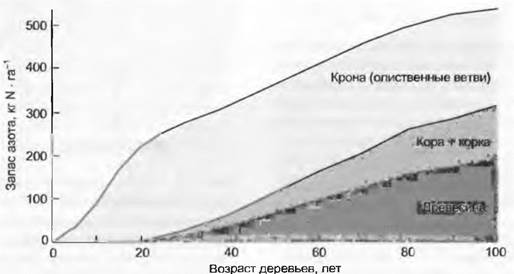
The most crucial nitrogen reserves in an ecosystem are contained within biomass and soil humus. Structure/19.html">The Importance of humus as a nitrogen sink increases toward the poles and reaches its minimum in tropical rainforests due to extremely small humus reserves per 1 m2. The nitrogen concentration in humus is roughly three times higher than in leaves and 10 to 20 times higher than in wood. This remarkable fact indicates that a significant fraction of soil humus nitrogen is incorporated into aromatic carbon compounds and soil Peptides, where the C/N ratio is about 15. Chemically bound in this manner, nitrogen is unavailable to plants and barely accessible to microorganisms. Once nitrogen enters the humus fractions, it is removed from the nutrient cycle for a prolonged period. Humification—i.e., the fixation of carbon in the soil as a complex of humic acids and peptides—underlies the competition for nitrogen among plants. These reserves can be mobilized through major mechanical soil disturbance or liming. Forest clearing also accelerates decomposition processes, which increases nitrogen inputs into watersheds (Fig. 13.17) while simultaneously meeting the nitrogen demands of the regenerating forest (Fig. 13.18).
Fig. 13.17. Nitrogen release into surface waters following clear-cutting in New Brunswick (USA). Peak nitrate-nitrogen concentrations at The surface of the drained stream correspond to monthly nitrogen losses of approximately 5 kg • ha-1. The total for the first year after logging amounted to about 70 kg • ha-1
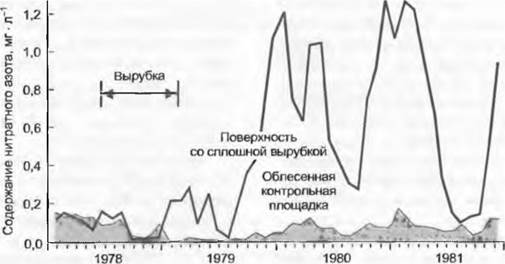
Fig. 13.18. Recovery of nitrogen reserves in spruce forest biomass in Austria following clear-cutting. From the time canopy closure is completed (around 25 years), the nitrogen pool in the crowns remains constant, whereas the pool in the trunks continues to increase. The graph clearly shows that in a 100-year-old forest, nearly half of the total nitrogen is concentrated in the leafy branches
13.6.3. Nitrogen Investment Strategies
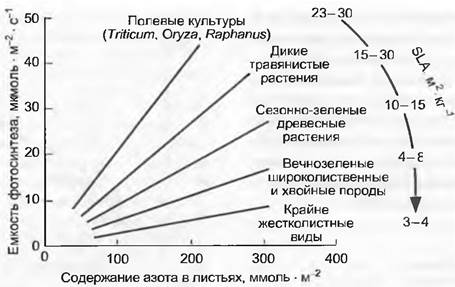
The Economics of nitrogen investment is a cornerstone of functional plant ecology. A species' success in changing environmental conditions is determined by how much nitrogen is deployed, where, and for how long. Tissues with high nitrogen (protein) content exhibit high metabolic activity (Photosynthesis, Respiration, formation of new tissues; Fig. 13.19); yet, for these very same reasons, they are highly attractive to herbivores. Premature loss of such plant tissues due to damage is quite costly. The relationships between maximum photosynthetic capacity Amax and leaf nitrogen content per unit area within defined leaf morphotypes are so close (and linear) that leaf nitrogen data can predict Amax with a relatively low margin of error (Fig. 13.20). Due to the close and similarly linear relationship between Amax and gmax (maximum stomatal diffusive conductance for water vapor; see Fig. 13.14), a dual dependency becomes evident.
Fig. 13.19. Nitrogen distribution in the leaves of an Eucalyptus grandis canopy. The zonation is based on the following factors: higher up (i.e., on the outside) more light is available, and "sun" leaves have a higher photosynthetic capacity and thus more protein. Leaves in the interior of the canopy receive less light, are older, and are therefore often more scleromorphic (nitrogen is "diluted" by a larger amount of carbon), have a lower specific leaf area (SLA), and have a lower demand for Rubisco (a key photosynthetic enzyme)
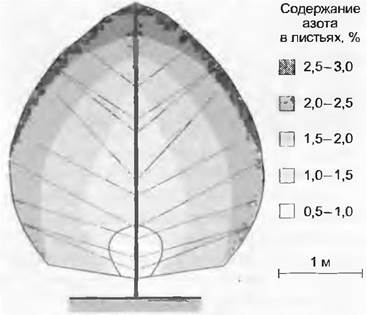
Fig. 13.20. Relationships between photosynthetic capacity, leaf nitrogen content, and specific leaf area. There is a close linear correlation between nitrogen content per unit of leaf area and the highest photosynthetic rate per unit of leaf area under normal atmospheric CO2 concentrations. The slope of the regression line decreases as leaf area per gram of dry weight (SLA, m-2 • kg-1) decreases. Leaves with a low SLA are typically thicker and/or tougher and longer-lived. They tie up a relatively larger amount of carbon in non-photosynthetic structures
Nutritional nitrogen supply per unit of leaf area also correlates closely with SLA or its reciprocal, LMA (leaf mass per area, g • m-2) (Fig. 13.21). Leaves where 1 g of dry matter corresponds to a small surface area contain less N and more C, making them less attractive to herbivores; however, they also assimilate less and are relatively "expensive" in terms of carbon investment per unit area.
Fig. 13.21. Relationships between nitrogen and carbon investments in leaves. Within defined leaf morphotypes, there is a linear relationship between the amount of nitrogen per unit of leaf area and dry matter per unit of leaf area (leaf mass per area, LMA = 1/SLA), regardless of plant species. Such clustering along discrete regressions corresponds to roughly equal life spans for these leaf types (similar nitrogen concentrations as a percentage of dry weight and amortization periods—i.e., the time required for a leaf to pay back its "construction costs"). The decrease in nitrogen percentage with increasing leaf lifespan can have two causes: a reduction in N content within the protoplast or an increase in Cell wall mass while protoplast nitrogen supply remains unchanged. As a rule, both factors are at play

Obviously, such differences in investment can only be compensated for by a prolonged functional lifespan. Leaves with a low nitrogen percentage and high carbon content must remain active for a long time to offset their own carbon costs at a low photosynthetic rate and to supply assimilates throughout the plant. Such leaves typically persist for a long time (sclerophyllous leaves, evergreen conifer needles). Conversely, leaves with a high SLA and high percentage N concentration (see Table 13.1 in Section 13.6.2) are short-lived and "amortized" within just a few days (herbaceous plants). Thus, differently provisioned leaves decompose as litter at very different rates following natural senescence. Leaf type thereby dictates the rate of nitrogen recycling within the system. This gives rise to a multidimensional interdependence among photosynthesis, water relations, functional lifespan, risk of herbivory, litter decomposition, and ecosystem nitrogen cycling (Fig. 13.22).
Fig. 13.22. The Central Role of nitrogen in leaf traits. Leaf nitrogen concentration itself prevents or drives various leaf modifications both within the individual leaf and plant, and at the ecosystem level. Some particularly important connections are shown here. Arrows indicate the direction of effect, while "+" or "-" signs denote the direction of the response when nitrogen concentration increases (!) and plant growth rate rises. The "+" or "-" signs are reversed if N concentration and associated growth rate drop, with the relationship to the latter being evident only within defined leaf morphotypes, as confirmed by the example of equally fast-growing summer-green and evergreen woody plants. The frequently assumed influence of Transpiration rate on leaf Nutrition has not been proven and is unlikely, which is why the arrow is omitted here. High soil moisture can promote both nitrogen availability and transpiration, but this is a coincidence (i.e., the former is not the cause of the latter). Plants thrive perfectly well in water vapor-saturated air without transpiration (water movement and nutrient transport in the xylem are closely coupled with phloem Functions)

Some of these relationships are so robust that they hold true across all biomes and life forms, as P. Reich has demonstrated using numerous examples (Fig. 13.23). As a general rule, as community maturity increases along a successional gradient, perennial, carbon-rich, and assimilation-weaker leaf types become more frequent, unless seasonal constraints apply (deciduous species in regions with cold winters). The longer nutrients are retained within leaves, the lower the risk of their loss from the system. Every leaf fall represents a risk of nutrient export from the system. Constraints are also imposed by plant self-shading. Prolonged leaf longevity is often generally associated with slow growth or low SLA.
Fig. 13.23. Mitochondrial respiration and leaf nitrogen concentration: A — dark respiration increases with increasing leaf nitrogen concentration (cf. Fig. 13.20); B — leaf lifespan decreases with increasing dark respiration. These comparisons encompass plant leaves from all climatic zones. Each point represents a separate species

Young (ruderal) plant communities consist of fast-growing, short-lived plants with nitrogen-rich, thin, rapidly amortized leaves that decompose very quickly upon death. Certain plants with long-lived leaves (e.g., conifers) retain their older leaves within the canopy for some time even when, due to shading by younger ones, they essentially no longer provide any significant net carbon production. At this stage, such leaves act as living nutrient reserves that can be withdrawn when needed (e.g., during spring flushing, leaf loss to herbivores, or nutrient deficits caused by topsoil drying). In Norway spruce (Picea abies), needles older than 4–5 years fall into this category.
To some extent, the phenomena described are complemented by other defense mechanisms. Plants can undoubtedly deter certain herbivores through the synthesis of Alkaloids, Glycosides, phenols, and Terpenes, or The production of oils, latex, or resin. However, these defense mechanisms are metabolically costly, and herbivores are often resistant to them. The yew (Taxus baccata), which is lethally poisonous to humans and cattle, is a favorite treat for some wild animals. Eucalypts lose up to half of their young shoots to herbivores annually despite their very high essential oil content. To our knowledge, no plant is too toxic for snails. Protein poverty and sclerophylly appear to be the most effective means of extending leaf lifespan. The net productivity of short-lived leaves with high activity and long-lived leaves with low activity can be nearly identical, which explains why plants with complementary leaf strategies can successfully coexist without fundamental differences in growth rate and success. Examples include Swiss stone pine and European larch (Pinus cembra and Larix decidua) in the Alps, bilberry and lingonberry (Vaccinium myrtillus and Vaccinium vitis-idaea) in the birch forest-tundra of Northern Europe, or seasonally green and evergreen species in Mediterranean shrublands.
Closely related to the concept of water use efficiency (see 13.5.4) is the widely used and equally ambiguous concept of nitrogen use efficiency (NUE). NUE is interpreted in very divergent ways; the N/C ratio or simply the % N is often used as a synonym for NUE to indicate how "efficiently" a plant utilizes nitrogen when it makes do with small amounts of it. Furthermore, NUE may be reported exclusively for leaves or for the whole-plant nitrogen content. NUE is often determined based on photosynthesis relative to Amax, most frequently without accounting for leaf lifespan and thus without considering the "photosynthetic yield" over their entire functional period. Since it remains unclear what is actually meant by efficiency (efficient for what?), this term should be avoided and, if necessary, replaced by "nitrogen utilization coefficient." As a rule, the simple concept of nitrogen concentration is sufficiently informative (without any far-fetched teleological assumptions).
As explained in Section 12.1, in natural plant communities adapted to specific habitats and developed there over long periods, community-level mineral nutrient deficiency is absent, even though the growth rate of individual plants is almost always nutrient-limited per se, which is also relevant for biomass production per unit area. Element-specific deficiency symptoms mentioned in Section 6.2.2.2, representing short-term responses to nutrient shortages, are highly significant for agricultural crops. However, during species and genotype competition within a habitat, generally only those taxa persist over the long term that can cope with deficit situations without exhibiting such symptoms. Surprisingly, elemental tissue analysis in wild plants can only rarely determine whether a mineral deficiency exists and, if so, of which specific nutrient. These plants grow in such a way that shortages of essential nutrients are avoided because, under certain conditions, their Organs—formed in smaller numbers and sizes—remain fully functional. In such cases, growth matches resource availability. Growth exceeding resource capacity would quickly eliminate such a species or genotype through reduced vitality. Plants of extremely cold biomes (high mountains, polar regions), where nitrogen uptake is constrained, even exhibit higher leaf nitrogen concentrations than comparable taxa from warmer regions—a phenomenon termed "luxury consumption" by F. Chapin. The environmental conditions of these habitats do not permit survival with poorly provisioned, low-productivity leaves. In such adapted species, optimal (economical) consumption of limited resources is ensured by controlled growth.
13.6.4. Soil Heterogeneity, Competition, and Symbiosis in the Rhizosphere
Nutrients are distributed unevenly in the soil, and various plant species explore different soil horizons with their roots (Fig. 13.24). This heterogeneity becomes increasingly important as nutrients, particularly phosphates, are less mobile. Soil heterogeneity comprises four components: 1) actual uneven distribution of substances within the soil matrix; 2) uneven and highly species-specific root distribution (soil Interference); 3) favorable processes that vary among species (e.g., mycorrhizal formation types and "open" symbioses); and 4) uneven soil moisture distribution.
Fig. 13.24. Species-specific root exploration of the soil profile, illustrated by pioneer vegetation on a Baltic Sea dune (featuring Ammophila arenaria, Eryngium maritimum, Elymus furcatus, Leymus arenarius, etc.)

Soil nutrients are accessible to plants only when the soil is adequately moist. In dry soils, not only are microbiological mineralization processes blocked, but nutrient transport (diffusion) and uptake are also paralyzed. Many developmental disorders and even pest attacks (such as forest pests) that are attributed to soil dryness actually stem from nutritional deficiency. In many so-called shallow-rooted plants, a small fraction of the roots is nonetheless located at a considerable depth (see Tab. 13.3 in Section 13.7.5.1); under severe drought conditions, this enables them to meet cuticular transpiration demands (with closed Stomata) and avoid true desiccation. Water scarcity is a major obstacle to nutrient supply, as it leads to the immobilization of nutrients in the most biologically active topsoil layer.
This offers a fresh perspective on the "hydraulic lift" discovered by M. Caldwell in Utah: by using their roots to transport water at night from nutrient-poor but moist deep soil layers to nutrient-rich but dry upper layers, plants gain access to nutrients. Since moisture is released by shallow fine roots into the rhizosphere they occupy, even minimal water displacement yields significant effects.
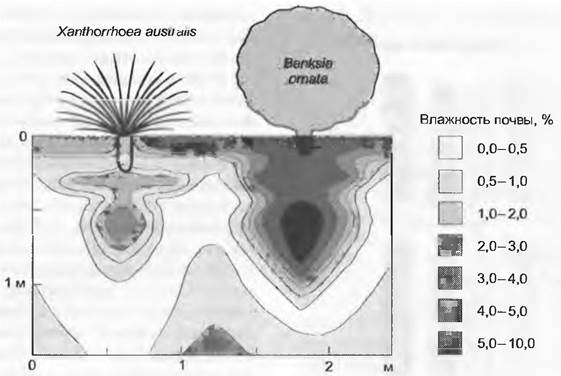
Through stemflow of precipitation along above-ground structures and the spatially differentiated use of soil moisture, plants actively influence the heterogeneity of nutrient distribution, especially during dry periods (Fig. 13.25). This spatial differentiation creates a structural template for the coexistence of plants with different rooting depth profiles. H. Mooney and colleagues have demonstrated that species diversity in the California chaparral is closely linked to such spatial patterns of soil exploration.
Fig. 13.25. Plant impact on soil water distribution and the resulting nutrient availability. Stemflow along shoots, species-specific root distributions in the soil profile (see Fig. 13.24), and the "hydraulic lift" combine with the inherent heterogeneity of soil structure to create a distinct pattern of nutrient availability. The diagram illustrates soil moisture per dry weight and concurrent nutrient availability in the arid Australian bush following 24 mm of precipitation on long-term dry soil (Nullarbor Plain, South Australia)
The utilization of various nitrogen sources in the soil is reflected in the species-specific nitrogen isotope composition of plants. During soil decomposition and restructuring processes, the stable 15N isotope is metabolized somewhat more slowly than 14N compounds. Consequently, 15N accumulates in the soil, while plant-available nitrogen is generally somewhat depleted in 15N compared to atmospheric nitrogen. This depletion heavily depends on which fractions (and at what soil depth) the microbes have processed the nitrogen. Alongside these two isotopically distinct nitrogen compartments, legumes, with the help of their symbionts, create a third compartment where the 15N/14N ratio remains nearly unchanged relative to the atmosphere (since 15N is not discriminated against by nodule bacteria). Recent studies in tundra and alpine regions have shown that ericaceous plants, sedges, legumes, and all other plant groups utilize fundamentally different soil nitrogen pools. Ericaceous plants draw on nitrogen pools extremely depleted in 15N, whereas Cyperaceae have access to a pool particularly rich in 15N. 15N-labeled fertilizer makes it possible to trace nitrogen pathways within an ecosystem (for other stable isotopes, see 13.5.4, 13.7.4).
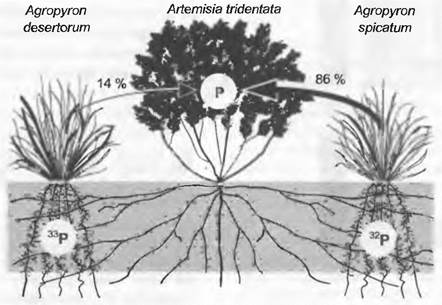
Competition-driven heterogeneity can be illustrated using phosphorus uptake. Unfortunately, phosphorus lacks stable isotopes; however, a radioactive isotope can be utilized. With a high degree of dilution, this allows researchers to trace phosphorus pathways from specific soil P sources to plants. In a classic experiment (Fig. 13.26), M. Caldwell and colleagues investigated the source of phosphorus for the dominant Great Basin shrub Artemisia tridentata when sharing soil space with two bunchgrass species of the genus Agropyron. Agropyron desertorum is an aggressive neophyte threatening to displace A. tridentata, whereas A. spicatum is a native species long established in the Great Basin flora. Phosphorus fertilizers labeled with 32P and 33P were injected into the root zones of both Agropyron species, and The ratio of the two isotopes in Artemisia was subsequently determined. Result: Artemisia has little access to phosphorus within the sphere of influence of A. desertorum; the phosphorus in the tissues of A. tridentata originates almost entirely from the root zone of A. spicatum. In this habitat, the neophyte acts as a phosphorus "thief".
Fig. 13.26. Root competition for soil nutrients. The typical Great Basin shrub Artemisia tridentata (sagebrush) grows in competition with Agropyron desertorum (introduced from Eurasia) and A. spicatum (native species). Phosphorus sources for the sagebrush are identified through the quantitative ratio of absorbed radioactive isotopes 32P/33P. Two different phosphorus isotopes were randomly injected into the root zones of both grass species (the chart depicts one such case). A. tridentata primarily obtains phosphorus from the native grass, whereas phosphorus from the neophyte grass's rhizosphere is barely accessible to the sagebrush, despite all plants being mycorrhizal
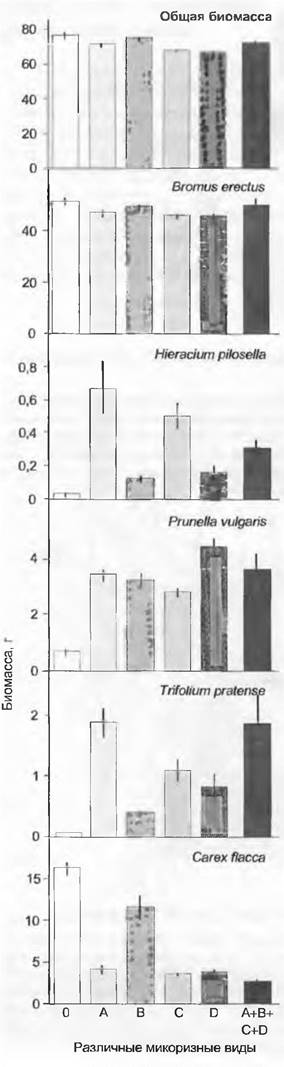
The anomalous inequality in nutrient access among plant species, driven by symbiosis, was recently demonstrated by M. van der Heijden and colleagues using grassland model communities (Fig. 13.27). They introduced mycorrhizal inoculum grown from single spores of different Glomus genotypes into a species-rich model ecosystem on sterile substrate. Depending on the mycorrhizal genotype, certain plant species dominated while others were suppressed. Some plant species vanished entirely if they failed to receive "their" specific genotype. Thus, the presence of particular mycorrhizal fungi determined whether a given plant species could successfully nourish itself and, consequently, governed the plant biodiversity of these grasslands. Whether these findings can be extended to standard practices of cultivating experimental plants in specific plots remains questionable.
Fig. 13.27. Impact of mycorrhiza on plant growth (biomass ± standard error). Different genotypes (isolates) of the endomycorrhizal genus Glomus (A, B, C, D) were inoculated into a small model ecosystem containing typical species of nutrient-poor, low-productivity Central European limestone grasslands on a sterile natural substrate. Plant species responded differently depending on the fungal isolate. In the absence of mycorrhiza (0), the only non-mycorrhizal species, Carex flacca, gained the advantage. The dominant Bromus erectus showed no response to isolate type. Species-specific mycorrhizal formation, which enhances nutrient availability, is a crucial determinant of biodiversity
13.6.5. Global Aspects of Nitrogen and Phosphorus
On large spatial scales and over long timescales, Earth's productivity has been limited primarily by three factors: temperature, water, and phosphorus, assuming solar radiation and atmospheric CO2 concentrations are held constant. Although increased water vapor (more clouds) can attenuate solar radiation, the current anthropogenic increase in CO2 has the potential to enhance carbon sequestration, but only slightly beyond the ceiling set by phosphorus availability. Phosphorus is a critical factor limiting productivity not only in many terrestrial ecosystems but also across vast expanses of the oceans. With the exception of certain regions in the Southern Ocean where iron limitation plays a role, adequate phosphorus availability—particularly in the Pacific Ocean—is a prerequisite for marine cyanobacteria to fix nitrogen into the system, which in turn acts as a prerequisite for carbon sequestration. P. Falkowski and colleagues established that atmospheric dust deposition from land (delivering supplemental phosphorus) ultimately drives oceanic productivity far out at sea.
The drier and consequently dustier the land masses exposed to prevailing winds, the higher the oceanic productivity. Given that vast land areas remained unglaciated during ice ages, the low atmospheric CO2 concentrations (190 ppm) during that era can be explained through the phosphorus cycle and its coupling to oceanic productivity. If astronomical models for glacial periods are reliable, similar ocean-land interactions must have been significantly more intense at that time.
On a regional scale, phosphorus supply is generally better in coastal ocean waters, on young alluvial deposits (and young soils in general); conversely, it is often poor on mature soils, in regions of low tectonic activity (such as Australia), or across heavily weathered soils. As noted above, however, vegetation in these areas often displays no overt symptoms of phosphorus deficiency. Plants respond by developing sclerophyllous (long-lived) leaves and rely heavily on mycorrhizae under such conditions. Plant-fungal symbiosis is as ancient as terrestrial life itself, and soil fungi may have played a decisive role in supplying plants with phosphorus ever since.
The situation with nitrogen is fundamentally different, as it is present in unlimited quantities in the atmosphere. The extent to which nitrogen can be fixed in an ecosystem depends solely on microbiological activity (which, in turn, requires phosphorus and carbon). Anthropogenic release of soluble nitrogen compounds has now reached such proportions that, according to calculations by P. Vitousek and colleagues, it already surpassed the volume of natural nitrogen fixation as early as 1987. Densely populated Regions of the Earth (including Europe) are currently ecologically nitrogen-saturated, even though anthropogenic atmospheric deposition into semi-natural vegetation amounts to 15–25 kg N·ha/year (which is "only" 1/10 to 1/20 of standard nitrogen fertilizer application rates in intensive agricultural systems).
13.6.6. Calcium, Heavy Metals, Salts
Beyond the primary nutrients—phosphorus and nitrogen—Plant Growth and survival are heavily influenced by other mineral soil components (see 6.2). The most prominent is calcium carbonate, which affects plant growth indirectly through its strong impact on soil pH (see 12.5.2.3; buffering) and via interactions with other soil properties (element availability, mycorrhization). However, plants also exhibit distinct behaviors toward the Ca2+ ion itself. Although many species can grow on both calcium-poor and calcium-rich substrates, in the latter case, calcium is precipitated as cell-physiologically inert oxalate (e.g., Silene and other Caryophyllaceae). True calciphiles (calciphilous plants) tolerate high concentrations of dissolved calcium in their cell sap (e.g., Gypsophila, an exception among Caryophyllaceae). Calcium-avoiding (calcifugous) plants, such as matgrass (Nardus stricta), are hypersensitive to Ca2+. The flora and vegetation of calcium-rich and calcium-poor habitats differ sharply (calciphiles vs. siliciphiles).
Two ericaceous dwarf shrubs growing in the Alps near the timberline, Rhododendron ferrugineum and R. hirsutum, typically occur in distinct habitats: the former on silicate rocks with strongly acidic soils (pH 4.0–6.0), and the latter on carbonate rocks with slightly acidic to slightly alkaline soils (pH 5.8–7.2). In their contact zones and transitional habitats (pH 5.4–6.4), populations of hybrids between the two species frequently form.
On calcium-rich rocks, the Initial Stages of soil formation yield diverse humus-carbonate soils (rendzinas) with an A–C profile (see 12.5.2.3). Their counterparts on silicate and quartz rocks are humus-silicate soils (rankers). The former possess high buffer capacity against acidification, whereas the latter are prone to acidification and base leaching. In Central Europe, carbonate substrates typically support dry grasslands characterized by Sesleria albicans (= S. varia) and Teucrium montanum, whereas silicate soils support analogous grasslands featuring Sedum acre and Scleranthus perennis. In the alpine meadow belt, the Elyno-Seslerietea communities on lime-rich soils are vicarious with Caricetea curvulae communities on lime-poor soils. Finally, specialized flora and vegetation (such as communities featuring the characteristic gypsophilous lichen Acarospora nodulosa) develop locally on carbonate-sulfate soils containing gypsum and/or anhydrite.
The localized accumulation of potentially toxic heavy metal compounds—such as copper, cobalt, nickel, manganese, uranium, aluminum, magnesium, zinc, selenium, and others—severely restricts plant growth, with the exception of a very limited group of ecophysiologically specialized species that tolerate these compounds and sometimes even accumulate them (see 6.2.2.4; where their significance as indicator plants is also discussed). In this context, It is worth noting the distinct vegetation found on serpentines (magnesium silicate with Al, Fe, and Ni) and calamine soils (on zinc ores; see 6.2.2.3), which stands out sharply against the surrounding landscape.
The accumulation of readily soluble salts (especially NaCl, Na2SО4, Na2CО3, as well as corresponding K and Mg compounds) in coastal regions and arid basin landscapes in continental areas exerts a decisive influence on plant life. As has been demonstrated repeatedly in discussions of the morphological, anatomical, and PHYSIOLOGICAL CHARACTERISTICS OF halophytes—plants of saline habitats (see 6.2.2.4).
The highest salt resistance is observed in Algae and Lichens of the littoral spray zone; they survive both the desiccation of concentrated brine and leaching by rainwater. In contrast, freshwater plants (glycophytes) suffer even from small amounts of sodium salts (about 50% seawater). Facultative halophytes (such as the sea aster Aster tripolium) can tolerate such concentrations quite well. Obligate halophytes actually achieve optimal growth at corresponding salt concentrations (for example, Salicornia at 75 – 100% seawater).
On humid coasts, soil salt concentrations decrease from the sea inland; this corresponds to the declining Salt Tolerance of obligate and facultative halophytes, which succeed one another along this gradient (e.g., on the coast of western Sweden; Fig. 13.28). However, in regions with arid seasons, even the coastal margin temporarily soaked by seawater becomes especially enriched with salts because soil solutions are more strongly concentrated here due to evaporation during the dry period. Such conditions prevail, for example, in mangroves (Fig. 13.29; see Box 4.5, Section 15.2.16), where soils become increasingly saline from the open sea toward the lagoon, and plant species are distributed accordingly in order of increasing salt tolerance.
Fig. 13.28. Vegetation profile along a salinity gradient on a low-lying marine shore in western Sweden. Abundance of various species along a 45 m profile from the shoreline to pastureland experiencing only slight salinity influence. Three distinct ecological groups are discernible from top to bottom on the graph. The maximum elevation difference along the profile is 1 m, and sea level fluctuations during most months of the year do not exceed 0.5 m, reaching the upper point of the profile only once in autumn.

Fig. 13.29. Mangrove zonation on the East African coast. Due to periodic drying at the point of the profile furthest from the sea, the highest salt concentration was recorded. The salt concentration in the soil solution 10 cm below the upper soil (mud) surface and in the squeezed leaf sap is given as osmotic potential in MPa. Four mangrove genera occupy characteristic zones along the gradient showing tidal fluctuations.

Last update: 07/08/2026
Editorial and Educational Adaptation: This material has been compiled based on the primary/original source text. The project team performed an editorial review, corrected technical inaccuracies, structured sections, and adapted the content for an educational format.
What was processed:
- elimination of formatting defects (OCR errors, structural breaks, corrupted characters);
- editorial organization of content;
- standardization of terminology in accordance with academic sources;
- verification of factual statements against the original source text.
All mentions of the author, publication year, and origin of the primary text have been preserved in accordance with the source.