Practical Protein Chemistry - A. Darbre 1989
Prediction of Peptide and Protein Conformation
Traditional Methods
Any scientific progress is invariably accompanied by a clash of Perspectives between experimentalists, who approach new concepts with caution, and theorists, who almost always view established ideas as approximate and limited. This section outlines, in the most general terms, some predictive techniques that experimentalists consider sufficiently reliable and readily employ in their work. This is followed by a Structure/133.html">Discussion of theoretical objections to The Use of these Methods, along with a description of improved approaches.
According to the hard-sphere model, atoms are represented as spheres whose sizes are determined by their Van der Waals radii. Conformations in which atoms overlap are deemed impermissible. If this condition is violated for even a single pair of atoms, the conformation is rejected. This method has limited utility because it permits far too many conformations, leaving the Selection of any particular one to pure intuition. In this approach, all interatomic interactions are ignored except for van der Waals repulsive forces, which correspond to infinite energy upon atomic overlap and zero energy in all other cases. However, when this approach is refined by quantitatively incorporating other well-documented interactions, such as Hydrogen Bonds, it becomes a convenient tool for studying the conformations of stereoregular molecules. It was precisely this combined approach that enabled Pauling and Corey to predict the existence of the $\alpha$-helix and $\beta$-sheet in Proteins, and Watson and Crick to discover The Double Helix of DNA.
The hard-sphere model is commonly encountered in practice when building physical molecular models. In a computer, the following expression is introduced:
Class="center">
where the Conformational Energy E of conformation X is equal to the sum of pairwise interactions between all atoms in the molecule; the indices i and j account for all atoms from the first to the last, and eij depends on the types of atoms i and j. The interaction energy eij between atoms i and j can be represented in various ways, one of which corresponds to the hard-sphere model:

Here, eij is a function of the distance rij between the atomic centers; it is discontinuous at rij = Rij (where Rij is the sum of the van der Waals radii of atoms i and j). The radii i and j are determined solely by the atom type (aliphatic carbon, carbonyl oxygen, etc.). For simple molecules, atomic radii are typically derived from interatomic distances within the crystal lattice. In the general case, eij represents a potential energy function that depends exclusively on the set of Rij values.
Equation (21.2) can be readily extended to account for hydrogen bonding; in this case, allowed conformations are those in which: (a) there are no overlapping atoms, and (b) the maximum number of hydrogen bonds is present.
The Limitations of the hard-sphere model stem from the fact that real atoms are neither rigid nor spherical. Furthermore, molecular behavior is governed by forces beyond mere steric repulsion. As noted above, incorporating hydrogen bonds is absolutely essential to prevent the hard-sphere model from being applied in its most primitive form. Electrostatic Interactions also play a significant role in molecules; these arise between atoms bearing full or partial charges caused by differences in electronegativity. However, these interactions cannot be described using a simple discontinuous function of rij. It is also worth noting that the hard-sphere model is viable only because regions of highest electron density do not change radically when isolated atoms combine to form a molecule. Yet, the deviation of atomic shapes from spherical Symmetry, the potential for Hydrogen bond formation, and the fractional charges localized on atoms—all of these represent notable changes that atoms undergo upon molecular association.
The soft-sphere (deformable-sphere) model is likewise based on Equation (21.2), but here eij is a continuous function of rij. Generally speaking, continuous potential Functions serve merely as analytical relations expressing the approximate dependence of energy changes on rij, and there is no strict requirement to assign direct physical meaning to individual component terms of the function.
Nevertheless, it is often convenient and justifiable to represent the continuous potential function as a sum of contributions, each corresponding either to van der Waals repulsion energy, electrostatic interaction energy, hydrogen bond energy, and so forth. The potential functions utilized can be written in various mathematical forms; using modern notation, the simplest expression for the energy eij can be expressed in the following general form:

Here, Aij, Bij, and Cij are parameters that depend on the types of the two interacting atoms (aliphatic carbon, carbonyl carbon, etc.). The term A largely dictates the potential energy of the hard-sphere model [Equation (21.2)], because as the exponent a increases, the distance dependence rij of the first term in Equation (21.3) grows rapidly. However, to ensure that the function eij converges to zero more rapidly as rij increases, an additional component B is required. This is usually interpreted as the contribution responsible for weak van der Waals attractive forces between interacting atoms (London dispersion forces caused by induced dipole moments). The magnitude of this contribution is relatively small compared to the overall calculation error, and the primary role of the second term is to ensure the proper balance of short-range forces at close distances. The third energy component, C, accounts for Coulombic electrostatic interaction arising from fractional charges placed, for simplicity, at the atomic centers. Hydrogen bond energy is not represented as a separate component because, in biological molecules, this type of interaction can be subsumed under electrostatic forces. Consequently, when Equation (21.3) is employed, the energy and orientation of Hydrogen bonds are not explicitly evaluated.
The first two components (A and B) are always present together in Equation (21.3), with the second component ensuring the existence of a minimum in the potential energy function. Let eijvw be the interatomic van der Waals interaction energy [i.e., Equation (21.3) without the third term, which represents the electrostatic contribution]. The METHOD FOR DETERMINING Aij and Bij values for various pairs of atoms is more convenient when these parameters are expressed as functions of eij0 (the minimum value of eijvw) and rij0 (the distance at which this minimum occurs). The existence of the minimum is due to the condition a > b and corresponds to the equilibrium arrangement of the atomic pair i and j, i.e., the state where significant repulsive forces and weak attractive forces balance each other out. Note that in a real molecule, due to interactions with all other atom pairs, such a state may correspond to equilibrium only by coincidence. Nevertheless, one can write:
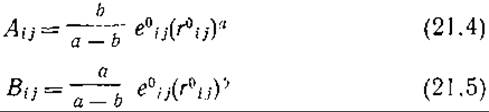
Here, rij0 plays a more crucial role than eij0, which is close to 0.4 kJ/mol, meaning that calculation results are relatively insensitive to errors in determining the latter value. The parameter rij0 should obviously depend on atomic sizes and is generally taken as the sum of the van der Waals radii Rij. However, atomic radii observed in crystals rarely correspond to true equilibrium values due to the presence of other interactions, including electrostatic ones, which dictate specific crystal packing geometries. Typically, Setting rij0 = Rij results in values of rij0 that are somewhat underestimated; therefore, more sophisticated methods for parameter determination have been tested for certain Applications [17]. Regardless of the computational approach, using Equation (21.3) achieves a much more accurate accounting of atomic size effects compared to the hard-sphere model.
The final energy component is usually expressed as

where qi and qj are the partial charges on atoms i and j, and $\varepsilon$ is a parameter corresponding to the dielectric permittivity. While the presence of the product qi∙qj in Equation (21.6) is theoretically well-founded, the use of the parameter $\varepsilon$ is somewhat questionable. Rather, $\varepsilon$ is best viewed simply as an auxiliary scaling factor designed to bring calculated data into agreement with experimental observations, since the value of $\varepsilon$ rarely matches the macroscopic dielectric permittivity of the system. In quantum mechanical calculations and the interpretation of experimental data, $\varepsilon = 1$ is typically assumed. Until recently, in relatively straightforward computations, it was customary to test all values of $\varepsilon$ from unity to infinity and analyze The impact of this parameter on the resulting outcomes. In recent years, various solution models have also been incorporated into these analyses.
a, b, and c are empirical constants. Different studies utilize various sets of these constants, and potential functions are classified accordingly, such as 12-6-1, 9-6-1, 9-6-2, etc. There are strong theoretical justifications for choosing b = 6 and c = 1, although when accounting for hydrogen bonding or to save computational time (as rij2 can be computed from atomic coordinates faster than rij), c > 1 is sometimes adopted. Choosing the value of a presents greater difficulties, because calculating component A theoretically justifies the use of an exponential function Aijexp(−\muij∙rij). However, in rough calculations, if the value of a is sufficiently large, this can be omitted. Exponential functions are rarely used because they introduce an additional parameter, $\muij$, and demand greater machine time. It should be noted that Aij, Bij, and Cij depend on a, b, and c, meaning that any modification to the latter requires recalculation from scratch.
The hard-sphere and soft-sphere models are almost invariably applied within the rigid-geometry approximation. This implies that during conformational changes and energy Minimization searches, only the dihedral angles of rotation around single bonds are allowed to vary. Bond Lengths, valence angles, and torsional angles involving double and triple bonds (or partially double/triple bonds) are generally held constant at values derived from crystallographic data. It is assumed that these structural parameters correspond to an equilibrium state, escaping from which requires a substantial energy input. These constraints are justified by two practical considerations: first, the computational problem is greatly simplified by reducing the number of conformations evaluated, and second, the resulting calculations become insensitive to interactions governing bond-stretching energies. Most importantly, this approach neglects contributions to conformational energy arising from changes in bond lengths and valence angles.
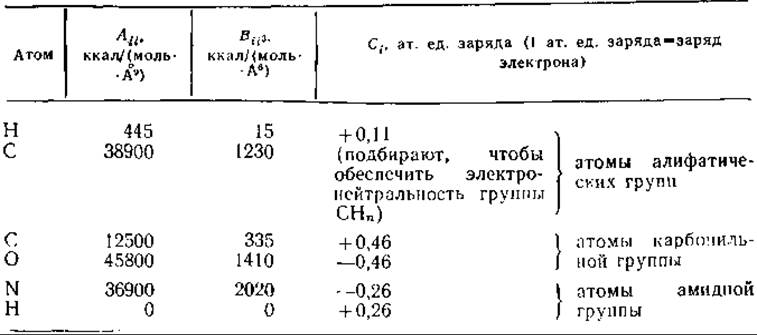
Table 21.1. Hagler-Huler-Lifson parameters using the 9-6-1 potential functiona
a Used in equation 

The parameter values were derived by Hagler et al. [17] and Hagler and Lifson [15] from crystal data of peptide-like molecules. It was demonstrated that these parameter values show excellent agreement with experimental data on molecular conformational properties [67] and ab initio quantum mechanical calculations [24]. These data can be utilized in calculations employing the valence force field approximation (see below). Although this parameter set is justifiably regarded as one of the best, it has been refined for each specific application in the author's laboratory and Hagler's laboratory.
Last update: 06/08/2026
Editorial and Educational Adaptation: This material has been compiled based on the primary/original source text. The project team performed an editorial review, corrected technical inaccuracies, structured sections, and adapted the content for an educational format.
What was processed:
- elimination of formatting defects (OCR errors, structural breaks, corrupted characters);
- editorial organization of content;
- standardization of terminology in accordance with academic sources;
- verification of factual statements against the original source text.
All mentions of the author, publication year, and origin of the primary text have been preserved in accordance with the source.