PLANT PHYSIOLOGY AND BIOCHEMISTRY
Lecture Notes
9. HETEROTROPHIC NUTRITION IN PLANTS
Heterotrophic nutrition via endogenous organic substances
In general, green plants are autotrophic. However, the organic substances synthesized in the leaves via Photosynthesis from CO2 and H2O are subsequently distributed to all other plant parts, which rely on these pre-formed carbohydrate compounds for their Nutrition—a process known as heterotrophy. Whenever a plant Organism utilizes stored organic reserves or cytoplasmic Biopolymers, these substances must first be hydrolyzed into a transportable and easily assimilable form. In principle, this process does not differ from Digestion in carnivorous plants.
Plants typically store reserve substances in the form of CARBOHYDRATES, Proteins, and fats, most commonly within the endosperm or the cotyledons of the seed embryo. In cereals, aleurone grains rich in storage proteins form in the peripheral zone of the endosperm. Starch accumulates in the endosperm and cotyledons of seeds with low lipid content, while Lipids are stored in spherosomes.
Therefore, during germination, two active zones exist within the seed: the mobilization zone for reserve substances (endosperm, perisperm, or cotyledons) and the growth zone (the embryo).
Digestive processes in the endosperm
Digestive processes in the endosperm occur primarily through the hydrolytic breakdown of reserve substances:
Class="center">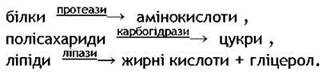
Let us examine what occurs during grain germination. In caryopses, a modified cotyledon called the scutellum serves to mobilize and absorb reserve organic substances. Its function is analogous to that of a Stomach. H+-pumps operate within the epithelial Cells of the scutellum, causing it to secrete organic acids (such as citric and oxaloacetic acid) into the endosperm. This acidification of the semi-viable endosperm cells (where nuclei and other Organelles have degraded) activates acid Hydrolases, primarily α-amylases, which break down starch into maltose and glucose. Furthermore, the epithelial cells of the scutellum secrete additional acid hydrolases into the endosperm, including α- and β-amylases, cellulase, proteases, glucanases, phosphatase, and RNase.
By the 3rd or 4th day of germination, the only living Cell layer—the peripheral aleurone layer—is recruited into the digestive activity of the scutellum. It also secretes organic acids and hydrolytic Enzymes. This synergistic activity leads to the complete dissolution of the endosperm's reserve substances.
The scutellum also acts as an absorptive organ. It facilitates The transfer of hydrolyzed reserve substances from the endosperm to the vascular bundles, which transport these compounds to the embryo. The transport of organic substances across The Plasma Membrane of scutellar cells is driven by H+-pumps and occurs via H+-symport.
This entire process is under hormonal control. The secretory activity of the scutellum is activated by cytokinin and auxin, while the aleurone layer is activated by gibberellin, which originates from the scutellum and the embryo.
Similar processes occur during the germination of dicots, although in the latter case, digestion is intracellular rather than extracellular.
Mobilization of stored protein in germinating seeds
The seasonal periodicity of plant development includes dormancy periods, preceding which assimilates from the leaves are stored for future use. These reserves are essential for the plant to initiate growth in the following vegetative season. Proteins, Polysaccharides, and triglycerides serve as reserve forms of nutrients (being relatively osmotically inactive).
Storage proteins are localized in aleurone grains and protein bodies, consisting mainly of globulins (the primary form in dicots) and albumins. Depending on their solubility in various Solvents, they are further classified as prolamins and glutelins. Legumes contain 20–30% protein by dry weight, oilseeds 17–42%, and cereals 7–14%.
Aleurone grains are storage organelles in cells, ranging from 0.1 to 25 μm in size. They are surrounded by a single membrane and contain 70–80% protein by dry weight. Their composition also includes carbohydrates, Phospholipids, phytin, RNA, and oxalates. Aleurone grains can be simple or complex. Complex grains are characteristic of dicots and contain Two Types of inclusions—globoids and crystalloids—surrounded by an amorphous layer. In cereals, aleurone grains are simple and are located in the aleurone layer. Aleurone grains contain several acid hydrolases.
Protein bodies are found in the starchy endosperm of cereals. These are heterogeneous systems containing various groups of storage proteins, starch, and lipids, reaching sizes of several micrometers.
Protein degradation begins immediately after imbibition and is carried out by several groups of proteases. There are three stages of proteolysis:
Stage 1 — Limited proteolysis of the bulk of storage proteins, primarily those in the Morphology/4.html">MAIN Organs OF the embryo. Protein mobility and solubility increase. Their Hydrolysis releases Amino Acids required for the synthesis of new enzyme systems.
Stage 2 — Lasts 5–10 days. Rapid breakdown of all storage proteins into amino acids occurs, which are then transported to the embryo for heterotrophic nutrition.
Stage 3 — Complete degradation of remaining reserve and enzymatic proteins.
Intracellular Protein Digestion is characteristic of dicots. Their breakdown occurs in storage cells as early as 3–5 days after THE START OF imbibition. The activity of acid hydrolases—Phosphatases and proteases—increases sharply. Proteins of the amorphous matrix disappear first, followed by crystalloids, and finally, globoids. The mechanism for maintaining acidic pH remains unknown. Additional hydrolases are synthesized in The Endoplasmic reticulum adjacent to the aleurone grains. As hydrolysis proceeds, aleurone grains transform into vacuoles.
In caryopses, digestion occurs both intracellularly (in the aleurone layer) and extracellularly (in the endosperm). Both the hydrolysis and the Transport of Amino acids from the endosperm through the scutellum to the Vascular Tissues take place at a pH of 4-6. Thus, acidification of the endosperm is a critical stage in seed germination.
Mobilization of reserve carbohydrates
Carbohydrates are a vital group of storage nutrients in seeds. While some seeds contain significant amounts of sucrose, maltose, fructose, and other sugars, starch remains the primary reserve carbohydrate.
Cereals contain 50-75% starch by dry grain weight, while legumes contain 50-60%.
Starch is deposited in Plastids during seed maturation. Once starch granules reach a certain size, the lamellar Structure OF THE plastids disintegrates. The size of starch granules in different plants ranges from 15 to 50 μm.
During germination, free sugars are rapidly depleted, and starch granules begin to break down, their surfaces becoming pitted. This is mediated by phosphorylases. Subsequently, a robust mechanism involving hydrolases is activated, including α- and β-amylases, α-glucosidase, and dextrinase.
In dicotyledonous seeds, starch degradation is characteristically intracellular, beginning within the first hours of imbibition in the axial organs. Starch content in the cotyledons does not decrease until the 4th or 5th day of germination.
In caryopses, extracellular starch hydrolysis occurs, starting from the scutellum and progressing toward the distal part of the endosperm. The entire process begins within 20 hours. The scutellum accounts for 17% of the total amylase activity. Secretion of amylases by aleurone layer cells occurs only on the 3rd or 4th day.
Fat assimilation
Approximately 75% of flowering plant species store fats as a reserve. These neutral and polar lipids are contained within spherosomes (0.5 μm). Acid lipases have also been identified here. The primary Functions of spherosomes are the storage and digestion of fats.
In cereals, this process begins immediately after imbibition, with peak activity occurring on the 3rd day.
In oilseed crops, The breakdown of reserve fats begins on the 2nd or 3rd day. The entire process proceeds in three stages. In the first, lipase breaks down triglycerides into glycerol and Fatty acids. In the second stage, Fatty acids are degraded into acetyl-CoA, which, in the third stage, can be converted into Other Compounds or further oxidized.
A key role in fat digestion belongs to lipase, which is either already present in The Cell (synthesized in advance) or newly synthesized.
During seed germination, there is close contact between spherosomes and glyoxysomes, where the breakdown of monoglycerides (alkaline lipase) and β-Oxidation of Fatty acids occur. The reactions of The Glyoxylate cycle also take place there.
Glycerol is reduced to phosphodihydroxyacetone and can be utilized for the synthesis of sugars via Gluconeogenesis.
Last update: 07/08/2026
Editorial and Educational Adaptation: This material has been compiled based on the primary/original source text. The project team performed an editorial review, corrected technical inaccuracies, structured sections, and adapted the content for an educational format.
What was processed:
- elimination of formatting defects (OCR errors, structural breaks, corrupted characters);
- editorial organization of content;
- standardization of terminology in accordance with academic sources;
- verification of factual statements against the original source text.
All mentions of the author, publication year, and origin of the primary text have been preserved in accordance with the source.