MORPHOLOGY OF PLANT VEGETATIVE ORGANS
3. The Shoot
3.1. Concept and Functions of the SHOOT
A shoot is an unbranched stem bearing leaves and buds, which develops during a single growing season.
Typically, a vegetative shoot performs the function of aerial Nutrition. In addition, a shoot can serve for vegetative propagation, storage of nutrients and Water, attachment to a vertical support, and Protection of the plant against herbivory.
3.2. Structural Patterns of the Shoot
A shoot develops from a bud. The Structure/83.html">Structural elements of a shoot are the stem, leaves, and buds (Fig. 3).
Class="center">Figure 3. STRUCTURE OF THE shoot

The stem is the axial part of the shoot. It elongates due to the apical meristem located within the bud and exhibits indeterminate growth. In grass species (Poaceae), the stem grows through intercalary Meristems. The stem acts as a connecting link between two poles of the plant: the leaves, which carry out Photosynthesis, and the roots, which provide mineral nutrition from the soil. The stem facilitates The transport of organic substances (downward translocation), water, dissolved mineral salts, and ROOT-synthesized Organic compounds (upward translocation). Like the root, the stem can serve as a storage site for reserve nutrients and function as an organ of vegetative propagation.
Based on their structure, stems can be herbaceous or woody. In herbaceous plants (annuals and biennials), the tissue Cells of the stem do not undergo lignification, as these stems live for only a single growing season. A woody stem lives for many years and is characteristic of trees, shrubs, and subshrubs. In trees, the main stem is called the trunk, whereas in shrubs, individual stems are referred to as stems or trunks.
According to their cross-sectional shape, stems can be round (sunflower), triangular (sedge), quadrangular (sage), ribbed (parsnip), flat (prickly pear), or winged if lateral outgrowths are present along the sides of the stem (narrow-leaved everlasting pea) (Fig. 4).
Figure 4. Types of stem cross-sections

A leafless stem terminating in a flower or inflorescence (as in onions, garlic, and Hippeastrum) is called a scape (Fig. 5).
Figure 5. Scape of Hippeastrum

Poaceae species feature a stem with hollow internodes known as a culm. A false stem, formed by overlapping leaf sheaths, is characteristic of bananas.
The region of the stem where a leaf is attached is called a node. The distance between two adjacent nodes is the internode. The angle formed between the leaf and the upper portion of the stem originating from the node is called the leaf axil. An axillary or lateral bud is located within the leaf axil. When a leaf falls off, a leaf scar remains on the stem, bearing leaf traces—vascular bundles.
An apical bud is located at the apex of the shoot (Fig. 3).
A characteristic feature of the shoot is metamerism, which is the repetition of individual structural units along the longitudinal axis. From base to apex, an annual shoot consists of repeating elements called metameres; each metamere comprises a node with one or more attached leaves, an axillary bud, and the internode situated directly above.
The shoot exhibits negative geotropism—meaning it grows in the direction opposite to the pull of gravity—and positive phototrophic growth towards a light source.
The lifespan of a shoot is determined by environmental conditions. In plants with a short growing season (ephemerals), the stem lives for 30–45 days (e.g., *Holosteum umbellatum*); in most grasses, 120–150 days; and in trees, hundreds of years (apple tree: 200 years, pine: 500 years, etc.). The stem of the European yew can live for up to 3,000 years. Stem dimensions vary greatly: rattan palms have stems 200–300 meters long, the erect stem of the eucalyptus can reach a height of 150 meters, spruce up to 50 meters, oak 40 meters, and birch and maple 25 meters.
Shoots exhibit developmental cyclicity, which is associated with seasonal climate fluctuations. In temperate climates, plant growth pauses during autumn and winter, whereas in the tropics, this occurs during the dry season. By the onset of adverse conditions, buds are formed at the shoot apex and in the leaf axils.
3.3. The Bud: Structure and Classification of Buds
A bud is an embryonic, shortened shoot. It consists of an embryonic stem with an apical meristem and embryonic leaves. The axils of these leaves contain the primordia of lateral buds. The primordia of flowers or inflorescences may arise at the apex of the growing tip or in the leaf axils.
Buds are classified into several categories.
Based on the presence of bud scales—which are modified outer leaves serving a protective function—buds are divided into enclosed (covered) and naked buds (Fig. 6). Enclosed buds possess bud scales and are characteristic of plants in temperate latitudes. Naked buds lack protective scales and are typical of tropical and subtropical plants. Among plants of our region, naked buds can be found in viburnum, buckthorn, and barberry.
Figure 6. Covered and naked buds

According to their Structure and function, buds are categorized into vegetative, generative, and mixed (Fig. 7). Vegetative buds produce only leaves and are found in the majority of plants. Generative (floral) buds give rise to flowers or inflorescences (such as willow and forsythia). Mixed buds develop into shoots bearing both leaves and flowers (such as apple, cherry, lilac, and elderberry).
Figure 7. Structure of vegetative and generative buds

A special group comprises brood buds (bulbils), which develop in leaf axils (as in lilies) or within inflorescences (in certain allium species) and serve for Vegetative Reproduction. Depending on their position on the stem, buds may be terminal, lateral, or adventitious. Terminal buds develop at the apex of the shoot. Lateral
(axillary) buds develop in the leaf axil and contribute to the expansion of the plant's canopy. Lateral buds that remain dormant for a long time but begin to grow if the plant freezes or the terminal bud is removed are known as resting (dormant) buds. Terminal and lateral buds originate from the meristem of the apical growing tip. Adventitious buds can form in various PARTS OF THE plant: on the lower stem, on roots (root-suckering plants such as field bindweed, creeping thistle, lilac, and raspberry), or on leaf petioles (gloxinia, begonia, and African violet) (Fig. 8). In birch, maple, and walnut, groups of adventitious buds proliferate within the stem to form large woody outgrowths known as burls, which feature highly decorative grain patterns.
Figure 8. Adventitious buds on a Bryophyllum leaf

Axillary buds may develop in leaf axils not singly, but in groups. This bud arrangement can be serial or collateral (Fig. 9). In a serial arrangement, the buds develop one above the other, forming a vertical row of several buds. This type of arrangement is typical of dicotyledonous plants (such as honeysuckle, walnut, and false indigo). In a collateral arrangement, a row of buds is aligned horizontally, which is characteristic of monocotyledonous plants (such as gladiolus, crocus, and star-of-Bethlehem).
Figure 9. Serial and collateral bud arrangement

3.4. Phyllotaxy
Phyllotaxy refers to the arrangement of leaves on a plant stem. Leaves must be positioned in such a way that sunlight evenly illuminates almost every photosynthetic leaf. Consequently, three MAIN TYPES OF phyllotaxy evolved: alternate (spiral), opposite, and whorled. The primary diagnostic feature in determining the phyllotaxy type is the number of leaves originating from a single node.
In alternate phyllotaxy, a single leaf develops at each node (as seen in birch, oak, cherry, poplar, apple, wheat, etc.). Alternate, or spiral, phyllotaxy is the most complex and widespread type among angiosperms. It is characterized by various patterns of the leaf cycle. In spiral phyllotaxy, starting from the terminal bud, the bases of successively formed leaves can be connected by an imaginary line. This
line is called the genetic spiral (parastichy). Leaves are positioned along the genetic spiral such that groups of them lie directly above one another in longitudinal rows. These can be connected by a vertical straight line known as an orthostichy (Fig. 10).
Figure 10. Spiral leaf arrangement: 1/2 - iris, gladiolus; 1/3 - reed, sedges; 2/5 - oak, poplar, dog rose, tobacco; 3/8 - cabbage, plantain

The section of the shoot between the two nearest leaves lying on the same orthostichy is called a leaf cycle.
The number of turns of the genetic spiral within a leaf cycle can vary—1, 2, 3, 5, or more. The number of leaves in a leaf cycle is correspondingly 2, 3, 5, or more. This regularity was discovered by the Italian mathematician Fibonacci. The formula for alternate phyllotaxy can be expressed as a fraction: the numerator represents the number of turns of the genetic spiral, and the denominator indicates the number of leaves in the leaf cycle.
When counting leaves, the first leaf of the subsequent cycle is not included. Adding the numerators and denominators of two adjacent fractions yields the next variant of alternate leaf arrangement. This sequence is known in mathematics as the Fibonacci series: 1/2, 1/3, 2/5, 3/8, 5/13, and so on.
Each species, and sometimes an entire plant family, is characterized by its specific phyllotaxy. For example, it is 1/2 in wheat, grape, and apple; 1/3 in sedges and tulip; 2/5 in pear, currant, plum, and poplar; 3/8 in cabbage, radish, and flax; and 5/13 in bergenia, etc. Furthermore, the fraction also indicates the angle of divergence of the leaves along the spiral (the divergence angle). Thus, for the formula 1/2, the angle of leaf divergence is 1800; for 1/3, it is 1200; for 2/5, 1440; for 3/8, 1350; for 5/13, 1380, and so forth.
In opposite phyllotaxy, two leaves are formed at each leaf node, positioned directly across from each other. The leaves of two adjacent pairs lie on a different orthostich, ensuring that the upper leaves do not cast shade on the lower ones (mint, deadnettle, carnation, Norway maple). Decussate phyllotaxy is rarely distinguished as a separate type when the planes of adjacent leaf pairs are mutually perpendicular.
Whorled phyllotaxy is characterized by The formation of three or more leaves at each leaf node (oleander, herb Paris). The leaves of the lower and upper whorls are located on different orthostichs and receive uniform illumination without shading one another (Fig. 11).
Figure 11. Types of phyllotaxy

Pseudowhorled phyllotaxy is sometimes observed (woodruff, bedstraw). In this case, the leaves and stipules are developed equally and do not differ in size.
A general pattern across all types of phyllotaxy is the equal angular distance between leaves attached to the same leaf node.
Phyllotaxy is an inherited trait. However, it can change during shoot growth. In addition, leaf petioles can bend toward the light. As a result, the blades of all leaves
are arranged in such a way that they do not shade each other, instead forming a single plane where all gaps between large leaves are filled by smaller ones. This phenomenon is known as a leaf mosaic.
3.5. Shoot Branching
Branching is the formation of a system of branched axes, which leads to an increase in the total surface area of contact with the external environment and the overall above-ground mass of the plant. Branching evolved in the plant body even before the appearance of vegetative Organs. Dichotomous, monopodial, sympodial, and false-dichotomous branching are distinguished.
In the simplest case, the apex of the main axis forks and gives rise to two or more axes of the next order. Such branching is termed dichotomous (apical). During this process, the apical meristem divides, resulting in two secondary axes, each of which subsequently forks to form tertiary axes, and so on. It is characteristic of lower plants—multicellular Algae whose body is called a thallus. The same type of branching is found in certain lower spore-bearing plants, such as clubmosses and mosses. Dichotomous branching is the most ancient.
Monopodial branching is distinguished by the fact that throughout the plant's life, the main axis (first-order shoot) maintains indeterminate apical growth. The lateral axes also branch monopodially. Monopodial branching is typical of horsetails, most ferns, and conifers (spruce, fir, pine). It is rarely found in angiosperms (pyramidal oak, Lombardy poplar, etc.).
Angiosperms (flowering plants) are dominated by sympodial branching. Its distinctive feature is that the apical bud ceases growth early or grows weakly and gradually dies back. The lateral bud closest to it then begins to grow. The shoot it produces appears to act as a continuation of the main one. The apical bud of this lateral shoot likewise ceases growth, and a new "main" shoot arises from a lower lateral bud, and so on. With sympodial branching, the entire stem consists of separate segments that appear to be assembled from lateral shoots (apple, linden, grape, strawberry, etc.).
In many flowering plants, monopodial and sympodial branching are combined. Monopodially branching shoots ensure vegetative growth, while sympodially branching ones produce flowers and fruits. Shoot pruning is based on this phenomenon: removing the apices enhances sympodial branching and increases crop yield (apple, pear, grape).
A special case of sympodial branching is false-dichotomous branching. It occurs when leaves and, consequently, lateral buds are arranged in an opposite manner. In this case, both upper lateral buds begin to grow simultaneously, producing two apical shoots (lilac, horse chestnut, carnation, mistletoe) (Fig. 12).
Figure 12. Types of branching: dichotomous in clubmoss, monopodial in juniper, sympodial in bird cherry, false-dichotomous in maple (1, 2, 3, 4 - axes of the first and subsequent orders)

Tillering is a specific type of shoot branching. It occurs in both woody and herbaceous plants.
Tillering is characterized by the formation of numerous lateral shoots from buds located at the Base of the parent shoot within the soil or near its surface. The internodes at the base of this shoot are shortened, causing many lateral buds to cluster closely together. Adventitious roots develop at the shoot nodes, forming a fibrous root system. The region of shortened internodes where tillering shoots form is called the tillering node or tillering zone. The tillering zone is especially pronounced in grasses (Poaceae).
Based on their tillering habits, V.R. Williams (1931) divided grasses (cereals) into three biological groups: densely tufted, loosely tufted, and rhizomatous (Fig. 13).
Figure 13. Tillering in grasses (1 - caryopsis, 2 - seminal roots, 3 - adventitious roots, 4 - tillering node, 5 - first-order axis, 62, 63, 64 - axes of the second and subsequent orders, 7 - rhizome)
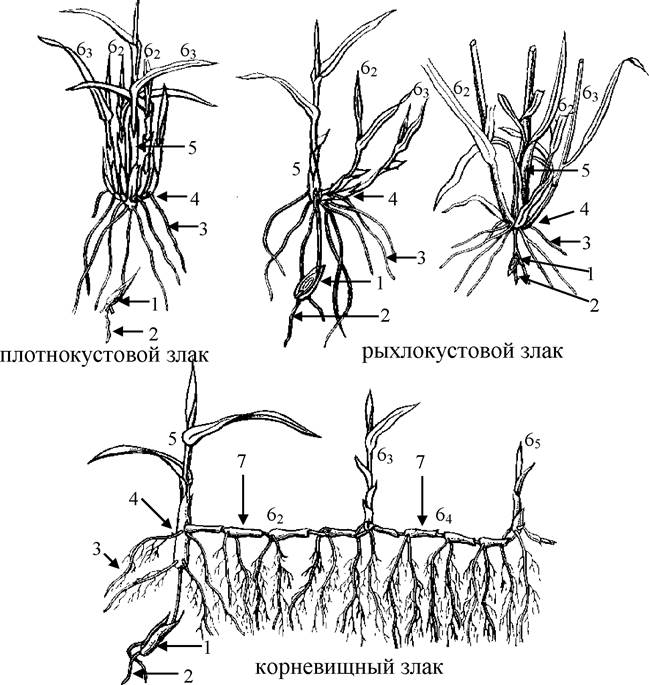
Densely tufted grasses (feather grass, sheep's fescue) produce shoots that grow vertically upward and closely adjoin one another, with their tillering node located on the soil surface. In loosely tufted grasses (wheat, oats, barley), shoots diverge at an angle, and the tillering node is established in the soil at a depth of
5–6 cm. Rhizomatous grasses (couch grass, Bermuda grass, smooth brome) possess underground shoots—rhizomes—from which upward-growing lateral shoots emerge, with the tillering node situated underground at a depth of 5–6 cm.
The high capacity for tillering and rooting in grasses evolved over the course of evolution and proved decisive in interspecific competition and their spread across all continents of the planet.
3.6. Classification of Shoots
Shoots are classified according to their direction of growth, internode length, and spatial orientation.
Based on their direction of growth (relative to the soil surface), shoots are divided into orthotropic and plagiotropic. Orthotropic shoots are upright and grow vertically upwards; plagiotropic shoots grow horizontally or at an angle.
Depending on internode length, typical shoots are divided into elongated shoots with extended internodes and shortened shoots with short internodes and closely spaced nodes (Fig. 14).
Figure 14. Types of shoots according to internode length (a - annual growth increment)

Elongated, or vegetative, shoots function as the skeletal supporting structures of the crown. They bear well-developed leaves.
Shortened shoots develop within the crowns of many fruit trees (apple, pear, cherry) and shrubs (currant, gooseberry). These shoots are generative, meaning they ensure flowering and fruiting. In fruit growing, they are referred to as "fruit spurs". Such shoots develop from lateral (axillary) buds, with an annual growth increment of just a few millimeters. These shortened shoots are entirely covered with numerous scars left by fallen bud scales and leaves. Some shortened shoots are vegetative and bear leaves (barberry, pine, larch, etc.).
Shortened shoots also include basal rosettes in dandelions, plantains, and other plants.
Depending on their spatial orientation, stems can be erect (sunflower, poplar), ascending (prostrate knotweed, red clover), twining (hops, field bindweed), tendril-climbing (ivy), climbing (grapevine, garden pea), prostrate (creeping Jenny, bird's-FOOT trefoil), and creeping (white clover) (Fig. 15).
Figure 15. Stem orientation in space: erect in maize, climbing in grapevine, twining in hops, creeping in clover, prostrate in loosestrife

Plants with twining, climbing, or tendril-bearing stems are often referred to as lianas. Lianas are characterized by rapid growth, elongated internodes, and lightweight, relatively thin stems, which allow them to reach the light by leaning on neighboring plants. Lianas can be either herbaceous or woody.
3.7. Modifications (Metamorphoses) of the Shoot
Both subterranean and aerial shoot metamorphoses are distinguished. Aerial metamorphoses include tendrils, spines, phylloclades, and cladodes; subterranean metamorphoses include tubers, bulbs, corms, and rhizomes.
Tendrils are modified shoots that serve for climbing and attaching to a support. Young tendrils are upright, but with age, they coil around a support. Tendrils are highly sensitive to Touch and can be simple or branched. Simple tendrils occur in cucumber, bifid tendrils in watermelon, and multi-branched tendrils in certain species of pumpkins (Fig. 16).
Figure 16. Grapevine tendrils

A spine represents a shortened shoot with a pointed apex. Spines are an adaptation of plants to living in dry and hot climates. They reduce the evaporating surface and protect plants from being eaten by animals. Spines can be simple (unbranched) or complex (branched). Simple spines are found in blackthorn and apricot, while complex ones occur in honey locust; however, in the early Selection/3.html">Stages of development, the spines of honey locust are simple. In some plants, only the tips of shoots with limited growth that end in a "point" transform into spines (blackthorn, cherry plum, sea buckthorn). In others, spines arise from axillary buds (hawthorn, lemon) (Fig. 17).
Figure 17. Spines

Phylloclades and cladodes are flattened, leaf-like stems or entire shoots. Phylloclades are lateral shoots that possess limited growth.
In butcher's-broom, which is widespread in the Caucasus and Crimea, phylloclades develop in the axils of scale-like leaves, and scale-like leaves and inflorescences also form on the phylloclades. In asparagus, the phylloclades are small, needle-like, and sessile in the axils of scale-like leaves of the main skeletal shoot.
Cladodes, unlike phylloclades, are shoots that retain the capacity for prolonged growth and feature green, flat, long stems. They are found in prickly pear cactus and the Australian plant Muehlenbeckia (Fig. 18).
Figure 18. Phylloclades and cladodes

Phylloclades and cladodes evolved in plants adapted to arid environments.
The tuber is a shoot metamorphosis characterized by a thickened stem and leaves reduced to small, inconspicuous, early-deciduous scales. Lateral buds develop in the leaf axils. Tubers can be above-ground (in cyclamen, the hypocotyl swells) or subterranean—such as in potatoes and Jerusalem artichokes—developing at the tips of elongated underground stems called stolons. The stem portion of a potato tuber is thickened and features shortened internodes. The end of the tuber facing the stolon and bearing a depression at the point of attachment is termed the base, while the opposite end is the apex. The attachment sites of undeveloped leaves—known as eyebrow ridges—are clearly visible on the tuber surface, with axillary buds (commonly called "eyes") located in their axils. The arrangement of the eyes on the tuber is spiral, mirroring the phyllotaxy on the stem. An apical bud is situated at the apex of the tuber. Each eye may contain up to three axillary buds, of which only one germinates while the others remain dormant. Under favorable conditions, the buds sprout rapidly and grow into independent plants, utilizing the reserve nutrients stored in the tuber. The bulk of the tuber consists of storage tissue, with cells packed with starch. Tubers contain Vitamin C; yellow-fleshed varieties contain carotene (provitamin A), and purple-fleshed varieties contain anthocyanins (Fig. 19).
Figure 19. Potato tubers

The bulb is a shortened, predominantly subterranean shoot consisting of a flattened stem (the basal plate or basal disc) with extremely short internodes, bearing fleshy, succulent scales that store water and nutrients. Bulbs vary widely in shape: pear-shaped, ovoid, flattened, etc. The stem portion of the bulb is small, flat or conical in shape, and is called the basal plate. Numerous fleshy leaf scales originate from the basal plate (Fig. 20).
Figure 20. Bulb structure

Bulbs may be tunicated (as in onions), where each scale completely envelops the preceding one, or imbricate (as in lilies), where the scales overlap like roof tiles without fully enclosing one another.
The outer bulb scales are often dry and protective, while the inner ones are succulent, storing reserve nutrients such as CARBOHYDRATES, biologically active compounds, Essential Oils, and vitamin C. The basal plate terminates in an apical bud, whose leaves give rise to above-ground green shoots. Adventitious roots develop on the underside of the basal plate. Buds form in the leaf axils of the bulb, giving rise to new bulbs, one of which will serve as the replacement bulb. From this replacement bulb, a flowering shoot develops the following year. Daughter bulbs (often called "offsets" or "cloves") form in the axils of other leaves and take several years to mature and flower. A bulb containing daughter bulbs is termed a compound bulb. It is enclosed in common outer scales (as in garlic and the round-headed leek) (Fig. 21).
Figure 21. Bulbs

All plant bulbs fall into two categories: those with rhizomes and those without. In rhizomatous bulbs, rhizomes grow horizontally outward from the basal plate through the soil, forming a new bulb at some distance from the parent bulb; this new bulb roots and can sprout after a few years. Examples include tulips and wild onions. Bulbs without rhizomes are much more common and serve as standard planting material in vegetable and flower farming.
In addition to subterranean bulbs, some plants produce aerial bulbs that develop from axillary buds in the leaf axils. These are known as bulbils and serve for vegetative propagation. Occasionally, such bulbils appear in inflorescences in place of flowers (e.g., bulbous bluegrass, viviparous knotweed).
Bulbous plants are most abundant in steppes, semi-deserts, deserts, high-altitude alpine zones, and broadleaf forests. They belong to the ecological group known as ephemeroids. Their above-ground flowering shoots are short-lived, appearing in early spring and
dying back by early summer after fruiting. The perennial underground shoot—the bulb—remains in the soil, allowing the plants to survive both summer drought and harsh winter conditions.
Corms are found in gladioli, crocuses, and colchicums. While they superficially resemble true bulbs, their reserve nutrients are stored in the stem tissue rather than leaf scales, exactly like a tuber, and all leaf scales are dry and membranous. New corms develop within the leaf axils (Fig. 22).
Figure 22. Crocus corms

The rhizome is a modified underground shoot characteristic of perennial herbaceous plants. It ensures natural vegetative propagation in many species (such as couch grass, Bermuda grass, field horsetail, and yarrow). While outwardly resembling a root, a rhizome differs in lacking a root cap and possessing reduced leaves in the form of colorless or brown scales, in whose axils lateral buds develop; adventitious roots emerge from the stem nodes (Fig. 23).
Figure 23. Rhizome of couch grass

Rhizome Morphology varies greatly: thin and horizontal in couch grass, thick and horizontal in irises, and so on. Every spring, above-ground shoots develop from the apical and axillary buds of the rhizome, which then die off in autumn. In short rhizomes, the buds are closely spaced, resulting in clustered above-ground shoots. In long rhizomes, the buds are set far apart, and the aerial shoots are scattered. As older sections of the rhizome decay, distinct new sections break away to become independent plants. Spreading in all directions, long-rhizomatous grasses rapidly colonize vast areas. If a rhizome produces just 5 above-ground shoots in its first year, and this propagation rate continues, a staggering 10 million new shoots can grow by the tenth year. This explains why rhizomatous weeds—such as couch grass, Bermuda grass, and Johnsongrass—are notoriously difficult to eradicate.
In the stem Tissues of rhizomes belonging to certain dicotyledonous plants, compounds of industrial and medicinal value are synthesized: Tannins in cinquefoil, Dyes in dyer's madder, and essential oils in valerian.
Last update: 07/08/2026
Editorial and Educational Adaptation: This material has been compiled based on the primary/original source text. The project team performed an editorial review, corrected technical inaccuracies, structured sections, and adapted the content for an educational format.
What was processed:
- elimination of formatting defects (OCR errors, structural breaks, corrupted characters);
- editorial organization of content;
- standardization of terminology in accordance with academic sources;
- verification of factual statements against the original source text.
All mentions of the author, publication year, and origin of the primary text have been preserved in accordance with the source.