MORPHOLOGY OF PLANT VEGETATIVE ORGANS
4. The Leaf
4.1. Concept of the Leaf, Functions of the Leaf
The leaf is a lateral, flattened plant organ with limited growth, which performs the functions of Photosynthesis, Transpiration, and gas exchange.
The Main Functions of a typical leaf are photosynthesis, Respiration, and transpiration. Additionally, the leaf can serve to store nutrients and Water, provide attachment (tendrils), protect against herbivores and excessive evaporation (spines), and participate in Vegetative Reproduction.
4.2. Structural Patterns of the Leaf
The leaf develops exogenously, initiating as a small protuberance on the SHOOT apex from the outer layers of the meristem. Frequently, paired structures—stipules—form on the sides of the lower (basal) part of this primordium; initially, they outgrow the leaf blade, covering and protecting it. The leaf blade develops later, growing first by its apex and subsequently by intercalary growth at the base. The leaf petiole forms later (Fig. 24).
Class="center">Figure 24. Leaf development (1 - leaf primordium, 2 - leaf blade, 3 - stipules, 4 - petiole)

As a lateral organ by origin, the leaf has a more or less flat shape, a dorsiventral Structure (from Lat. dorsum - back, venter - belly; dorsoventralis - dorsal-ventral), and a single plane of Symmetry.
As a rule, a leaf cannot form other Organs on itself, although in some cases adventitious buds and roots can form on leaves (in Begonia, Saintpaulia, etc.).
4.3. MORPHOLOGICAL STRUCTURE OF the Leaf
A typical mature leaf is subdivided into a leaf blade (or multiple blades in compound leaves), a petiole, stipules, and a leaf base (Fig. 25).
Figure 25. Leaf structure

The leaf blade is the most important part of a typical leaf, carrying out its primary functions: photosynthesis, gas exchange, and transpiration. The leaf blade is characterized by a flat shape, dorsiventrality, and limited growth.
The petiole connects the leaf blade to its base. Its functions include support, conduction, and orientation of the leaf blade relative to the light source, which is achieved through varying petiole lengths and curvatures. Depending on the length of the petiole, leaves are classified as petiolate or short-petiolate. Based on the presence or absence of a petiole, leaves may be petiolate, where the leaf blade is attached to the stem via
a petiole, or sessile, where the leaf lacks a petiole and attaches directly to the stem by its base (Fig. 26).
Figure 26. Petiolate and sessile leaves

Depending on how sessile leaves attach to the stem, they can be semi-amplexicaul, where the expanded Base of the leaf blade partially embraces the stem; amplexicaul, where the expanded base completely embraces the stem; perfoliate, where the base of the leaf blade surrounds the stem and its edges fuse together; or decurrent, where the edges of the leaf blade grow down along the internode (Fig. 27).
Figure 27. Various Forms of leaf attachment to the stem

The leaf base represents its basal part that articulates with the stem. It may be inconspicuous or slightly thickened (Fig. 28).
Figure 28. Petiolate leaf with a pulvinus at the base

The base can significantly expand in length and width, enclosing the internode and forming a leaf sheath that protects the axillary buds and the intercalary meristem at the base of the internode (Fig. 29).
Figure 29. Structure of a sheathing leaf

At the junction where the sheath transitions into the leaf blade, a ligule is formed—a small, colorless, membranous outgrowth. The margins of the leaf blade at this point form auricles. The ligule helps optimize illumination of the leaf blade by deflecting the leaf, and prevents moisture, phytopathogenic fungal spores, and insect larvae from penetrating into the sheath tube, thereby protecting the intercalary meristem. The formation of a leaf sheath is characteristic of representatives of both monocot classes (families Liliaceae, Cyperaceae, Poaceae) and dicot classes (family Apiaceae).
Paired lateral outgrowths, known as stipules, frequently form at the base of the leaf. The shape, size, and functions of stipules vary among different plants (Fig. 30).
Figure 30. Various forms of stipules (st - stipules)

Stipules develop earlier than the leaf blade and serve to protect it; subsequently, they may persist for a long time or be shed after bud break. Stipules can be free (as in grapes) or adnate to the petiole (as in rose and pea) (Fig. 31).
Figure 31. Types of stipules

4.4. Classification of Leaves
Depending on the number of leaf blades, leaves are subdivided into simple and compound.
4.4.1. Simple Leaves
A leaf possessing a single leaf blade, only one joint between the petiole and the stem, and falling entirely during leaf fall is termed a simple leaf.
Simple leaves are typical of virtually all herbaceous plant species and the majority of tree and shrub species. The leaf blade may be entire or lobed to varying degrees. If the incisions of the leaf blade do not exceed 1/4 of the width of its half-blade, the leaf is considered to have an entire blade; if the incisions are deeper, it has a divided blade.
Leaves with an entire leaf blade are characterized by 5 features:
- by the shape of the leaf blade;
- by the margin shape of the leaf blade;
- by the apex shape of the leaf blade;
- by the base shape of the leaf blade;
- by the venation pattern of the leaf blade.
The shape of the leaf blade is determined by The ratio of its length to width and THE POSITION OF its maximum width (Fig. 32).
Figure 32. Shapes of leaf blades

Special forms of the leaf blade are distinguished: scale-like, needle-like, cordate, reniform, sagittate, hastate, etc. (Fig. 33).
Figure 33. Special forms of the leaf blade: 1 - linear-ribbon, 2 - ensiform, 3 - filiform, 4 - setaceous, 5 - acicular, 6 - scale-like, 7 - terete, 8 - sagittate, 9 - hastate, 10 - triangular, 11 - rhombic, 12 - cordate, 13 - reniform, 14 - spathulate, 15 - peltate

Based on the margin shape of the leaf blade, leaves are classified as entire, dentate, doubly dentate, serrate, doubly serrate, crenate, sinuate, etc. (Fig. 34).
Figure 34. Leaf margin shapes

Based on the apex shape of the leaf blade, obtuse, acute, acuminate, cuspidate leaves, leaves with an emarginate apex, etc. are distinguished (Fig. 35).
Figure 35. Apex shapes of the leaf blade

Based on the base shape of the leaf blade, leaves can be cuneate, rounded, cordate, truncate, hastate, etc. (Fig. 36).
Figure 36. Base shapes of the leaf blade

Venation of the leaf blade is determined by the arrangement pattern and branching method of the Veins. Several types of venation are distinguished.
In dichotomous venation, veins branch dichotomously and do not form anastomoses (small transverse veins connecting larger ones). Dichotomous venation is characteristic of fern leaves, and among gymnosperms, of Ginkgo.
In parallel venation, veins run parallel to each other along the entire leaf blade (leaves of Poaceae and some Liliaceae).
In arcuate venation, veins are curved in an arc, running parallel to the leaf margin (leaves of lily of the valley, plantain).
In reticulate venation, a main vein runs down the middle of the leaf blade, from which repeatedly branching lateral veins extend. Reticulate venation is most common in dicotyledonous
plants.
In palmate venation, 3–5 or more veins of approximately equal thickness diverge from the base of the leaf blade (leaves of maple, plane tree, currant) (Fig. 37).
Figure 37. Types of leaf blade venation

Leaves with a lobed or divided leaf blade are characterized by:
- the pattern of blade dissection (ternate, palmate, pinnate);
- the degree of dissection (depth of incisions) of the leaf blade (lobed, cleft, partite);
- Other forms of dissection.
If the depth of the leaf blade incision is greater than 1/4 and less than 1/2 of the half-blade width, the leaf is called lobed, and the projections between the incisions are lobes. If the leaves are dissected for more than 1/2 of the half-blade width, but the incisions do not reach the midrib or the base of the leaf, the leaf is called cleft, and the projections between the incisions are known as clefts (or divisions). If the incisions reach the midrib or the base of the leaf, the leaf is called parted, and the projections are segments. Depending on the number and arrangement of the projections, ternate, palmate, and pinnate dissection are distinguished (Fig. 38).
Figure 38. Types of dissection in simple leaf blades
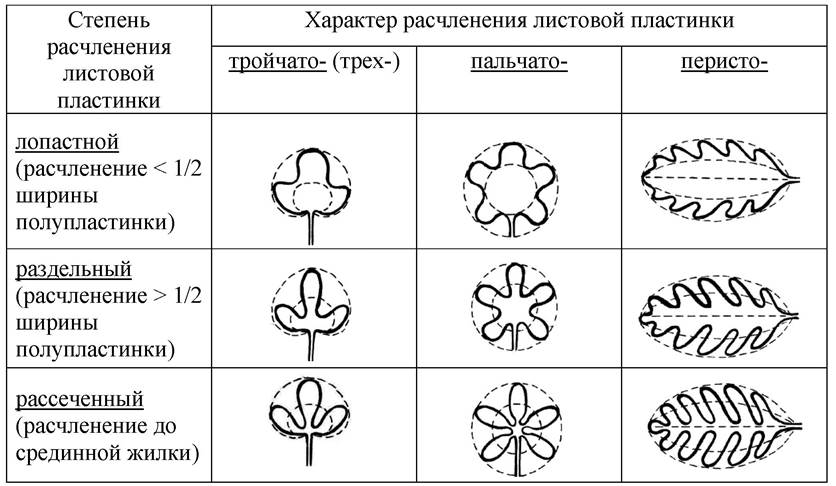
The name of a leaf with a dissected blade is derived from the pattern and degree of dissection (e.g., ternately lobed, palmately cleft, pinnately parted, etc.). Leaves can be twice or thrice dissected if the lobes or segments of their leaf blades are, in turn, dissected as well.
Aside from general types of dissection, there are other specific forms of leaf blade dissection. A lyrate leaf features a rounded upper lobe, division, or segment that is significantly larger than the lateral ones. A pectinate leaf has narrow, linear, parallel segments. A runcinate leaf is characterized by sharp, triangular lobes or segments. An interruptedly pinnate leaf exhibits an alternation of large and small lobes and segments (Fig. 39).
Figure 39. Special forms of leaf blade dissection

4.4.2. Compound Leaves
A compound leaf has multiple leaf blades (leaflets), each with its own petiolule attached to a common axis (the main petiole), known as the rachis (Fig. 40).
Figure 40. Structure of a compound leaf

During leaf fall, the leaflets of a compound leaf drop first, followed by the rachis, because an abscission zone exists between the leaflets and the rachis. Depending on the number of leaflets and their arrangement, the following types of compound leaves are distinguished.
A trifoliate leaf has three leaflets attached at a single point (as in clover, strawberry, and wood sorrel).
In a palmately compound leaf, more than three leaflets are attached at a single point (as in horse chestnut and lupine).
In pinnately compound leaves, the leaflets are arranged along the sides of the rachis. An imparipinnate (odd-pinnate) leaf ends in a single terminal leaflet (as in black locust and rowan), while a paripinnate (even-pinnate) leaf ends in a pair of leaflets (as in pea, vetchling, and vetch).
Depending on the degree of rachis branching, bipinnate and tripinnate leaves are distinguished. In this case, the leaflets attach to secondary or tertiary axes (Fig. 41).
Figure 41. Compound leaves

4.5. Heterophilly. Leaf Mosaic
Different leaf forms may occur on a single shoot. Plants frequently exhibit ontogenetic heterophilly, or varied leaf Morphology (differences in the shape, size, and structure of leaves on the same plant). In this regard, plants display three categories (formations) of leaves depending on their position. Low leaves are located at the base of the shoot and appear as scales or membranous structures. Their leaf blades are often underdeveloped. In most cases, they wither away before the end of the plant's growing season. Low leaves perform a protective function. Intermediate leaves develop in the middle part of the shoot; they are well-developed, green, and carry out photosynthesis, transpiration, and gas exchange. They are the most characteristic leaves for a given plant. Upper leaves develop in the inflorescence region, serving as bracts for individual flowers or inflorescence branches. They are underdeveloped, faintly colored, lacking petioles and stipules, and may be membranous. Sometimes upper leaves perform an additional function of attracting insects, in which case they are brightly colored.
The appearance of leaves with varying structures and shapes on a single plant may be related not only to age-related differences but also to the Influence of Environmental factors. In such cases, the phenomenon is referred to as ecological heterophilly. It is particularly pronounced in aquatic plants. The floating (supra-aquatic) leaves of these plants are entire or lobed, whereas submerged leaves are repeatedly dissected into thread-like segments or ribbon-like structures (Fig. 42).
Figure 42. Ecological heterophilly

As the shoot grows, the arrangement of leaves may change. Leaf petioles are capable of bending, thereby rotating the leaf blade. As a result, a leaf mosaic is formed—an spatial arrangement of leaves that minimizes mutual shading and optimizes light interception. In this arrangement, leaf blades lie horizontally, avoiding mutual shading, with smaller leaves positioned in the gaps between larger ones. This maximizes the utilization of scattered sunlight.
4.6. Leaf Lifespan. Leaf Fall (Abscission)
Leaf lifespan refers to the period from bud burst to leaf Senescence and Death. In deciduous trees and shrubs, leaf lifespan is 4–5 months. In plants of subtropical, taiga, tundra, and alpine regions, leaves live from 2 to 5 years. In conifers, leaves function for 15 years or even longer.
Once leaves reach their maximum size, Aging processes begin, leading to senescence. This is accompanied by the outflow of various plastic substances (CARBOHYDRATES, Amino Acids) from the leaf blades. The leaf changes color—turning yellow or red—due to The breakdown of chlorophyll and the accumulation of carotenoids and anthocyanins.
During leaf aging, an abscission layer forms at its base, consisting of easily separating parenchyma. Along this layer, the leaf detaches from the stem, and a protective cork layer forms at the site of the future leaf scar. In monocots and herbaceous dicots, an abscission layer usually does not form, and the leaf dies and disintegrates gradually.
In deciduous trees and shrubs, leaf fall—known as defoliation—occurs in autumn. The trigger for this process is the changing day length.
Leaf fall has an adaptive significance because it reduces the evaporating surface, protecting the above-ground Organs of the plant from drying out in winter, since moisture loss during this time cannot be compensated. Dropping leaves reduces the likelihood of heavy snow accumulation on branches, which could otherwise lead to broken limbs and downed trunks. In frost-free regions with sharply defined dry periods (such as tropical savannas), leaf fall helps plants survive the drought.
4.7. Leaf Modifications (Metamorphoses)
Leaves can be modified into tendrils, spines, phyllodes, trap devices, scales, fleshy scales, etc.
The upper part of the leaf or the entire leaf may transform into a simple or branched tendril, which is sensitive to Touch and adapted for climbing. In Representatives of the genera *Pisum* (pea), *Lathyrus* (vetchling), and *Vicia* (vetch), the upper part of the rachis and three to seven leaflets are modified into tendrils (Fig. 43).
Figure 43. Tendrils

Spines serve to reduce the evaporating surface of the plant's aerial part and protect other plant organs from being eaten by animals. Spines are more common in plants inhabiting dry and hot climates. In cacti, leaves are completely metamorphosed into spines, which, In addition to reducing evaporation, condense water vapor from the air. In barberry, the leaves of elongated shoots turn into spines. In sainfoin and milkvetch, the rachis of a compound leaf may be modified into a spine after the leaflets fall. In acacia, spurge, robinia, and Christ's thorn, stipules are modified into spines (Fig. 44).
Figure 44. Spines

Phyllodineous acacias, growing in desertified savannas of southwestern Australia, are characterized by the presence of phyllodes. These are metamorphoses of the petiole or leaf base into a structure resembling a leaf blade and performing the function of photosynthesis. Phyllodes look like leaves with an entire blade; they are thick and leathery (Fig. 45).
Figure 45. Shoot of a phyllodineous acacia (the lower part of the shoot bears bipinnate leaves with conventional petioles, while the upper part bears leaves consisting solely of phyllodes)

Bulbous plants are characterized by Two Types of metamorphoses—dry and succulent bulb scales. The dry outer scales perform a protective function, while the succulent ones are modified leaf bases that serve to store nutrients (Fig. 46).
Figure 46. Dry and succulent bulb scales

Among the most fascinating metamorphoses are trap devices. They develop in carnivorous plants that grow in mineral-deficient soils and obtain nitrogen- and phosphorus-rich Nutrition by digesting animals. The structure of trap devices varies. In the round-leaved sundew (*Drosera rotundifolia*), which is widespread in the northern and central regions of Russia, the upper surface and edges of the leaves bear glandular-headed hairs. Insects, attracted by the mucus secreted by these glands, land on the leaf, after which the leaf margin slowly curls inward and captures the insect, which is then digested by Enzymes contained within the mucus (Fig. 47).
Figure 47. Leaves of the round-leaved sundew

In the coastal region of North Carolina (USA), the Venus flytrap (*Dionaea muscipula*) grows, whose leaves have transformed into two circular lobes equipped with long Teeth along the margins. On the surface of both lobes, there are three sensitive trigger hairs. When an insect touches these hairs, the leaf lobes snap shut. The inner surface of the leaf features small glands that secrete a fluid containing digestive enzymes (Fig. 48).
Figure 48. Venus flytrap

The most complex trapping mechanisms are found in plants of the genus Nepenthes, which grow in tropical Asia, Australia, the Seychelles, and Madagascar. During the Formation of the trap, the tip of the leaf elongates into a thin, long tendril, at the end of which a pitcher with a lid develops. A broad blade at the base of the leaf performs photosynthesis, the elongated middle section can twine around tree trunks, and the apical part—the pitcher—serves to catch insects. The outer surface of the pitcher features serrated outgrowths that provide structural support for the trap while guiding crawling insects. The upper rim of the pitcher bears Cells that secrete sweet nectar to attract insects, as well as wax that renders the surface slippery. Consequently, insects that fall inside the pitcher cannot escape, as the inner surface of the trap is lined with numerous stiff, downward-pointing hairs. Digestive enzymes are secreted within the pitcher to digest the trapped insects. The pitcher features a fixed lid that prevents rainwater from entering while simultaneously serving as a landing platform for insects (Fig. 49).
Figure 49. Leaf of a Nepenthes plant

Last update: 07/08/2026
Editorial and Educational Adaptation: This material has been compiled based on the primary/original source text. The project team performed an editorial review, corrected technical inaccuracies, structured sections, and adapted the content for an educational format.
What was processed:
- elimination of formatting defects (OCR errors, structural breaks, corrupted characters);
- editorial organization of content;
- standardization of terminology in accordance with academic sources;
- verification of factual statements against the original source text.
All mentions of the author, publication year, and origin of the primary text have been preserved in accordance with the source.