MORPHOLOGY OF PLANT VEGETATIVE ORGANS
5. Root and Root System
5.1. Concept of the ROOT, Functions of the root
The root is an axial vegetative organ that does not bear leaves, exhibits radial Symmetry, and grows in length as long as the apical meristem remains active.
The primary function of the root is to absorb Water and dissolved mineral nutrients from the soil. In addition, the root anchors the plant in the soil, serves as a storage organ for reserve nutrients, and synthesizes certain Organic compounds that are subsequently transported to other plant Organs. In root-suckering plants, roots also perform the function of vegetative propagation.
5.2. Structural patterns of the root
The root emerged in connection with the transition of plants to land. A typical root is a subterranean organ characteristic of all vascular plants except mosses. The morphological differences between a root and a stem lie in the absence of leaves or any of their modifications on the root. The apical meristem of the root, which ensures its elongation, is protected by a root cap. Roots exhibit positive geotropism and therefore grow primarily downward into the soil, unlike the stem, which is characterized by negative geotropism.
5.3. Classification of roots
According to their origin, roots are divided into primary (tap), adventitious, and lateral roots. The primary root develops from the embryonic radicle of the seed. Adventitious roots arise on other plant organs (stems, leaves). Lateral roots are Branches of the primary and adventitious roots.
In relation to their substrate (habitat), roots are classified as terrestrial, aquatic, aerial, and parasitic. Terrestrial roots are typical of 70% of modern seed plants and develop in the soil. Aquatic, or floating, roots form in water in floating aquatic plants. Aerial roots are located in the air and are typical of epiphytic plants that grow on the stems and branches of other plants. Parasitic roots (haustoria) are found in parasitic plants and proliferate within the Tissues of the host plant.
According to their shape, roots are divided into cylindrical (thick, with a uniform diameter throughout), cord-like and filiform (also uniform in diameter along their entire length, but thinner), nodulose (with irregular node-like thickenings), globose, napiform, etc.
5.4. Classification of root systems
A root system is the aggregate of all the roots of an individual plant. Two Types of Root systems are distinguished: taproot and fibrous (Fig. 50).
Class="center">Figure 50. Types of root systems
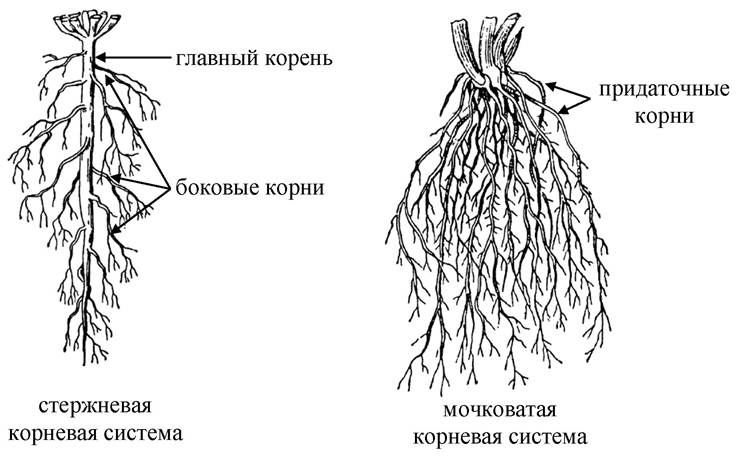
The taproot system is characterized by a well-developed primary root that significantly exceeds the lateral roots in length and thickness. This type of root system is typical of members of the class Dicotyledones and is particularly well developed in woody plants.
The fibrous root system lacks a prominent primary root. It is either poorly developed or dies off in the early Selection/3.html">Stages of development. The Root System is formed by A large number of adventitious roots that develop at the lower nodes of the stem. The fibrous root system appeared later in an evolutionary sense As a result of plant ADAPTATION TO ENVIRONMENTAL conditions.
The Development of the root system facilitates the penetration of plant roots to great depths and widths in the soil, allowing them to occupy the maximum possible volume. Root expansion significantly increases the absorbing surface area of the root. Plants can form root systems in 2–3 tiers, which is determined by the distribution of nutrients and moisture in the soil.
5.5. Root modifications (metamorphoses)
Root modifications include root crops, root tubers, stilt roots, respiratory roots, contractile roots, haustoria, etc.
Storage roots perform the function of nutrient storage. This is accompanied by significant thickening of the root. Among storage roots, root crops and root tubers are distinguished.
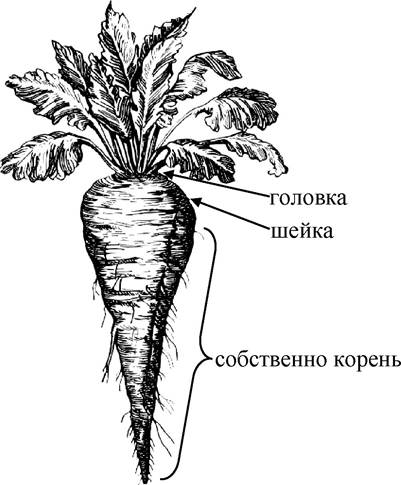
A root crop is a modified, thickened primary root that can be napiform, fusiform, or cylindrical in shape. Morphologically, a root crop consists of a HEAD, a neck, and the true root proper, which differ in origin. The head of the root crop is its upper part; it bears leaves and buds and represents a shortened stem. The neck is located below the head, bears no leaves or roots, and represents the expanded hypocotyl. The true root proper is the lower part of the root crop, which is strongly thickened and gives rise to lateral roots. Root crops are well developed in beets, carrots, radishes, and turnips (Fig. 51).
Figure 51. Beet root crop
Root tubers arise as a result of the modification and thickening of lateral and adventitious roots in lesser celandine, orchids, and dahlias (Fig. 52).
Figure 52. Root tubers

Stilt roots are modified adventitious roots that form on the stem of the main SHOOT at a height of 2–3 m. They are well-developed in mangrove plants, which grow in tidal inundation zones (Fig. 53).
Figure 53. Stilt roots

Respiratory roots (pneumatophores) also develop in plants inhabiting waterlogged environments. In this case, lateral roots grow horizontally, producing branches with negative geotropism that grow vertically upwards. They grow through the soil to form pneumatophores. Their main function is to supply the roots with oxygen (Fig. 54).
Figure 54. Respiratory roots

Aerial roots are characteristic of epiphytic plants; they absorb water from atmospheric water vapor and precipitation (Fig. 55).
Figure 55. Aerial roots of an orchid

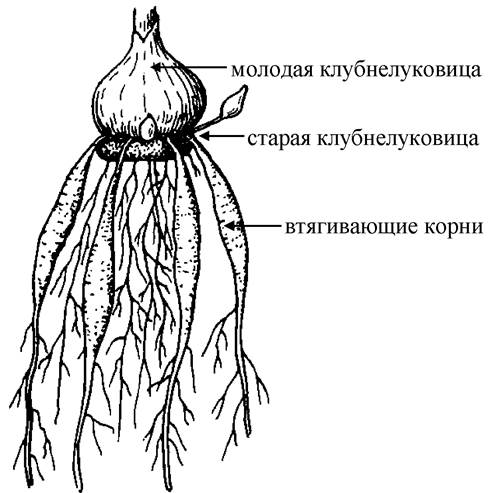
Contractile roots can shorten at their base, pulling the shoot (bulb or rhizome) deeper into the soil. Such roots are found in gladioli, irises, lilies, fritillaries, and other plants (Fig. 56).
Figure 56. Corm of a gladiolus with thickened contractile roots at the base
Plank roots are large plagiotropic lateral roots featuring a flat, board-like outgrown Structure along their entire length. They develop in trees of the upper and middle layers of tropical rainforests and provide them with structural support.
Pillar roots are typical of tropical figs (such as the banyan tree, sacred fig, and rubber plant). They initially form as adventitious roots on the tree branches, eventually reaching the soil and taking root. Over time, they transform into pillar-like roots that support the tree canopy (Fig. 57).
Figure 57. Pillar roots of a banyan tree

Climbing roots (or holdfasts) are modified aerial roots that develop in lianas and help them attach to vertical Supports. In parasitic plants, haustorial roots penetrate the tissues of the host plant and absorb nutrients from it (Fig. 58).
Figure 58. Climbing roots of ivy

5.6. Mycorrhiza and Root Symbiosis
The roots of many plants can form symbiotic associations (mutually beneficial relationships) with Fungi and Bacteria.
The association between higher plant roots and fungi is known as mycorrhiza. Here, fungal hyphae encircle the plant roots, forming a dense mantle that facilitates the uptake of water and dissolved mineral salts. In return, the fungus receives nitrogen-free organic compounds from the plants. Based on their structure, two MAIN TYPES OF mycorrhiza are distinguished: ectotrophic and endotrophic (Fig. 59).
Figure 59. Mycorrhiza

Ectomycorrhiza (external mycorrhiza) is formed when fungal hyphae encircle plant roots to create a dense mantle. This type is widespread among woody plants, such as birch, linden, oak, and aspen. Root hairs atrophy when this type of mycorrhiza is present. The fungal hyphae supply the plant entirely with water and mineral nutrients. In endomycorrhiza (internal mycorrhiza), the fungal hyphae penetrate the interior of the root Cells while the cells remain alive; the mycelium breaks down, and its contents are gradually assimilated by the plant. Ectotrophic mycorrhiza is more commonly found in herbaceous plants.
For certain plants (such as oak, pine, and aspen), the presence of fungi is a prerequisite due to their specialized type of Nutrition known as mycotrophy—that is, nutrition mediated by fungi.
Plants can enter into a symbiotic relationship with bacteria of the genus Rhizobium, leading to The formation of root nodules. These bacteria penetrate plant roots from the soil through The Cell walls of root hairs, stimulating the proliferation and enlargement of root cells. As a result, growths known as nodules are formed, within which bacterial colonies develop. The bacteria fix atmospheric nitrogen and convert it into a bound form that can be assimilated by the plant, while utilizing the nutrients found within the root cells. Thus, the bacteria enhance the nitrogen nutrition of plants, and upon root decay, they enrich the soil with nitrogen. Nodulation on roots is characteristic primarily of members of the legume family (Fabaceae), such as clover, alfalfa, peas, and vetch (Fig. 60).
Figure 60. Root nodules on leguminous plants

Last update: 07/08/2026
Editorial and Educational Adaptation: This material has been compiled based on the primary/original source text. The project team performed an editorial review, corrected technical inaccuracies, structured sections, and adapted the content for an educational format.
What was processed:
- elimination of formatting defects (OCR errors, structural breaks, corrupted characters);
- editorial organization of content;
- standardization of terminology in accordance with academic sources;
- verification of factual statements against the original source text.
All mentions of the author, publication year, and origin of the primary text have been preserved in accordance with the source.