MORPHOLOGY OF VEGETATIVE PLANT ORGANS
2. Structure of Seedlings
The principal Water/115.html">Vegetative Organs of seed plants—both underground (ROOT) and aboveground (SHOOT)—are already established within the seed. Their development and subsequent structural elaboration occur during seed germination, seedling growth, and the establishment of mature plants.
In monocotyledonous plants (family Poaceae), when the seed germinates, the root begins to grow first; it ruptures the seed coat and penetrates the soil (Fig. 1).
Class="center">Figure 1. Germination of a wheat grain

The young seedling anchors itself in the soil and absorbs water containing dissolved mineral salts. Following the root, the shoot begins to grow—consisting of a stem with leaves and buds. A bud, protected by the first embryonic leaf known as the coleoptile, pushes its way up through the soil. The first true leaf emerges to the exterior by rupturing the coleoptile.
Soon the primary root, which developed from the embryonic radicle, dies off, while adventitious roots form from shortened internodes, establishing a fibrous root system.
In dicotyledonous plants, the embryonic radicle also begins to grow first. During the Initial Stages of germination, the stem is loop-shaped. Using this bend, it pushes through the soil, then straightens out, bringing the cotyledons and the plumule up to the surface. The cotyledons turn green and photosynthesize for a time, while the bud continues to grow upward, forming the stem and the first true leaves. These are referred to as juvenile leaves because they differ markedly from the leaves of the mature plant.
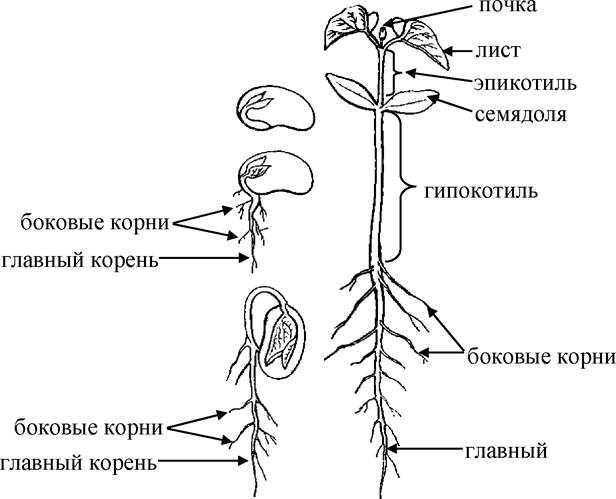
The region between the root and the stem is termed the root collar. The portion of the stem between the root collar and the cotyledons is the hypocotyl (or hypocotyledonous axis), while the portion between the cotyledons and the first leaves is the epicotyl (or epicotyledonous axis) (Fig. 2).
Figure 2. Bean seed seedling
In some dicotyledonous plants (such as pea and oak), the hypocotyl does not develop, and the cotyledons are not brought to the surface, remaining instead in the soil.
Last update: 07/08/2026
Editorial and Educational Adaptation: This material has been compiled based on the primary/original source text. The project team performed an editorial review, corrected technical inaccuracies, structured sections, and adapted the content for an educational format.
What was processed:
- elimination of formatting defects (OCR errors, structural breaks, corrupted characters);
- editorial organization of content;
- standardization of terminology in accordance with academic sources;
- verification of factual statements against the original source text.
All mentions of the author, publication year, and origin of the primary text have been preserved in accordance with the source.