BIOLOGY Volume 3 - A Guide to General Biology - 2004
23. THE CONTINUITY OF LIFE
23.9. Regulation of Gene Activity
Following the deciphering of METABOLISM/28.html">The Genetic Code and the elucidation of Introduction/20.html">DNA Structure, research in genetics made monumental strides. One of the central questions engaging molecular geneticists is how the Regulation of Gene activity ensures that every Cell carries out a unified developmental program while simultaneously performing its own specialized Functions.
All somatic Cells of a given Organism carry the same Complement of genes; that is, they contain an identical number of Chromosomes bearing the same alleles. Nevertheless, the cells of a multicellular organism vary widely in Structure and function. Even within a single cell, The rate of Protein Synthesis can fluctuate depending on prevailing circumstances and metabolic demands. Insights into the mechanisms controlling gene activity within cells were first gained through The Study of ENZYME SYNTHESIS REGULATION in E. coli.
In 1961, François Jacob and Jacques Monod conducted a series of experiments to understand The Nature of enzyme induction in E. coli. It is estimated that the cells of this bacterium synthesize roughly 800 Enzymes. Some of these are produced continuously and are termed constitutive enzymes; others are manufactured only in the presence of a specific inducer, which need not be the substrate of the enzyme itself. Such enzymes, exemplified by β-galactosidase, are called inducible enzymes.
E. coli grows rapidly on a culture medium containing glucose. When cells are transferred to a medium containing lactose instead of glucose, growth does not resume immediately, but experiences a brief lag before proceeding at the same rate as on the glucose medium. Research has shown that growth on lactose requires two substances that E. coli does not normally synthesize: β-galactosidase, which hydrolyzes lactose into glucose and galactose, and lactose permease, which enables The Cell to rapidly absorb lactose from the environment. This illustrates how an environmental shift (replacing glucose with lactose) induces the synthesis of a specific enzyme. Other experiments with E. coli demonstrated that a high concentration of The amino acid Tryptophan in the medium suppresses The production of tryptophan synthase, an enzyme required for tryptophan synthesis. The synthesis of β-galactosidase serves as an example of enzyme induction, whereas the suppression of tryptophan synthase synthesis serves as an example of enzyme repression. Based on these observations, Jacob and Monod proposed a mechanism explaining Induction and Repression—the genetic "on-off" switch mechanism.
Class="center">23.9.1. The Jacob-Monod Hypothesis
The genetic instructions determining the Amino acid sequences of the aforementioned Proteins are contained within structural genes. The instructions for β-galactosidase and lactose permease are closely linked on the same chromosome. The activity of these genes is regulated by another gene—the regulator gene—which is thought to prevent structural genes from entering an active state. The regulator gene may reside at some distance from the structural genes. Evidence for its existence comes from studies of mutant E. coli cells lacking this gene, which therefore produce β-galactosidase constitutively. The regulator gene contains the genetic code for a repressor protein that blocks the activity of the structural genes. The repressor does not act directly on the structural genes, but rather indirectly by influencing an adjacent region known as the operator gene. The operator and structural genes together constitute an Operon (Fig. 23.34).
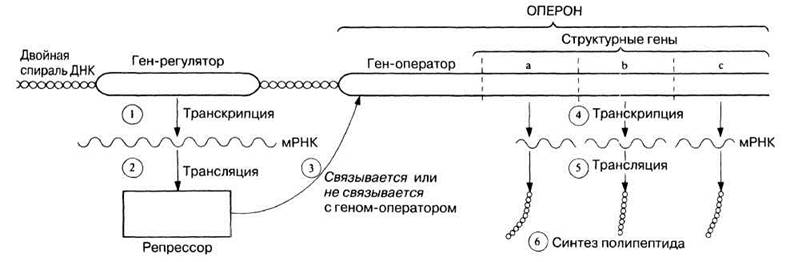
Fig. 23.34. Key structures and processes involved in the Regulation of Protein Synthesis According to the Jacob and Monod hypothesis. Numbers indicate The sequence of events.
The repressor is a specialized allosteric protein that either binds to the operator gene, suppressing its activity ("switching it off"), or fails to bind, allowing it to become active ("switching it on"). When the operator is "on," the structural genes undergo Transcription to produce mRNA, which is then translated by Ribosomes and tRNA into Polypeptides. When the operator is "off," no mRNA is produced, and its encoded polypeptides are not synthesized (Fig. 23.34).
The mechanism determining whether the allosteric protein attaches to the operator gene is simple yet sensitive to intracellular fluctuations. It is hypothesized that the repressor molecule possesses at least two active sites capable of binding either an inducer molecule or a corepressor molecule, depending on their relative concentrations at any given time, as described in Section 23.9.4.
23.9.2. Enzyme Induction
The binding of an inducer molecule to its Active Site on the repressor alters the repressor's tertiary structure (an allosteric effect; see Section 4.4.4), rendering it unable to bind to the operator gene and thereby lifting repression. The operator gene becomes active and "switches on" the structural genes.
When E. coli is cultured on a glucose medium, the regulator gene produces a protein with repressor properties that binds to the operator gene and "switches it off." Consequently, the structural genes remain unactivated, and neither β-galactosidase nor lactose permease is synthesized. Upon transferring the Bacteria to a lactose-containing medium, the lactose acts as an inducer of protein synthesis by binding to the repressor molecule and preventing its attachment to the operator gene. The structural genes shift to an active state, mRNA is produced, and the enzymes are synthesized. Thus, lactose induces its own breakdown.
23.9.3. Enzyme Repression
When a corepressor molecule binds to its active site on the repressor protein, it enhances the affinity of the repressor for the operator gene. This results in the inactivation of the operator, effectively preventing the structural genes from being "switched on."
E. coli synthesizes the amino acid tryptophan in the presence of the enzyme tryptophan synthase. When tryptophan is present in excess within the cell, a portion of it acts as a corepressor for enzyme synthesis by binding to the repressor molecule. The corepressor-repressor complex attaches to the operator gene and inhibits its activity. The structural genes are "switched off," mRNA is no longer produced, and tryptophan synthase synthesis halts. This represents an example of feedback inhibition at the genetic level.
23.9.4. Regulation of Metabolic Pathways
The dual mechanism of induction and repression described above enables intricate crosstalk between the Cytoplasm and The Genome, ensuring fine-tuned Regulation of cellular metabolism. In a simple metabolic pathway, the initial substrate and the final product can function as an inducer and a repressor, respectively. This allows the cell to synthesize enzymes in precisely the quantities needed at any given moment to maintain the end-product at optimal levels. Such a regulatory strategy is exceptionally economical. Negative feedback mediated through the allosteric inhibition of the first enzyme by the end-product rapidly halts a metabolic pathway without disrupting the Synthesis of Other enzymes. In the model proposed by Jacob and Monod, the end-product binds to the repressor molecule to amplify its inhibitory effect on the operator gene, shutting down the synthesis of all pathway enzymes and effectively halting the entire metabolic route.
23.9.5. Modifications to The operon hypothesis
Following the proposal of the gene switch mechanism by Jacob and Monod in 1961, subsequent research yielded further data that clarified various aspects of the model. Genetic evidence led to the postulate of a promoter gene located adjacent to the operator gene, positioned between it and the regulator gene. The promoter is thought to serve two primary functions. First, it acts as the binding site where RNA polymerase attaches before moving along the DNA during transcription—the process by which mRNA is synthesized from structural genes. This movement, of course, depends on whether the operator gene is in an active state. Second, The base sequence of the promoter determines which of the two DNA strands binds RNA polymerase, thereby serving as the template for mRNA transcription.
Last update: 06/08/2026
Editorial and Educational Adaptation: This material has been compiled based on the primary/original source text. The project team performed an editorial review, corrected technical inaccuracies, structured sections, and adapted the content for an educational format.
What was processed:
- elimination of formatting defects (OCR errors, structural breaks, corrupted characters);
- editorial organization of content;
- standardization of terminology in accordance with academic sources;
- verification of factual statements against the original source text.
All mentions of the author, publication year, and origin of the primary text have been preserved in accordance with the source.