BIOLOGY Volume 3 - A Guide to General Biology - 2004
24. VARIATION AND GENETICS
Genetics can rightfully be considered one of the most vital fields of biology. For millennia, humans have employed Genetic Methods to improve domestic animals and cultivated plants without having any understanding of the underlying mechanisms. Judging by various archaeological findings, as early as 6,000 years ago people realized that certain physical traits could be passed down from one generation to the next. By selecting specific organisms from natural populations and cross-breeding them, humans developed improved plant varieties and animal breeds possessing desired characteristics.
However, it was not until the early 20th century that scientists began to fully grasp Structure/19.html">The Importance of the laws of heredity and its mechanisms. Although advances in Cell/15.html">Microscopy made it possible to establish that hereditary traits are transmitted from generation to generation via sperm and egg Cells, it remained unclear how microscopic particles of biological material could carry the vast array of traits that make up an individual Organism.
The beginning of scientific research in the field of heredity was pioneered by the Austrian monk Gregor Mendel, who in 1866 published a paper laying the foundations of modern genetics. Mendel demonstrated that hereditary traits do not blend, but are instead passed from parents to offspring as discrete units. These units, represented in offspring in pairs, remain distinct and are transmitted to subsequent generations in male and female Gametes, each containing one unit from each pair. In 1909, the Danish botanist Johannsen named these units genes, and in 1912, the American geneticist Morgan showed that they are located on Chromosomes. Since then, genetics has made great strides in explaining The Nature of heredity at both the organismal and Gene levels.
24.1. Mendel's Research
Gregor Mendel was born in 1822. In 1843, he entered the Augustinian monastery in Brünn (now Brno, Czech Republic), where he took holy orders. Later, he traveled to Vienna, spending two years studying natural history and mathematics at the university, and returned to the monastery in 1853. The subjects Mendel chose undoubtedly had a significant impact on his subsequent work on the Inheritance of Traits in peas. While still in Vienna, Mendel became interested in plant Hybridization and, in particular, the Different types of hybrid offspring and their ratios. These problems became the subject of Mendel's scientific investigations, which he began in the summer of 1856.
The success achieved by Mendel was partly due to his fortunate choice of an experimental subject: the garden pea (Pisum sativum). Mendel verified that, compared to other pea species, this species possessed several distinct advantages.
1. It has many varieties that clearly differ in A number of traits.
2. The plants are easy to cultivate.
3. The reproductive Organs are completely enclosed by the petals, so the plant normally self-pollinates. Consequently, all varieties breed true, meaning their traits remain unchanged from generation to generation.
4. Artificial cross-breeding of varieties is possible, yielding fertile hybrid offspring. Out of 34 pea varieties, Mendel selected 22 with clearly expressed differences across a range of traits and used them in his crosses. Mendel was interested in seven main traits: stem height, seed shape, seed color, pod shape and color, and flower position and color.
Even before Mendel, scientists had conducted such plant experiments, but none obtained such precise and detailed data, nor could they explain their results in terms of The Mechanism of heredity. The factors that ensured Mendel's success must be recognized as essential conditions for any scientific research. These conditions are formulated below:
1. Conducting preliminary research to become familiar with the experimental subject.
2. Careful planning of all experiments, ensuring that attention remains focused on a single variable at a time, as this simplifies observation.
3. Strict adherence to experimental Procedures to rule out the Introduction of variables that could distort the results.
4. Rigorous documentation of all experiments and obtained results.
5. Obtaining a sufficient quantity of data to ensure statistical reliability.
As Mendel wrote, "the reliability and utility of any experiment are determined by the suitability of the chosen material for the purposes for which it is used."
It should be noted, however, that Mendel was somewhat fortunate in his choice of experimental subject: the Inheritance of the traits he selected lacked several more complex genetic phenomena, such as incomplete dominance or codominance (Section 24.7.1), control by more than one gene pair (Section 24.7.6), and genetic linkage (Section 24.3).
24.1.1. Inheritance in Monohybrid Crosses and the Law of Segregation
For his initial experiments, Mendel chose plants from two varieties that differed clearly in a single trait, such as flower position: flowers can be distributed along the entire stem (axial) or located at the tip of the stem (terminal). Mendel cultivated plants differing in a single pair of alternative traits over several generations. Seeds from plants with axial flowers always produced plants with axial flowers, and seeds from plants with terminal flowers produced plants with terminal flowers. Thus, Mendel confirmed that his chosen plants bred true. This made them suitable for hybridization experiments (experimental crosses). Mendel's method consisted of the following: he removed the anthers from a number of plants of one variety before self-pollination could occur. Mendel referred to these plants as the "female" parents. Then, using a brush, he applied pollen from the anthers of another plant variety to the stigmas of these "female flowers." Afterward, he placed small caps over the artificially pollinated flowers to prevent pollen from other plants from reaching their stigmas. Mendel performed reciprocal crosses, transferring pollen grains from axial flowers to terminal ones and from terminal to axial ones. In all cases, the seeds subsequently harvested from the resulting hybrids grew into plants with axial flowers. This trait—"axial flowers"—observed in the first hybrid generation (later, in 1902, Bateson and Saunders designated this with the symbol F1), Mendel termed dominant. None of the F1 plants had terminal flowers.
Mendel capped the flowers of the F1 plants (to prevent cross-pollination) and allowed them to self-pollinate. The seeds harvested from these F1 plants were counted and planted the following spring to produce the second hybrid generation, or the F2 generation. (The F2 generation is always the result of Inbreeding in the F1 generation or, as in this case, self-pollination.) When these plants flowered, some developed axial flowers while others developed terminal flowers. In other words, the "terminal flower" trait, which was absent in the F1 generation, reappeared in the F2 generation. Mendel concluded that this trait had been present in the F1 generation in a hidden form but was unable to manifest itself, and therefore he designated it as recessive. Out of 858 plants obtained by Mendel in the F2 generation, 651 had axial flowers and 207 had terminal flowers. Mendel conducted a series of similar experiments, using a pair of alternative traits each time. The results of experimental crosses for seven pairs of such traits are shown in Table 24.1. In all cases, Analysis of the results showed that The ratio of dominant to recessive traits in the F2 generation was approximately 3:1.
Class="center">Table 24.1. Results of Mendel's Experiments on the inheritance of seven pairs of alternative traits. (The observed ratio of dominant to recessive traits approaches the theoretically expected 3:1)
Trait |
Parental plants |
F2 generation |
Ratio |
||
dominant trait |
recessive trait |
dominant trait |
recessive trait |
||
Stem height |
Tall |
Dwarf |
787 |
277 |
2.84:1 |
Seeds |
Smooth |
Wrinkled |
5474 |
1850 |
2.96:1 |
Seed color |
Yellow |
Green |
6022 |
2001 |
3.01:1 |
Pod shape |
Inflated |
Constricted |
882 |
299 |
2.95:1 |
Pod color |
Green |
Yellow |
428 |
152 |
2.82:1 |
Flower position |
Axial |
Terminal |
651 |
207 |
3.14:1 |
Flower color |
Red |
White |
705 |
224 |
3.15:1 |
Total |
14949 |
5010 |
2.98:1 |
||
The example above is typical of all Mendel's experiments investigating the inheritance of a single characteristic (monohybrid cross). Briefly, it can be summarized as follows:
Observations

Based on these and similar results, Mendel arrived at the following Conclusions.
1. Since the original parent strains bred true, the variety with axillary flowers must possess two "axillary factors", while the variety with terminal flowers must possess two "terminal factors".
2. F1 plants contained one factor derived from each parent plant via the gametes.
3. These factors do not blend in F1, but retain their individual identity.
4. The "axillary" factor is dominant to the "terminal" factor, which is recessive.
The Separation of a pair of parental factors during gamete formation, resulting in each gamete receiving only one of them, is known as Mendel's first law, or the law of segregation. According to this law, all characteristics of a given organism are determined by pairs of internal factors. Only one of such a pair of factors can be represented in a single gamete.
We now know that the hypothetical factors determining characteristics (e.g., flower position and color, seed shape and color, etc.) are segments of a chromosome known as genes.
The experiments described above, conducted by Mendel while studying the inheritance of a single pair of alternative traits, serve as an example of a monohybrid cross. It can be described using symbols and related to MODERN CONCEPTS OF gamete formation and Fertilization. A gene is conventionally denoted by the first letter of the word describing the dominant trait, with an uppercase letter (e.g., A) denoting the dominant allele, and a lowercase letter (e.g., a) denoting the recessive one. All terms and symbols discussed above are explained in Table 24.2.
Table 24.2. Most common genetic terms (with explanations using the crosses shown in Fig. 24.1 as an example)
Term |
Explanation |
Example |
Gene |
The basic unit of heredity for any given trait |
Gene determining flower position |
Alleles |
Alternative forms of the same gene that determine mutually exclusive traits |
A or a |
Locus |
THE POSITION OF a gene on a DNA molecule |
|
Homozygote |
A diploid containing two identical alleles of a given gene |
AA or aa |
Heterozygote |
A diploid containing two different alleles of a given gene |
Aa |
Phenotype |
The physical or chemical expression of the trait under study, determined by the interaction between the genotype and the developmental environment |
Axillary flower, terminal flower |
Genotype |
The alleles present in an organism at the locus determining a given trait |
AA, Aa, aa |
Dominant |
An allele that determines the phenotype even in the presence of an alternative allele |
A |
Recessive |
An allele that determines the phenotype only in the presence of another identical allele |
a |
F1 generation |
The first filial generation resulting from a cross between homozygous parental lines |
|
F2 generation |
The second filial generation obtained by crossing two individuals from F1 |
Fig. 24.1 illustrates the correct method for describing a monohybrid cross or solving a genetic problem involving the inheritance of a single pair of alternative traits.

Fig. 24.1. Complete genetic explanation of one of Mendel's Monohybrid Crosses. (2n — diploid state, n — haploid state; Section 23.1.2)
A dominant-to-recessive phenotype ratio of 3:1 is characteristic of the F2 generation in a monohybrid cross. Mendel's conclusions regarding the transmission of a single allele by each gamete and its phenotypic expression are consistent with the laws of probability. The probability that a gamete produced by a heterozygous F1 parent will carry the dominant allele A or the recessive allele a is 50%, or 1/2. If gametes of each of the two types occur with a probability of 1/2 among a given parent's gametes, the probability of each of the four possible gamete combinations at fertilization will be 1/2 x 1/2 = 1/4. Consequently, 4 F2 genotypes are possible. The statistical probability of the meeting of gametes containing alleles A and a during random fertilization is shown in Fig. 24.2. Due to dominance, the phenotypic ratio among the offspring will be 3 dominant phenotypes to 1 recessive. As can be seen from Table 24.1, the results obtained by Mendel in his breeding experiments confirm this theoretically derived ratio.
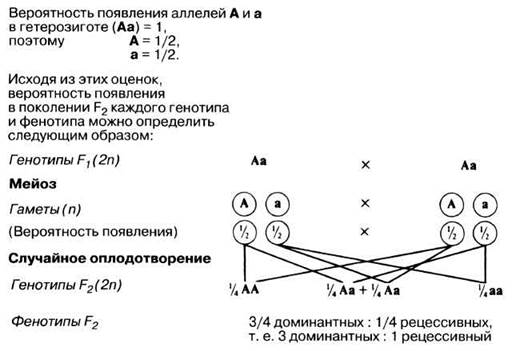
Fig. 24.2. Probability explanation of the 3:1 Mendelian ratio in a monohybrid cross.
24.1. Crossing a pure-breeding brown-coated mouse strain with a pure-breeding grey-coated mouse strain produces brown-coated offspring. The F2 generation from intercrossing these F1 mice yields brown and grey mice in a 3:1 ratio.
a) Provide a full explanation for these results.
b) What would be the outcome of crossing a heterozygous brown-coated F2 individual with a grey individual from the pure parental line?
Last update: 06/08/2026
Editorial and Educational Adaptation: This material has been compiled based on the primary/original source text. The project team performed an editorial review, corrected technical inaccuracies, structured sections, and adapted the content for an educational format.
What was processed:
- elimination of formatting defects (OCR errors, structural breaks, corrupted characters);
- editorial organization of content;
- standardization of terminology in accordance with academic sources;
- verification of factual statements against the original source text.
All mentions of the author, publication year, and origin of the primary text have been preserved in accordance with the source.