Genetics - A. V. Sivolob 2008
Formal Genetics: Patterns of Trait Inheritance
Mendel's Laws
Monohybrid Crosses
A cross involving the analysis of a single pair of alternative traits is called a monohybrid cross. Let us return to the example already considered at the end of Section 1: the inheritance of pea seed color, which depends on the sgr Gene. In accordance with the rules formulated above, we will designate the normal (dominant) allele of this gene as A (the gene produces a functional product that causes The breakdown of chlorophyll and, accordingly, the yellow color of the seeds), and the mutant recessive allele as a (the gene fails to produce a functional product, and the seeds remain green). In fact, it is precisely this type of mutation—where the gene loses its ability to encode a full-fledged product—that typically leads to The Emergence of a recessive form of the gene.
Class="center">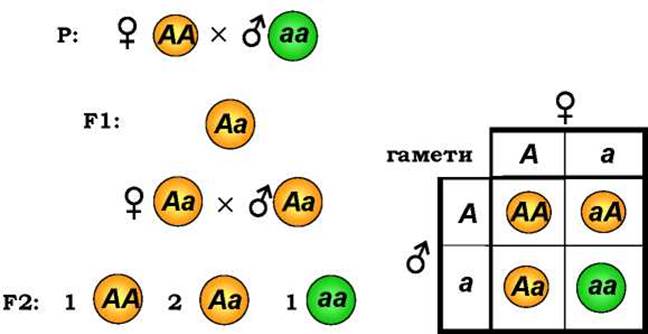
Fig. 3.1. Scheme of a monohybrid cross of homozygous parental pea lines with yellow and green seeds, followed by the crossing of the first-generation hybrids. On the right, a Punnett square for the second cross is shown.
Mendel used two previously obtained true-breeding (genetic) lines for his crosses; these are groups of individuals that stably reproduce the same hereditarily constant traits over a succession of generations. That is, the parental forms (as Mendel established from the final outcome) were homozygous for alleles A and a, with yellow and green seeds, respectively (Fig. 3.1). In the first generation, following the fusion of Two Types of Gametes (each parent produces gametes of only one type), all individuals were yellow heterozygotes—only the dominant allele manifested itself, while the trait of the other parent (the recessive one) was not observed. This phenomenon formed the basis for formulating Mendel's first law (or the law of uniformity of first-generation hybrids): in the first generation resulting from a cross between homozygotes with dominant and recessive traits, only the dominant trait appears.
First-generation hybrids produce two types of gametes—carrying either allele A or a. When these hybrids are crossed, three different allele combinations should be formed (strictly speaking, four combinations, two of which—aA and Aa—are equivalent). To facilitate the calculation of these combinations, a table proposed by Punnett (also known as a Punnett square) is sometimes used: the types of gametes are recorded in the first row and the first Column, and the offspring's allele combinations are then obtained at the intersections. As seen from the Punnett square in Fig. 3.1, the frequency of Aa heterozygotes will be twice as high as the equal frequencies of homozygotes for the dominant and recessive alleles. Consequently, for A large number of second-generation individuals, the genotypes AA, Aa, and aa will occur in a 1 : 2 : 1 ratio, while the phenotype ratio (yellow to green) will be 3 : 1. This is precisely the result that Mendel obtained. The statement that the dominant trait segregates into dominant and recessive traits in a 3 : 1 ratio In the second generation is called Mendel's second law, or the law of segregation.
Mendel subjected the resulting groups of offspring to self-pollination and established that plants with recessive traits do not segregate in subsequent generations. One-third of all individuals with the dominant trait behave in the exact same manner, whereas the remaining two-thirds of dominant individuals segregate into dominant and recessive offspring once again in a 3 : 1 ratio.
We will not reiterate here the Conclusions that Mendel drew from his results—effectively, he described The behavior of Chromosomes during Meiosis and Fertilization. The Significance of his work also lay in demonstrating that by tracking the inheritance of external traits in crosses, one can draw conclusions about an individual's genotype.
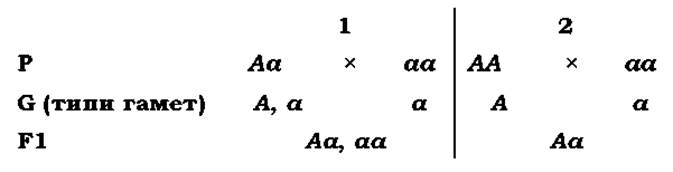
Sometimes such conclusions can be made even without crossing: if a given Organism exhibits a recessive trait, it is always homozygous. However, in the case of a dominant trait, such an unambiguous Conclusion cannot be made, as the individual may be either homozygous or heterozygous. In cross diagrams, such an individual is often denoted by the phenotypic radical A_ (implying that the underscore may represent either a capital or a lowercase letter without altering the phenotypic manifestation). To determine the genotype, a test cross is used, in which the individual under study (with a dominant trait) is crossed with an individual homozygous for the recessive allele; this clearly identifies the individual's genotype. Depending on the genotype of the individual under study, the test cross either yields a 1 : 1 segregation ratio (heterozygote, variant 1) or results in all offspring exhibiting the dominant trait (homozygote, variant 2):
Last update: 11/08/2026
Editorial and Educational Adaptation: This material has been compiled based on the primary/original source text. The project team performed an editorial review, corrected technical inaccuracies, structured sections, and adapted the content for an educational format.
What was processed:
- elimination of formatting defects (OCR errors, structural breaks, corrupted characters);
- editorial organization of content;
- standardization of terminology in accordance with academic sources;
- verification of factual statements against the original source text.
All mentions of the author, publication year, and origin of the primary text have been preserved in accordance with the source.