Genetics - A. V. Sivolob 2008
Formal Genetics: Patterns of Trait Inheritance
Mendel's Laws
Interaction of Alleles of a Single Gene
The described example of pea seed color inheritance illustrates the case of complete dominance, where the phenotypic expression does not depend on the dosage (two or one) of dominant alleles in the genotype. However, Other types of allelic Gene interactions are frequently encountered in nature.
The first of these occurs when a recessive allele fails to produce a functional product, yet the trait depends on the number of copies of the dominant allele in the genotype. For instance, the red flower color in snapdragons (*Antirrhinum majus*) depends on The amount of red pigment, which in turn is synthesized through The activity of an enzyme controlled by a specific gene. Two alleles AA result in an intense red color, the aa homozygote (lacking both the enzyme and the pigment) is characterized by white flowers, and the heterozygote exhibits half the color intensity of the dominant homozygote (yielding half the amount of enzyme and pigment)—resulting in pink flowers (Fig. 3.2). Feather curliness in pigeons is inherited similarly: individuals heterozygous for the curliness gene have wavy feathers. This type of allelic interaction is termed incomplete dominance. Under incomplete dominance, the heterozygote features a phenotype distinct from both homozygotes; with this caveat, Mendel's first law remains unchanged. As for the offspring of heterozygous crosses, the genotypic and phenotypic ratios coincide, yielding 1 : 2 : 1.
Class="center">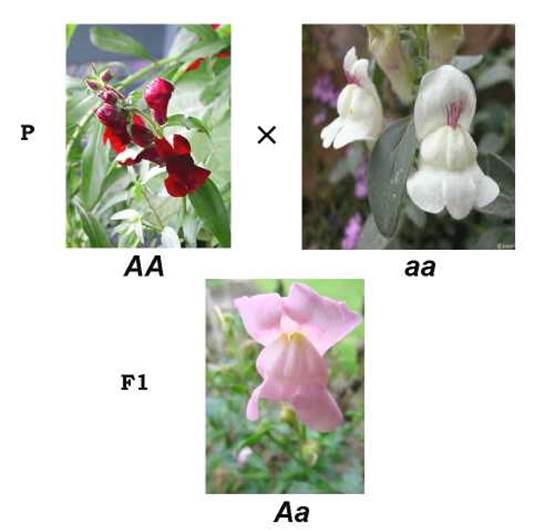
Fig. 3.2. Incomplete dominance of flower color in snapdragons.
Similar ratios are characteristic of codominance, with the distinction that progeny resulting from the cross of different homozygous types display the phenotypic traits of both parents simultaneously. In other words, both alleles are dominant in this case, producing functional products that differ slightly in certain characteristics. This situation is quite common with Enzymes, where two alleles direct the synthesis of two Proteins—isozymes—with virtually identical activity, yet differing in molecular weight (e.g., one protein possesses an additional structural domain, a terminal tail, etc.).
The Examples considered require an important clarification. The fact that two homologous Chromosomes can harbor at most two different alleles of a single gene does not imply that a gene within a population is restricted to a maximum of two alleles. In reality, genes most often exist as multiple (theoretically unlimited) different alleles. This phenomenon is known as multiple allelism. A classic example of multiple allelism is the ABO Blood group system. The four well-known Blood Groups—O, A, B, and AB—are determined by three alleles of a single gene: IA, IB, and i0. The alleles IA and IB are codominant (responsible for The formation of Two Types of Antigens, A and B, on the erythrocyte surface), yet both are dominant over the i0 allele, which produces no antigen. Three alleles allow for six possible combinations, but recessiveness reduces the number of phenotypes (blood groups) to four: group O corresponds to the i0i0 genotype, group A to the IAIA and IAi0 genotypes, group B to IBIB and IBi0, and group AB to the IAIB genotype.
Last update: 11/08/2026
Editorial and Educational Adaptation: This material has been compiled based on the primary/original source text. The project team performed an editorial review, corrected technical inaccuracies, structured sections, and adapted the content for an educational format.
What was processed:
- elimination of formatting defects (OCR errors, structural breaks, corrupted characters);
- editorial organization of content;
- standardization of terminology in accordance with academic sources;
- verification of factual statements against the original source text.
All mentions of the author, publication year, and origin of the primary text have been preserved in accordance with the source.