Genetics - A. V. Sivolob 2008
Formal Genetics: Patterns of Trait Inheritance
Mendel's Laws
Dihybrid and Polyhybrid Crosses
In his experiments, Mendel also analyzed the inheritance of two pairs of contrasting traits simultaneously: such crosses are called dihybrid crosses, and individuals heterozygous for two genes at the same time are termed dihybrids. Mendel crossed pea strains with yellow and smooth seeds with plants having green and wrinkled seeds. All first-generation hybrids produced yellow and smooth peas: the yellow color, as in the previous example, dominated over the green, and the smooth shape over the wrinkled one. Keeping A/a to designate the color alleles, let us denote the seed shape alleles as B (smooth) and b (wrinkled). Following self-pollination of the first-generation hybrids, a 9 : 3 : 3 : 1 phenotypic ratio was observed—it turned out that 9/16 of the progeny possessed two dominant traits simultaneously (yellow and smooth seeds), two groups of 3/16 exhibited only one of the two dominant traits (yellow and wrinkled, green and smooth), and 1/16 of the individuals displayed both recessive traits.
If we assume (as Mendel did) that the two genes inherit independently, dihybrid crosses can be considered as two independent Monohybrid Crosses. According to Mendel's second law, the color segregation In the second generation is 3/4A_ : 1/4aa, and the shape segregation is likewise 3/4B_ : 1/4bb. Using the well-known product rule of probability (the probability of two independent events occurring simultaneously is equal to the product of the probabilities of each of those events), we can calculate the aforementioned segregation ratio:
Class="center">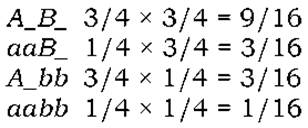
Applying the product rule and knowing the segregation ratios in a monohybrid cross, one can calculate the proportions of both phenotypic and genotypic classes in polyhybrid crosses (Table 3.1).
Table 3.1. Selected parameters of segregation in polyhybrid crosses
|
Cross |
Number of allele pairs by which parents differ |
Number of gamete types produced by the heterozygote |
Number of F2 phenotypic classes under complete dominance |
Number of F2 genotypic classes |
Proportion of F2 individuals homozygous for all genes |
|
Monohybrid |
1 |
2 |
2 |
3 |
1/4 |
|
Dihybrid |
2 |
4 |
4 |
9 |
1/16 |
|
Trihybrid |
3 |
8 |
8 |
27 |
1/64 |
|
Polyhybrid |
n |
2n |
2n |
3n |
1/4n |
Having analyzed the results of dihybrid crosses, Mendel formulated the postulate of independent assortment of traits, which subsequently became known as Mendel's third law.
Last update: 11/08/2026
Editorial and Educational Adaptation: This material has been compiled based on the primary/original source text. The project team performed an editorial review, corrected technical inaccuracies, structured sections, and adapted the content for an educational format.
What was processed:
- elimination of formatting defects (OCR errors, structural breaks, corrupted characters);
- editorial organization of content;
- standardization of terminology in accordance with academic sources;
- verification of factual statements against the original source text.
All mentions of the author, publication year, and origin of the primary text have been preserved in accordance with the source.