Fundamentals of Biochemistry - A. A. Anisimov 1986
Enzymes
Mechanism of Enzymatic Catalysis
For any reaction to occur, the reacting molecules must come into direct contact with each other. However, not every molecular collision leads to an interaction; a reaction only proceeds if the molecules possess a sufficient reserve of kinetic energy. The population of molecules in any substance represents a statistical distribution with varying levels of kinetic energy (Fig. 3.5). The energy required to reach the activated (transition) state—or the excess energy above the average molecular energy at a given Temperature that molecules must possess to enter into a reaction—is called the activation energy (Ea).
In the case of enzymatic reactions, this energy barrier is lowered through The formation of an enzyme-substrate complex. The lower the activation energy, the faster the reaction proceeds, because molecules with a lower energy reserve are able to react (Fig. 3.6). As shown in Fig. 3.6, both in enzymatic and non-enzymatic reactions, the starting molecules must become activated and acquire a higher energy reserve to reach the Transition State before they can be transformed into reaction products; however, Ea is lower in the case of an enzymatic reaction.
Class="center">
Fig. 3.5. Distribution of kinetic energy in a population of molecules:
A — reacting molecules (activated molecules), Ea — minimum activation energy
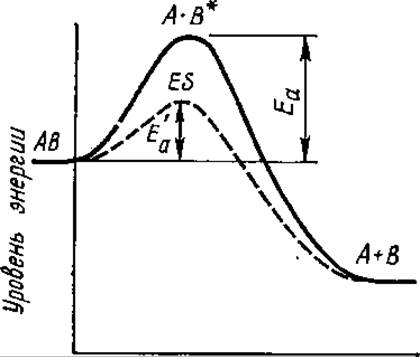
Fig. 3.6. Reaction energy profiles: Ea and E'a — activation energy of non-enzymatic and enzymatic reactions, AB — initial substance, A+B — reaction products, A⋅V* — activated molecules, ES — activated complex
Thus, the high rates of enzymatic reactions are ultimately the result of a lowered activation energy in catalyzed reactions. Because biological catalysts reduce the activation energy, enzymatic reactions proceed at high rates even at relatively low temperatures.
The reduction of activation energy in Enzymatic Catalysis is closely related to the multi-step nature of these reactions. Instead of occurring in a single step, they proceed in a stepwise manner through several intermediate reactions. Consequently, the activation barrier of the overall reaction is broken down into several lower barriers for each intermediate step, which the reacting molecules find much easier to overcome than a single large barrier.
Enzymatic catalysis exhibits characteristics of both homogeneous and heterogeneous catalysis, taking place at the interface of two phases. The catalytic action of Enzymes can be divided into 3 stages: 1) binding of the substrate molecule (S) to the enzyme (E), 2) Conversion of the substrate, and 3) release of the final reaction products (P) from the enzyme. The simplest scheme of an enzymatic reaction is written as follows:

The First stage of the reaction is usually the fastest, while the second is the slowest. In the first stage, an enzyme-substrate complex (ES) is formed, which alters the Structure and properties of the substrate molecule and generates its transition forms. This serves as the primary prerequisite for accelerating its conversion in the catalyzed reaction.
The Formation of the ES complex is made possible by a specific affinity of enzymes for their substrates. The clearest articulation of this concept was put forward by E. Fischer (1890) to explain Enzyme Specificity. He compared the enzyme and substrate to a lock and key, suggesting that an enzyme fits its substrate like a key in a lock. Today, it is well established that a steric match exists between the spatial structures of the substrate and the enzyme's Active Site; however, as will be shown later, this match is not absolute. Ionic bonds, Hydrogen Bonds, and hydrophobic interactions all participate in the formation of the enzyme-substrate complex. The formation of temporary covalent bonds between the enzyme and substrate is possible in certain enzymatic reactions only during the 2nd stage—upon substrate conversion and the formation of intermediate and transition states. ES complexes are highly labile, existing for mere fractions of a second; nevertheless, researchers have managed to isolate A number of such complexes to date.
The formation of the ES complex creates the foundation for high catalytic activity. Studies have shown that when the ES complex forms, the enzyme and substrate molecules not only come into close proximity but also orient themselves relative to one another in a specific way. In addition to steric complementarity, There is a topochemical match between the substrate structure and the enzyme's active site, ensuring the interaction of the enzyme's recognition groups (binding zone) with the recognizable groups of the substrate. Enzyme-substrate binding is typically multipoint; the higher the Specificity of the enzyme, the greater the number of recognition points.
An important factor contributing to the increased Rate of Enzymatic reactions is the manifold extension of the contact time between reacting molecules, brought about by multipoint substrate binding by the enzyme. The duration of contact during a collision in a purely chemical reaction is roughly equal to the period of thermal molecular vibrations (10-13–10-12 s). Within this brief timeframe, a chemical reaction does not always have time to occur.
Another factor boosting The rate of enzymatic reactions is induced fit between the enzyme and substrate. According to the induced-fit theory first proposed by D. Koshland, in the absence of substrates, the functional groups at the active sites of many enzymes are oriented in such a way that optimal interaction with complementary substrate groups does not initially occur. The entry of the substrate into the enzyme's active site triggers a conformational change in the enzyme, positioning its functional groups optimally for the catalytic process. Evidence for enzyme conformational changes upon substrate binding comes from differences between X-Ray Diffraction patterns of free enzymes and those bound to a specific inhibitor. Such conformational changes during the binding of substrates and their analogs have been clearly demonstrated for Carboxypeptidase A, Lysozyme (which hydrolyzes Introduction/37.html">Bacterial Cell wall Polysaccharides), and Other Enzymes. For example, in carboxypeptidase A, the presence of a substrate analog causes a shift of Certain amino acid residues in the active site (Tyr-248 shifts by approximately 1.2 nm, while Arg-145 and Glu-270 shift by 0.2 nm).
Upon optimal binding of the substrate(s) to the enzyme, a productive enzyme-substrate complex is formed—that is, a complex that yields the reaction product(s) through a series of intermediate steps. These processes take place during the 2nd stage of the enzymatic reaction. The rapid progression of the enzymatic reaction is facilitated by the fact that the interaction between the substrate and the enzyme induces strain in the susceptible bonds of the substrate (deforming or destabilizing them), meaning these bonds become less stable than they are in the free substrate.
The rate enhancement driven by enzymes also results from the greater Hydrophobicity of the active site microenvironment compared to the surrounding solution. In such an environment, desolvation of the charged substrate occurs, leading to the destabilization of the bond targeted for Cleavage.
An important feature of enzymatic reactions is that substrate conversion proceeds via multifunctional catalysis. Multifunctionality is ensured by The Diversity of amino acid residues in the protein moiety of the enzyme and the cofactor groups within the active site. Several enzyme groups act upon the reactive chemical bond of the substrate simultaneously or via a sequence of consecutive attacks. This results in the polarization of the susceptible bond followed by its cleavage.
Many groups in the active sites of enzymes function as general acids or bases, acting upon the substrate, activating it, and thereby accelerating catalysis. According to Brønsted, general acids are any proton Donors, while general bases are proton acceptors. General Acid-Base Catalysis is particularly efficient, yielding rate increases of 10- to 100-fold. The side chains of Amino Acids such as Glu, Asp, His, Lys, and Tyr function as general acid-base catalysts in the active site. In their protonated form, they act as acid catalysts; in their unprotonated form, they act as basic catalysts.
Electrophilic and nucleophilic catalysis are also of great importance in enzymatic reactions. The active sites of certain enzymes contain electrophilic and nucleophilic groups that participate directly in the catalytic act. An electrophilic group is an electron pair acceptor (a Lewis acid), whereas a nucleophilic group is an electron pair donor (a Lewis base).
The nucleophilic groups of enzymes participate in Nucleophilic substitution reactions, leading to the formation of covalent intermediates—a process known as Covalent Catalysis. A nucleophilic group takes THE PLACE OF the leaving group to form a covalent intermediate, which is unstable and readily breaks down into reaction products. The imidazole group of Histidine (His) is a powerful nucleophile; consequently, chemical modification of His within the active site leads to Enzyme inactivation. Other nucleophilic groups include the OH group of Serine (Ser) and the SH group of Cysteine (Cys). Examples of electrophilic groups include Metal Ions such as Zn2+, Fe3+, and others.
A significant number of enzymes are known to form covalent intermediates with substrates or reaction intermediates, whereby specific active-site groups undergo covalent modification by the substrates. For example, the modification of serine in Chymotrypsin, subtilisin, and plasmin involves the formation of a carboxylic acid ester  , while alkaline phosphatase forms a phosphoric acid ester
 . In Papain and glyceraldehyde-3-phosphate dehydrogenase, cysteine is modified into a carboxylic acid thioester
in transaldolase and pyridoxal-dependent enzymes, Lysine forms a covalent intermediate with substrates known as a Schiff base H2N—(СН2)4—
The formation of covalent intermediates selectively increases the probability of a specific reaction pathway, because a covalently bound intermediate has restricted mobility and can therefore assume a more favorable spatial orientation relative to the relevant enzyme groups to complete the reaction. The acceleration of an enzymatic reaction resulting from covalent intermediate formation ranges from 102- to 103-fold or even more.
Specific acid-base catalysis, i.e., substrate activation under METABOLISM/18.html">The Influence of elevated concentrations of H3O+(H+) and OH- ions, is rarely encountered in biochemical reactions, whereas this type of reaction is widespread in organic chemistry. Thus, the exceptionally high rates of enzymatic reactions are achieved through a combination of multiple effects: Proximity and Orientation effects, which arise from the steric and topochemical complementarity of the enzyme and substrate; induced fit of the active site structure to the transition state of the substrate and the generation of "strain" within the substrate; polyfunctionality and multi-step catalysis; the specific physicochemical microenvironment of the active site; and, as a cumulative result, a decrease in the activation energy of the catalyzed reaction. All these effects stem from the complex architecture of enzyme molecules. Furthermore, the unique STRUCTURE OF THE enzyme's active site ensures its high degree of specificity.
The active site structure, substrate binding mechanism, catalytic properties, and Primary Structure have been thoroughly investigated in such hydrolytic enzymes as chymotrypsin, Ribonuclease, lysozyme, and carboxypeptidase A. The MECHANISM OF ACTION for each of these enzymes has also been fully described. Below, as illustrative examples, current concepts regarding the mechanisms of certain enzymatic reactions are briefly examined. In the Active Site of chymotrypsin, a pivotal role in catalysis is played by Ser-195 and His-57. The distance between the OH group of Ser and the third nitrogen atom of the imidazole ring of His is 0.3 nm, and a Hydrogen bond forms between them, thereby enhancing the nucleophilic reactivity of the Ser hydroxyl group. The first nitrogen atom of His-57 forms a hydrogen bond with the COOH group of Asp-102, which is also part of the chymotrypsin active site; this results in the formation of a charge-transfer network comprising Asp-102, His-57, and Ser-195 (Fig. 3.7, stage I).
The anion of the Ser OH group carries out a nucleophilic attack on the carbon atom of the susceptible peptide bond in the substrate, yielding an acyl-enzyme intermediate, followed by the release of the first reaction product—the amine product (stage II). Next, deacylation (Hydrolysis of the acyl-enzyme) takes place, yielding the second reaction product and regenerating the enzyme in its original state (stages III, IV).
Upon the binding of lysozyme to its substrate—a bacterial cell wall polysaccharide composed of numerous disaccharide units (N-acetylglucosamine—N-acetylmuramic acid)—a forced contact occurs. This manifests as a minor displacement (~0.07 nm) of certain amino acid side chains within the active site. Upon substrate binding, one of the hexose rings, positioned opposite the catalytic groups of the active site, is driven into a strained conformation (shifting from a chair to a half-chair conformation), which facilitates the accelerated hydrolysis of the glycosidic bond involving this conformationally strained hexose (Fig. 3.8).

Fig. 3.7. Sequence of catalytic stages in chymotrypsin action (see text for details)

Fig. 3.8. Proposed mechanism of lysozyme action: I, II, III — reaction stages, D, E — substrate (S) hexose residues
The catalytic residues of the active site are Glu-35 and Asp-52, with Glu-35 residing in a hydrophobic microenvironment in a protonated state, whereas Asp-52 is located in a hydrophilic microenvironment and remains ionized (Fig. 3.8, stage I). Glu-35 acts as a proton donor to the oxygen atom of the cleavable glycosidic bond. Concurrently with bond cleavage, a hexose carbonium ion (C+) is formed, which is stabilized by the negative charge on Asp-52 (stage II). Subsequent hydrolysis ensues: a Water-derived OH group attacks the carbonium intermediate, while the water proton is accepted by Glu-35, thereby completing the reaction (stage III). The rate enhancement of the lysozyme-catalyzed reaction is driven by several synergistic effects: substrate strain, forced contact, concerted acid-base catalysis mediated by Glu-35, and electrostatic stabilization of the carbonium ion by Asp-52.
One of the Functions performed by metals in enzymes is acting as electrophilic catalysts. For instance, in the active site of carboxypeptidase A, which harbors a Zn2+ ion, the latter serves as an electrophilic agent that withdraws electron density from the substrate peptide bond, thereby facilitating its hydrolysis (Fig. 3.9).

Fig. 3.9. Binding of the C-terminal substrate fragment (highlighted by bold lines) within the active site of carboxypeptidase A:
Zn2+ functions as an electrophilic agent targeting the scissile peptide bond
Last update: 06/08/2026
Editorial and Educational Adaptation: This material has been compiled based on the primary/original source text. The project team performed an editorial review, corrected technical inaccuracies, structured sections, and adapted the content for an educational format.
What was processed:
- elimination of formatting defects (OCR errors, structural breaks, corrupted characters);
- editorial organization of content;
- standardization of terminology in accordance with academic sources;
- verification of factual statements against the original source text.
All mentions of the author, publication year, and origin of the primary text have been preserved in accordance with the source.