Plant Physiology - Musienko M. M. 2001
Plant Physiology and Biotechnology: Achievements and Development Prospects
Plant Biotechnology and Cell Culture
The FEATURES OF PLANT Cell, tissue, and organ culture Methods outlined above enable The Development of various technologies based on them. Among these, the industrial production of BIOLOGICALLY ACTIVE SUBSTANCES of plant origin holds a prominent place.
The point is that cultured Cells generally retain The ability to synthesize secondary metabolites characteristic of the plant species from which they were derived. Naturally, some deviations in their spectrum compared to source plants may occur. This method makes it possible to obtain Alkaloids and Glycosides, saponins, Phenolic Compounds, Essential Oils, phytohormones, etc.
A crucial starting principle for this is establishing plant cell cultures with high biosynthetic capacity. Through mutagenesis and Selection, the most productive lines are identified. Mutant cell lines of Rauvolfia serpentina (a producer of valuable alkaloids), Dioscorea deltoidea (producing diosgenin), and others have already been obtained using this approach. Even more promising is The transfer of individual genes determining Secondary METABOLISM into a producer cell.
The second major direction is The Use of tissue cultures for rapid clonal micropropagation and plant pathogen elimination (sanitation). The foundation of this biotechnology lies in THE CONCEPT OF the potential induction of differentiation and Organogenesis—The Emergence of a biological form from a single PLANT CELL AND its capacity to form an entire plant (Fig. 212). In vivo, within a tissue with specific structural differentiation, a cell performs a narrow, specific function. The realization of its morphogenetic potentials in vivo is constrained by factors and conditions determined by the mother plant. However, when a cell is isolated from the tissue and placed under artificially controlled in vitro conditions, its potential to regenerate a plant from a single cell or a group of cells is realized. Here, totipotency is governed by the selective Induction and Repression of Genetic information.
Class="center">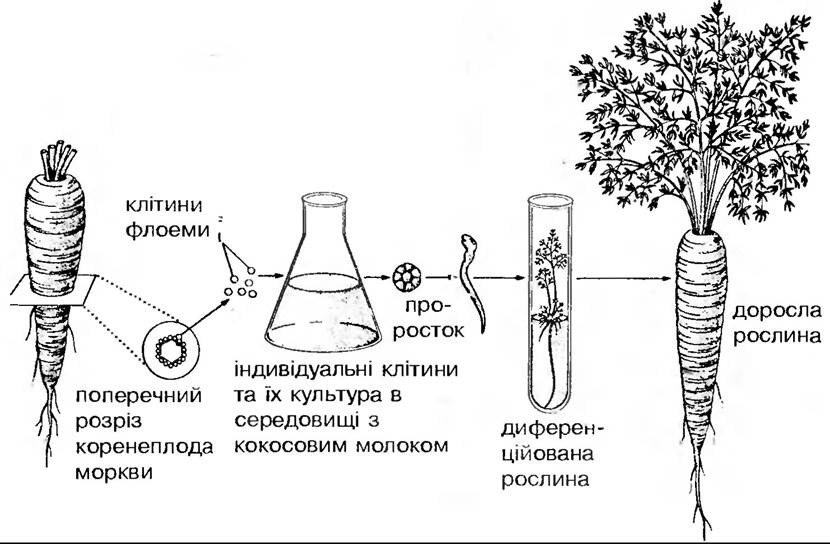
Fig. 212. Technique of phloem isolation from Daucus carota and tissue culture, first performed by F. S. Steward (1950) at Cornell University (USA)
All cells are totipotent, yet the manifestation of this property is currently observed primarily in cells known as meristemoids. Meristemoids are morphogenetically competent cells that respond to differentiation Inducers and nutrient medium compositions to form shoots, roots, and embryos. Morphologically, they appear in callus cultures as small, isodiametric, thin-walled cells with a large Nucleus, dense Cytoplasm, and virtually no vacuoles. Because apical Meristems and embryonic cells consist precisely of such cells, it is easiest to induce organogenesis in Tissues derived from these Organs. The number of meristemoid cells—and consequently the expression or suppression of totipotency—depends significantly on the conditions The Cell experiences before or during the regeneration induction period. Among these, illumination, Temperature, and The Influence of specific chemical compounds are the most critical. Expanding our knowledge of the physicochemical and biological factors that determine the Structural and functional state of a cell in vitro will enable the successful cultivation of even those Cells and Tissues that are currently difficult to culture under controlled conditions (Kalinin, Kushnir, Sarnatskaya, 1992).
Thus, regeneration from any plant cell is possible if they can be transformed into meristemoids by creating appropriate conditions. Microclonal propagation is asexual Vegetative Reproduction yielding genetically identical forms, which ensures the preservation of genetically uniform planting material.
Under production conditions, this method is widely used—including in Ukraine—for example, for the sanitation and rapid clonal propagation on a virus-free basis in potato seed production technology (Kuchko, 1992). As early as 1934, P. White discovered that Viruses are absent in the ROOT apices of plants infected with tobacco mosaic virus. The absence of viruses in apices no smaller than 0.1 mm forms The basis of the method for obtaining virus-free plants from meristematic cells. Why are viruses absent specifically in the apices? As is known, leaf tissues are the most favorable sites for phytovirus reproduction. Viruses are incapable of autonomous movement throughout the plant; therefore, their migration through the plant Organism occurs via symplastic or apoplastic pathways. In contrast, the cells of apical meristems are small, with thin cellulosic walls, densely packed together, and divide rapidly; consequently, their plasmodesmata system is insufficiently developed. All of this hinders the apoplastic and symplastic pathways of viral migration. Physiological and genetic mechanisms responsible for the absence of viruses in the apical meristem cannot be ruled out either (e.g., phytohormonal inhibition of viral genome self-Replication). However, the microclonal sanitation method becomes more reliable and effective when combined with additional heat Treatment and plant Chemotherapy. For example, exposing sunflower or wheat seeds to temperatures of 45–50 °C for one hour suppresses viral infections without damaging the embryo. This method makes it possible to use larger meristems (0.3–0.8 mm) for clonal propagation, which survive much better on nutrient media.
Recently, research has been underway to find antiviral preparations produced by the plants themselves for use in chemotherapy during plant sanitation. Positive results have been obtained using extracts of lavender, chamomile, sage, and other plants.
The feasibility of applying in vitro clonal propagation methods has been established for more than 400 plant species across 82 families. Clonal micropropagation can be used to establish cultivar and species collections, and to preserve the genomes of endangered and rare plants. The advantages of plant micropropagation biotechnology over Traditional Methods are so obvious that they will undoubtedly drive its further refinement and development.
The third direction is the use of cell and Gene engineering Methods for the genetic Modification of the cell and the plant derived from it. For breeding programs, plant cell and gene engineering technologies hold enormous potential (Sidorov, 1990). Obtaining plants from mutant cells selected under selective conditions is also made possible by a unique property of The plant cell: totipotency. Cell culture techniques and Plant Regeneration from them already make it possible today to realize the potential of cell selection, particularly for resistance to stress factors, herbicides, and various diseases.
Special progress in this field has been achieved through the DEVELOPMENT OF NEW techniques for cultivating isolated cell protoplasts. The methodology of cell selection enables the targeted in vitro isolation of mutant forms with specific commercially valuable traits. Further deepening of our knowledge regarding the physiology of cultured cells, regeneration processes, their molecular mechanisms, and the Structural Features of plant nuclear and cytoplasmic genomes will open up new Prospects for the development of plant physiology and its impact on plant biotechnology.
Last update: 07/08/2026
Editorial and Educational Adaptation: This material has been compiled based on the primary/original source text. The project team performed an editorial review, corrected technical inaccuracies, structured sections, and adapted the content for an educational format.
What was processed:
- elimination of formatting defects (OCR errors, structural breaks, corrupted characters);
- editorial organization of content;
- standardization of terminology in accordance with academic sources;
- verification of factual statements against the original source text.
All mentions of the author, publication year, and origin of the primary text have been preserved in accordance with the source.