MEDICAL BOTANY - A.G. Serbin - 2003
SECTION 4. ECOLOGY, PHYTOCENOLOGY, PHYTOGEOGRAPHY
Elements of Plant Ecology
A plant's life cycle depends on its genetic makeup and environmental conditions. Plant ecology examines the Structure and Life of plants in relation to external conditions—specifically, The connection between a plant and its habitat. Environmental factors influencing plants are subdivided into abiotic, biotic, anthropogenic, and geological factors.
Abiotic factors. These include The impact of climatic factors such as Water, light, Temperature, and air, as well as METABOLISM/18.html">The Influence of soil and topography. Some of these factors affect the distribution of plants across the Earth's surface, while others exert local, individual effects.
Water is a vital component of plant Cells. All metabolic and life processes in a plant can only take place in an environment with an adequate supply of water. The primary role in moisture regimes belongs to precipitation (rain and snow). Annual precipitation is distributed unevenly across the Earth's surface. In certain tropical regions, such as Southeast Asia, annual precipitation reaches up to 10,000 mm. In contrast, some areas of the Namib Desert in southern Africa receive an average of only 8 mm of precipitation per year, while in certain PARTS OF THE Canary Islands and equatorial South Africa, where precipitation is virtually absent, plants utilize moisture from fog. Of primary importance is not merely the total annual precipitation, but rather its seasonal distribution. The tropics feature regions where precipitation occurs year-round; here, plants flourish, do not shed their leaves, and the cambium remains active. In other tropical regions, distinct rainy and dry seasons occur, prompting plants to shed their leaves during the dry season and form annual rings in their wood. In deserts, precipitation falls during the winter and early spring, giving the desert a green cover during this period. Moisture deficiency significantly affects organ growth and formation, structural development, and overall plant growth. For instance, in the dry subtropical climate of the Mediterranean, characterized by long, dry summers, evergreen plants with hard, leathery leaves, succulent stems (stem succulents), and stick-like leaves (cacti and cactus-like euphorbias) predominate. Ephemeroids—plants with underground storage Organs such as bulbs—develop leaves and flower for a brief period when precipitation occurs or the soil is saturated with melted snow. With the onset of the dry season, their aerial biomass dies off, while their bulbs are pulled deeper into the soil by contractile roots (e.g., tulips, sea squill, autumn crocus). Atmospheric humidity is also of great importance; in humid air, plants grow better and expend less energy on Transpiration. In arid regions, plants exhibit a slowed growth of above-ground mass, while their ROOT systems reach deep into water-bearing strata.
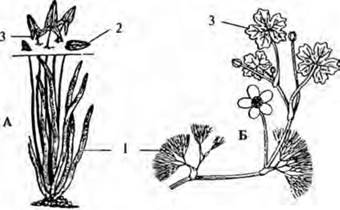
Based on their water requirements and habitat moisture conditions, plants are divided into the following ecological groups: hydrophytes, hygrophytes, mesophytes, and xerophytes. Hydrophytes are aquatic plants that grow in bodies of water (e.g., lotus, yellow water-lily, white water-lily, arrowhead). Their submerged parts generally differ both anatomically and morphologically from their unsubmerged parts (Fig. 1.46, 4.1). The root primarily serves to anchor the plant in the substrate. Mechanical Tissues are almost entirely absent, conducting tissues and root hairs are poorly developed, and aircarrying parenchyma—aerenchyma—is well-developed. The epidermis lacks Stomata and a cuticle. Floating leaves possess stomata exclusively on their upper surface (epistomatic leaves).
Class="center">Fig. 4.1. Heterophylly in hydrophytic plants: A — arrowhead; B — variable-leaf buttercup: 1 — submerged leaves; 2 — floating leaves; 3 — aerial leaves
Hygrophytes, mesophytes, and xerophytes are land dwellers. They utilize soil and subsurface moisture and vary in their degree of water supply. Hygrophytes grow in conditions of excessive moisture and lack adaptations to protect against evaporation: their leaves are large and glabrous, the cuticle is thin, and stomata are located on both surfaces (amphistomatic leaves). The central cylinder is poorly developed, vascular elements are sparse, and The Root System is shallow and sparingly branched. This ecological group includes many Ericaceae and Araceae. Mesophytes are plants that grow under conditions of adequate moisture. This group encompasses the majority of meadow and forest plants, numerous fruit crops, as well as wheat, corn, oats, peas, soybeans, sugar beets, hemp, and others. A distinct subgroup of mesophytes consists of ephemerals and ephemeroids. Ephemerals have a growing season lasting from 4 to 6 weeks, during which soil moisture is abundant, after which they die off. Ephemeroids are perennial plants that survive the dry season in the form of bulbs (e.g., tulips, colchicum) or rhizomes, while their aerial parts die back. Xerophytes grow in conditions of constant or seasonal moisture deficit. They possess various adaptations for conserving and economically utilizing water, or for extracting moisture from deep soil horizons. The osmotic pressure in root cells is extremely high (sometimes exceeding 100 atm), enabling them to absorb highly concentrated soil solutions. In many xerophytes, leaf blades are reduced in size, epidermal cells are small with thickened walls, the palisade mesophyll is arranged in multiple tiers, and the venation network is denser. Reduction of transpiration in xerophytes is achieved through the rolling of leaf blades, dense pubescence of dead hairs that reflect sunlight, positioning of stomata within depressions called crypts, the presence of a thick cuticle, narrow vascular vessels, and other adaptations (Fig. 1.44, 1.45). Xerophytes include certain species of wormwood, feather grass, mullein, saxaul, oleander, Spanish broom, crested wheatgrass, wild varieties of pear and plum, olive, almond, pistachio, oleaster, sweet bay, as well as certain cultivars of wheat, barley, sand oat, sorghum, Sudan grass, and others. Several specialized subgroups are distinguished among xerophytes. Hemixerophytes are plants with root systems that penetrate down to the water table (e.g., camel thorn, sickle alfalfa). They transpire intensively, but their above-ground mass does not achieve lush development due to extreme atmospheric dryness. Poikiloxerophytes are organisms capable of tolerating severe desiccation without regulating their water balance (such as Lichens and soil cyanobacteria of semi-deserts). In succulents, leaves are typically reduced to scales or spines, or both leaves and stems are fleshy, consisting of a water-storing parenchyma and mucilage (e.g., cacti, cactus-like euphorbias). Plants growing on heavily saline soils (such as glasswort, saltworts) are also generally classified as xerophytes.
Various types of xerophytes form distinctive steppe and desert plant communities across different Zones of the globe, thereby shaping unique Types of Vegetation.
Temperature. This factor plays a crucial role in plant life. Vital processes such as seed germination,
development, mineral Nutrition, Photosynthesis, Respiration, flowering, Fertilization, and others occur only within specific temperature ranges.
The overall thermal regime of plants is determined by two main indicators: air temperature and soil temperature. The thermal regime of the air is less amenable to human modification than other climatic factors. Air temperature fluctuates across seasons and within the course of a day. Because the temperature regime varies significantly across different geographic zones of the Earth, this environmental factor exerts a profound influence on the global distribution of plants and The formation of various vegetation types. Different plants require differing amounts of heat. For instance, lemon, orange, and eucalyptus, which thrive in warm southern climates, perish at temperatures ranging from — 6 to — 8 °C. Many temperate fruit trees of Europe (apple, pear, cherry, etc.) can withstand temperatures down to — 30 °C. Seeds of certain plants (such as red clover and timothy grass) can germinate at 1 — 2 °C, whereas heat-loving southern crops like soybeans, tea, and corn require 10 — 15 °C. Excessively high temperatures are likewise detrimental to plants, causing cellular protoplasm to coagulate and resulting in plant death.
The soil temperature regime primarily affects the absorptive activity of roots. Low temperatures disrupt normal Plant Mineral Nutrition. Perennial plants are better adapted to low temperatures because they accumulate soluble CARBOHYDRATES in their roots by autumn, which enhances their winter hardiness. Many plants possess adaptations that protect them from extreme soil temperatures. For example, woody plants in high-altitude regions often adopt a prostrate, creeping growth form (elfin wood or krummholz) and become blanketed by snow, which shields them from severe cold. To introduce fruit and citrus crops to more northern regions, horticulturists artificially cultivate creeping bush varieties. The temperature regime is modified most vividly within forest communities.
Temperature requirements are an inherited trait of an Organism, depending on its species and developmental stage. Every plant must undergo a temperature stage, or vernalization stage. For example, vernalization in spring wheat requires a temperature of 10 — 12 °C, whereas winter wheat requires 0 — 10 °C. Seeds of certain plants will only germinate after exposure to low temperatures.
Temperature ranges form the basis for the zonal distribution of vegetation. Based on their temperature preferences, plants are categorized into thermophilic species, which require relatively high temperatures for metabolic activity (e.g., cotton, cinchona, cacao), and cryophilic or cold-hardy species (e.g., cranberry, lingonberry, arctic horseradish). The majority of plants occupy an intermediate position between these groups.
While shaped by temperature, plant communities simultaneously modify and generate their own microclimate.
Light. The Significance of light as an environmental factor affecting plants is immense and multifaceted. Above all, light is essential for photosynthesis; the life of green plants is impossible without it. Plant life processes are substantially influenced by light intensity, day length (photoperiod), and light quality.
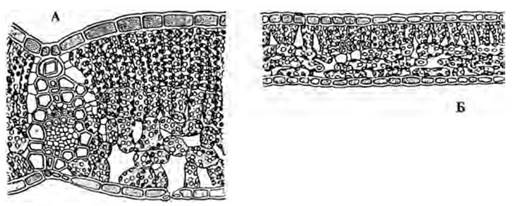
Depending on light intensity, plants are classified into heliophytes (light-loving), sciophytes (shade-loving), and shade-tolerant species. Heliophytes can develop normally only under sufficiently bright illumination and cannot tolerate shading (many steppe grasses, pine, etc.). They typically feature thick, rigid leaf blades with strongly developed palisade parenchyma and mechanical tissues. Under intense illumination, palisade tissue sometimes develops on both the upper and lower sides of the leaf, forming isolateral leaves (Fig. 1.44, D, E). The epidermis consists of small, thick-walled cells, often multi-layered and covered by a thick cuticle layer. A high density of stomata is usually present on the lower leaf surface. Stem internodes are shortened. Sciophytes develop normally only in diffused light and under shaded conditions. This group includes most plants inhabiting the understory of forest ecosystems, particularly deciduous forests (ferns, mosses, wood sorrel, herb Paris, boxwood, etc.). Their leaf blade is thin, palisade parenchyma is very weakly developed or entirely absent, and the spongy layer consists of a small number of cells containing large Chloroplasts. The epidermis is single-layered and large-celled, frequently containing chloroplasts; epidermal Cell walls are thin, lacking an outer cuticular layer. Stomata are sparse, superficial or slightly elevated, and larger than those in the epidermis of heliophytes. Owing to less intense transpiration, conducting bundles and mechanical tissues are less developed. Shade-tolerant plants (fir, linden, heather, wild strawberry, etc.) typically grow in full light but can also endure shading because their mesophyll structure is plastic and adapts to lighting conditions (Fig. 4.2).
Fig. 4.2. Cross sections of beech leaves: A — sun leaf; B — shade leaf
Plants developing under severe light deprivation become etiolated (blanched), thin, and elongated with extended internodes. Woody plants growing under light-starved conditions in dense forests are characterized by slender trunks, a lack of branching, and a tendency to shed lower branches. Certain open-habitat plants possess various adaptations protecting them from direct sunlight: leaves oriented edge-wise to the sun's rays (e.g., Australian eucalyptus); leaves arranged in a single north-south oriented plane (compass plant/prickly lettuce); leaves with a glossy surface that reflects a portion of solar radiation; or leaf blades that are folded (palms) or covered in hairs.
Plant communities consist of species with varying light requirements. This stratification is particularly evident in forests, where the canopy layer is formed by heliophytes, the lower layer by sciophytes, and the middle layer is dominated by shade-tolerant species.
The physiological response of plants to day length is known as Photoperiodism, a key factor governing plant geographic distribution. The duration and annual rhythm of daylight increase from the equator toward the poles. Near the equator, plants receive approximately 12 hours of daily illumination year-round. In temperate and polar regions, summer day length exceeds 12 hours, while in certain zones near the end of spring, daylight lasts up to 24 hours. Through historical evolution, plants have adapted to specific durations of sunlight. Based on their day-length response, plants are divided into two primary groups: short-day plants and long-day plants. During the same summer period in the south, day length is always shorter than in the north. Short-day plants include southern species (corn, sorghum, millet, cotton, etc.). If these plants are moved northward into long-day conditions, their vegetative period is substantially prolonged, producing more abundant vegetative mass while delaying the formation and ripening of fruits and seeds. An analogous phenomenon is observed when long-day plants are transferred to short-day conditions. Long-day plants include species of northern origin (red clover, oats, flax).
Air as an ecological factor plays a particularly vital role in photosynthesis. The chemical composition of the atmosphere is relatively uniform across different Regions of the globe and comprises (by volume): about 78% nitrogen, about 21% oxygen, about 1% ozone, 0.03% carbon dioxide, 0.01% argon, and trace amounts of other gases (ammonia, sulfur dioxide, water vapor). Oxygen and carbon dioxide are the most critical for plants. Oxygen is essential for plants, just as it is for All living organisms, for respiration. Carbon dioxide serves as the source of atmospheric or carbon nutrition for green plants during photosynthesis. Increasing the carbon dioxide content in the air (up to a certain threshold) promotes more intense photosynthesis and, consequently, boosts the productivity of green plants. Therefore, when growing vegetables and other crops in greenhouses, the carbon dioxide concentration is often artificially elevated. In large cities and industrial centers, the air is frequently polluted with various flue gases—such as soot, ash, and smoke—along with toxic substances like acetone, Ethylene, ether, nitrogen oxide, and others, which have a detrimental effect on plants. Soot, smoke, and other combustion byproducts settle on leaves in a dense layer, sharply reducing the intensity of photosynthesis and respiration, predisposing plants to Burns, and disrupting their normal GROWTH AND DEVELOPMENT. Coniferous plants (such as fir, pine, and spruce) are particularly sensitive to gases and soot, as their needles are exposed to the harmful effects of industrial emissions year-round.
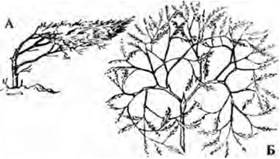
Wind, or air movement, directly influences transpiration. Strong winds, especially hot dry winds (known as *suhovei* in Russian steppes), accelerate moisture evaporation in plants and severely dry out the soil. Plants shed a significant number of leaves, which reduces their photosynthetic surface area, diminishes the accumulation of organic substances, and lowers the yields of green mass and seeds. The mechanical effects of wind include windfall, tree uprooting, lodging of cereal crops, erosion of the topsoil, and the exposure of underground plant organs. A layer of fine dust on leaves substantially impairs photosynthesis, transpiration, and gas exchange. In exposed habitats subject to intense winds (mountain gorges, seashores, deserts), hurricanes frequently destroy large swaths of forests. In certain regions of the globe, prevailing winds blow persistently in one direction, creating characteristic flag-shaped crowns in woody plants (Fig. 4.3, A).
Wind as an ecological factor also has beneficial effects. Many plant species are pollinated by wind. Furthermore, wind frequently carries fruits, seeds, or entire tumbleweed-type plants (Fig. 4.3, B) over considerable distances, thereby facilitating their dispersal and propagation. Warm, moist winds have a favorable impact on vegetation development.
Fig. 4.3. Plant Adaptations to abiotic factors: A — flag-shaped tree crown; B — spherical tumbleweed-type inflorescence
Edaphic, or soil-related, factors. Soil represents the surface layer of the earth that Supports vegetation and possesses fertility. From a historico-natural perspective, soil is an independent natural body formed from the upper layers of rock under the combined influence of soil-forming factors: climatic (water, wind, temperature) and biotic (animals and plants). Soil formation is impossible without The activity of living organisms, primarily plants. Nature exhibits a strict, lawful interrelationship: soil — plants — soil. Plant-soil interactions are extraordinarily diverse. Plants derive water and mineral salts dissolved in it from the soil. Crop yields are significantly higher when water and nutrients are supplied to plants from the soil in a timely manner and in required quantities.
The distribution and composition of vegetation across various global zones are inextricably linked to soil diversity. Plants whose habitats are restricted to specific ecological conditions, soils, topography, climate, etc., are termed indicator plants. Some species prefer sandy soils, whereas others thrive better and in greater Abundance on saline, chalky, chernozem (black earth), and other soil types. The ability of individual plant species to grow on specific soils makes it possible to determine the character and quality of the soil based on the vegetation, and conversely, to deduce the plant composition from the soil characteristics. Plant composition and Variability strongly depend on soil fertility, making vegetation a reliable indicator of soil fertility levels. For instance, species such as matgrass (Nardus stricta) and tufted hairgrass grow on nutrient-poor soils, whereas couch grass, squill, stinging nettle, and others indicate rich, fertile soils. Plants serve as excellent indicators of soil chemical composition. Using indicator plants, one can establish the presence of various elements in the soil—such as copper, uranium, zinc, aluminum, nickel, nitrogen, potassium, phosphorus, and sodium. This technique is frequently utilized to assess soil quality in virgin lands. In Western Europe, some copper deposits were discovered thanks to the sticky catchfly plant. In the United States, chemical analysis of milkvetch (Astragalus) led to the discovery of uranium and selenium ore deposits.
Ecological groups of plants that prefer specific soils have distinct names reflecting The Nature of the soil substrate: psammophytes, halophytes, calciphiles, and others. Psammophytes, or sand-loving plants, grow on sandy soils characterized by high permeability, rapid heating and cooling cycles, nutrient scarcity, and other properties. Consequently, psammophytes exhibit intensive Vegetative Reproduction, the formation of horizontal and vertical adventitious roots on stems if buried by sand, and various adaptations that minimize transpiration. Most psammophytes feature rigid, narrow, or reduced leaves, and their fruits are adapted to rolling across the sand or are easily dispersed by wind (e.g., sandy milkvetch, sandy wormwood, sandy kochia, camelthorn, saxaul). Sand-loving plants are utilized to stabilize shifting sands and are often the pioneer colonizers of sand dunes.
Halophytes are a group of plants well-adapted to normal growth in desert and semi-desert zones on solonchaks and solonetz soils—saline soils with elevated (up to 2–3%) soil solution concentrations. Saline soils vary widely in their chemical composition, resulting in a diverse array of Morphology/18.html">PLANT LIFE FORMS and structures (glasswort, saltworts, certain aster species, sea wormwood, black saxaul, etc.). A large number of halophytes belong to the Chenopodiaceae family, with fewer representatives in the Asteraceae, Caryophyllaceae, Brassicaceae, and other families. Many halophytes feature fleshy stems and leaves equipped with well-developed water-storing tissue (succulents). Halophyte cells contain Cytoplasm resistant to high salt concentrations, combined with high osmotic pressure, enabling them to absorb water from highly concentrated soil solutions. Some halophytes are capable of excreting accumulated salts to the exterior via specialized salt glands and hydathodes (Fig. 1.22, G). Other halophytes do not accumulate salts because their root systems are largely impermeable to these substances. Calciphiles, or lime-loving plants, prefer alkaline soils rich in calcium carbonate (wood anemone, Lessing's feather grass, squill, Russian cornflower, dropwort, European larch, European silver fir, European beech, calcareous oak). A fairly large ecological group of plants prefers soils rich in sodium salts, poorly soluble chlorides, and calcium and magnesium sulfates (black wormwood, sea wormwood, kochia prostrata, black saxaul). Glycophytes are plants of freshwater habitats (with salt content below 0.5%). However, the majority of plants grow best under neutral to mildly alkaline soil reactions (red clover, timothy grass, meadow fescue, maples, English oak, silver birch).
Along with soil chemistry and structure, soil flora and fauna are of paramount importance. The soil, particularly the rhizosphere (root zone) of plants, harbors a vast multitude of diverse micro- and macroorganisms (Bacteria, Fungi, soil Algae, Protozoans, worms, insects, moles, etc.). They facilitate the decomposition of organic matter, thereby establishing normal conditions for soil formation and nutrient cycling. Soil formation is also heavily influenced by livestock grazing, ploughing, irrigation, and other anthropogenic activities. Complex interactions exist between the soil and all living organisms.
Orographical factors, or topography, encompass altitude above sea level, land surface features, slope aspect, slope steepness, and other relief characteristics. The impact of topography on vegetation is most clearly expressed in mountainous regions, where climatic, edaphic, and other ecological factors change dramatically with elevation. Consequently, mountainous areas exhibit a distinct regular distribution of vegetation in the form of vertical zones, or belts. Vegetation also varies depending on The Nature and aspect of the slope. South-facing slopes are dominated by more thermophilic (heat-loving) and heliophilic (sun-loving) plants than north-facing slopes. Topography, especially in mountainous terrain, exerts a profound influence on climate, which in turn acts as a powerful ecological factor for plants. Mountain ranges affect air currents and shield fertile land patches from cold air masses. For instance, the ridges of the Greater Caucasus and the Crimean Mountains block cold air, protecting the Black Sea coast from chilly winds. As a result, winters in Crimea and along the Caucasian Black Sea coast are mild, fostering The Development of plant communities comprising southern subtropical species (cypresses, palms, eucalyptus, citrus trees, bay laurel, tea, olives, etc.). The influence of topography on plant composition is also clearly noticeable in plains, where depressions tend to accumulate moisture and snow, while elevations experience drier conditions. In some cases, this affects plant development positively, and in others, negatively.
Biotic factors represent the influence exerted on plants by microorganisms, animals (zoogenic factor), and other plants (phytogenic factor).
It is difficult to fathom the colossal number of organisms inhabiting the soil that ensure its normal functioning. These include bacteria, fungi, algae, actinomycetes, lichens, and protozoan Representatives of the animal kingdom. Research shows that the total microbial biomass in podzolic soils reaches 20 t/ha, while in chernozem soils it ranges from 100 to 150 t/ha. Cultivated arable lands contain substantially more microorganisms than virgin and fallow lands. Soils in northern regions harbor fewer microorganisms than those in southern areas, which feature higher temperatures, better aeration, and optimal soil moisture. Supported by this vast mass of microorganisms, complex biochemical processes of organic matter decomposition occur continuously in the soil, converting it into soluble chemical compounds readily accessible to higher plants. Nature maintains a tight interrelationship between higher and lower plants. For instance, the Symbiosis between legumes and nitrogen-fixing bacteria promotes nitrogen accumulation in the soil, thereby creating favorable conditions for their growth. Many higher plants form symbioses with fungi (mycorrhiza), which supply the plant with water, assimilate soil Organic compounds, process them, and make them available to higher plants. Fungal diseases (rust, powdery mildew, smut) exert a major influence on plant growth, development, and natural Selection. They frequently trigger shifts in vegetation species composition, as disease-resistant species outcompete highly susceptible ones.
Higher plants frequently fall prey to numerous insects that inflict severe damage and occasionally decimate vast tracts of vegetation (locusts, oak eggar moths, etc.). All these factors drive the succession of plant species. At the same time, many insects and birds act as plant pollinators and vectors for fruits and seeds. The absence of a suitable pollinator can act as a limiting factor, precluding PLANT REPRODUCTION AND dissemination.
Mammals also exert a substantial impact on higher plants. For example, livestock grazing on forage lands significantly alters the botanical COMPOSITION OF THE flora and the Nutritional Value of those pastures. Animals readily consume highly palatable forage grasses while bypassing harmful and poisonous plants, which consequently multiply on pastures year after year. In the absence of pasture management and due to irrational use, lands become overrun with low-value and toxic plants. Furthermore, animals heavily trample and compact the soil, creating unfavorable conditions for valuable forage species. Woody and shrubby vegetation suffers greatly from animals stripping and eating bark. Smaller wildlife representatives—such as gophers, marmots, moles, and other burrowing and digging animals—influence soil formation and plant species composition. Earthworms play a major role in soil-building processes by mixing, aerating, and transporting soil particles from lower layers to the topsoil, thereby establishing optimal conditions for plant growth.
Phytogenic influence varies depending on the Nature of the plant interaction. Nature is the scene of continuous competition among plant species for survival, wherein certain plants suppress or displace others. The mutual influence of plants can be direct or indirect. Direct interactions among organisms occur during the struggle for resources and habitat (phenomena such as symbiosis and parasitism, or the shading of one plant by another). Indirectly, plants exert influence through physiologically active substances—such as inhibitors, phytoncides, Antibiotics, and Essential Oils—which suppress growth, destroy microorganisms, and more.
Anthropogenic factors encompass the multifaceted impacts of human activity on the development and distribution of plants, the vegetative cover, and other ecological factors. The creative role of humankind in altering nature is immense and essentially limitless. The breeding and dissemination of new species, forms, and cultivars, the establishment of shelterbelts and forest plantations, the creation of ponds and reservoirs, drainage and irrigation projects, land ploughing, fertilization, herbicide application, and other measures enable humans to substantially modify the vegetation of a given region and provide novel growing conditions for more valuable crops. Frequently, humans unconsciously disperse plant seeds over vast distances via cargo carried on steamships and railways. In this manner, plantain, mullein, thistle, and burdock were imported to America from Europe, whereas pineapple weed, certain amaranth species, ragweed, and others were brought from America to Europe. Among weeds, a special group known as ruderal weeds stands out; these plants are perpetual human companions, typically growing near fences and on construction rubble (stinging nettle, stramonium, henbane). Through Introduction—the relocation of plants to regions where they did not grow previously—humans artificially alter flora and landscapes. Human influence is also great regarding the propagation of useful plants, the purposeful cultivation of ornamental, medicinal, honey-producing, rubber-yielding, and other plant species. Through their activities, humans have generated a vast array of varieties across diverse plant species that, owing to their adaptive traits, successfully establish themselves in new regions. For instance, the watermelon, an immigrant from Africa, has become widespread in southern European regions. Thanks to new crop varieties, the cultivation zones of wheat, vegetable crops, apples, pears, plums, and other fruit trees have advanced significantly northward. Genetic Engineering represents a promising avenue for obtaining novel species and cultivars.
Geological, or historical, factors. The modern plant world has been shaped through a prolonged evolutionary process spanning several billion years. Over this immense span of time, our planet has repeatedly undergone complex climatic and soil transformations, which have profoundly influenced the composition of the flora. Driven by tectonic events (displacements, shifts, elevations and depressions of landmasses, earthquakes, etc.), the outlines of modern continents, seas, and oceans have continuously shifted. Certain continents and seas vanished while others emerged. In the distant past (during the Paleozoic era), for example, the Mediterranean Sea occupied an area many times larger than it does today, extending all the way to India. Alterations in the Mediterranean coastline gave rise to the Caspian, Black, and Aral Seas, which drastically affected the composition of the ancient Mediterranean flora. Our planet has experienced multiple glacial advances, triggering severe cooling across vast expanses of the Earth. Glacial periods contributed to the eradication of tropical vegetation in many global regions and significantly impoverished the flora and vegetation across extensive landmasses. All these historical factors, among others, exerted a profound influence on the climatic conditions of the Earth's surface and, consequently, on its vegetation.
Based on paleontological and paleobotanical data, it is known that the vegetation of the northern zone evolved from tropical floral elements. Under the influence of changing environments and natural selection over centuries, certain northern plants evolved from robust tropical ancestors into dwarf forms, yet they have preserved traces of their tropical heritage to the present day (lingonberry, cranberry, heather, and other evergreen dwarf shrubs of the north).
The combined impact of ecological factors
Under natural conditions and in cultivation, plants are perpetually influenced not by a single factor, but by a complex of ecological factors, which ensures their normal development. The Effect of each individual factor on a plant varies depending on its combination with others. Since all ecological factors are inextricably linked, A change in one inevitably triggers alterations in all the others. The environment and humankind continuously select plant forms from the limitless raw material provided by plant variability.
Last update: 07/08/2026
Editorial and Educational Adaptation: This material has been compiled based on the primary/original source text. The project team performed an editorial review, corrected technical inaccuracies, structured sections, and adapted the content for an educational format.
What was processed:
- elimination of formatting defects (OCR errors, structural breaks, corrupted characters);
- editorial organization of content;
- standardization of terminology in accordance with academic sources;
- verification of factual statements against the original source text.
All mentions of the author, publication year, and origin of the primary text have been preserved in accordance with the source.