ZOOLOGY with the Fundamentals of Ecology - H.V. Kovalchuk - 2003
Part II. SUBKINGDOM MULTICELLULAR ANIMALS – METAZOA
PHYLUM MOLLUSCA – MOLLUSKS
Structure and Life Functions
Mollusks are animals with a soft, unsegmented body divided into three main regions: the HEAD, the visceral mass (trunk), and the FOOT. The body is covered by a muscular Skin fold known as the mantle, a feature unique to these animals. Between the mantle and the body lies the mantle cavity. The mantle secretes a protective shell, which typically consists of three layers: the outer layer (periostracum), the middle layer (prismatic layer), and the inner layer (nacreous, or mother-of-pearl, layer). Conchiolin is an organic substance (protein) characteristic exclusively of mollusks. The middle layer is formed by calcareous prisms positioned perpendicularly to the body surface. The inner layer consists of individual nacre platelets—calcium carbonate crystals arranged parallel to the surface and cemented together by conchiolin. Conchiolin imparts various hues to the nacreous layer, which can be snow-white, yellowish, greenish, grayish, etc. The iridescent luster and play of colors of mother-of-pearl result from The phenomenon of light Interference. In some species, the shell is partially reduced.
The body cavity is mixocoel (hemocoel), formed by the remnants of the primary body cavity and a strongly reduced coelom. The Internal Organs are situated within the primary cavity filled with parenchyma; the coelomic remnants are represented by the pericardial cavity and the gonadal cavity. Most mollusks possess Cytology/cytology/32.html">Smooth Muscle tissue, which accounts for their slow movements. Only cephalopods, which are active and fast-swimming, have striated Muscles.
The Nervous System in most mollusks consists of 3 to 5 pairs of well-developed ganglia located in various PARTS OF THE body and interconnected by commissures and connectives. Nerves extend from these ganglia to various body parts (Fig. 136). This represents a dispersed ganglionic (or decentralized) type of nervous system. Some mollusks, such as chitons, exhibit a more primitive, metameric nervous system.
The Development of Sensory Organs depends on the ecological conditions in which the mollusks live. They possess eyes, tactile organs, organs of chemical sense (osphradia), and organs of equilibrium (statocysts), which are developed to varying degrees across different classes.
Digestive organs show certain signs of higher Organization compared to worms. The ducts of the Salivary Glands, whose secretion contains digestive Enzymes, open into the Oral Cavity. The Pharynx leads into the Esophagus, which may expand into a crop. A digestive gland, the hepatopancreas (Liver), is connected to the intestine. Its enzymes facilitate the Digestion of the main organic food components. Mollusks feed on both PLANT AND ANIMAL matter.
Excretory organs—Kidneys—are modified metanephridia. One end of the Kidney opens into the pericardial cavity (coelom), while the other opens into the mantle cavity.
Class="center">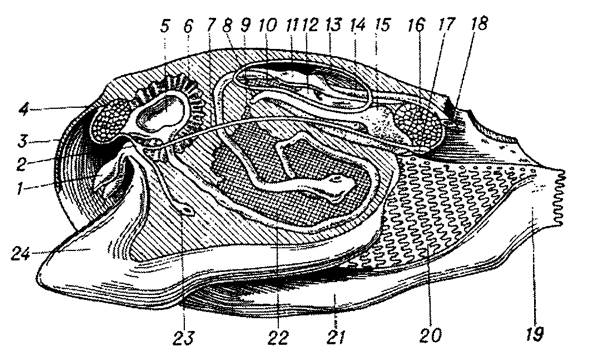
Fig. 136. Structure of a swan mussel (Anodonta):
1 - labial palps; 2, 17, 23 - nerve ganglia; 3 - Mouth; 4, 16 — anterior and posterior adductor muscles; 5 - Stomach; 6 — digestive gland (liver); 7 — nerve connective between ganglia; 8 - external opening of the kidney; 9 - genital opening; 10 - opening of the kidney into the pericardial cavity;
11 - ventricle of The Heart; 12 - atrium; 13 — pericardial cavity; 14 — hindgut; 15 — kidney; 18 - anus; 19 - excurrent siphon; 20 - gills; 21 - mantle; 22 - gonad; 24 - foot.
Respiratory organs are either gills, located in the mantle cavity, or Lungs. The lungs are functionally represented by the vascularized walls of the mantle cavity.
The Circulatory system is open (Blood pours from Blood Vessels into the body cavity). There is a central circulatory organ, the heart, consisting of 1–2 ventricles and one or more atria, surrounded by the pericardial coelom. The evolutionary emergence of the heart ensured a more efficient Blood Circulation throughout the Organism. There are also blood vessels and lacunae through which the blood circulates.
Mollusks reproduce exclusively sexually. Fertilization is mostly internal, though external in some species. Development can be either direct or accompanied by metamorphosis. Ovoviviparous and viviparous forms also occur.
In most marine mollusks, and among freshwater species only in the zebra mussel (Dreissena), the fertilized egg develops into a ciliated, free-swimming larva known as a veliger (from Latin *velum* – "sail" and *gero* – "to bear"), which is a modified trochophore. It eventually settles to the bottom, where its metamorphosis is completed.
THE PHYLUM MOLLUSCA includes seven classes: 1. Chitons (Polyplacophora, or Loricata); 2. Aplacophorans (Aplacophora); 3. Bivalves (Bivalvia); 4. Monoplacophorans (Monoplacophora); 5. Gastropods (Gastropoda); 6. Cephalopods (Cephalopoda); 7. Tusk shells (Scaphopoda).
Let us examine some of them in detail.
Last update: 13/08/2026
Editorial and Educational Adaptation: This material has been compiled based on the primary/original source text. The project team performed an editorial review, corrected technical inaccuracies, structured sections, and adapted the content for an educational format.
What was processed:
- elimination of formatting defects (OCR errors, structural breaks, corrupted characters);
- editorial organization of content;
- standardization of terminology in accordance with academic sources;
- verification of factual statements against the original source text.
All mentions of the author, publication year, and origin of the primary text have been preserved in accordance with the source.