MEDICAL BIOLOGY, HUMAN ANATOMY, PHYSIOLOGY AND PATHOLOGY - Y.I. Fedoniuk 2010
BIOLOGY
SECTION 1. BIOLOGICAL BASES OF HUMAN VITAL ACTIVITY
1.2. CELL. TISSUES. CONCEPT OF AN ORGAN, ORGAN SYSTEM, ORGANISM
MUSCULAR TISSUE
1. Cytology/cytology/32.html">SMOOTH Muscle tissue
Smooth muscle tissue (Fig. 1.22) is located in the walls of Blood Vessels and most hollow Internal Organs, such as the Esophagus, Stomach, intestines, Urinary Bladder, Uterus, etc. The morphological feature of smooth muscle tissue is its cellular Structure and the presence of a contractile apparatus in the form of smooth myofibrils.
Class="center">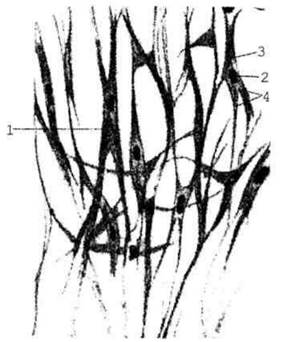
Fig. 1.22. Smooth muscle Cells: 1 - smooth myocyte; 2 - Cell Nucleus; 3 - Cytoplasm; 4 - cell processes.
Functionally, smooth muscle tissue is characterized by relatively slow contractions and The ability to maintain a contracted state for extended periods. In doing so, it expends a relatively small amount of energy and, accordingly, does not fatigue as quickly as striated musculature. This type of contractile activity is referred to as tonic. Smooth muscle tissue is innervated by the Autonomic Nervous system and therefore, unlike striated musculature, it is not subject to our conscious will, although it remains under the control of the Cerebral Cortex, much like all Other types of contractile Tissues.
The basic structural unit of smooth muscle tissue is the smooth muscle cell, or smooth myocyte. It has an elongated, spindle-like shape with tapered ends. Smooth muscle tissue is characterized by a very dense arrangement of its cells.
Last update: 08/08/2026
Editorial and Educational Adaptation: This material has been compiled based on the primary/original source text. The project team performed an editorial review, corrected technical inaccuracies, structured sections, and adapted the content for an educational format.
What was processed:
- elimination of formatting defects (OCR errors, structural breaks, corrupted characters);
- editorial organization of content;
- standardization of terminology in accordance with academic sources;
- verification of factual statements against the original source text.
All mentions of the author, publication year, and origin of the primary text have been preserved in accordance with the source.