LEHNINGER PRINCIPLES OF BIOCHEMISTRY - VOL. 2. BIOENERGETICS AND METABOLISM - 2014
PART II. BIOENERGETICS AND METABOLISM
13. BIOENERGETICS AND BIOCHEMICAL REACTION TYPES
13.2. Chemical Logic of Biochemical Reactions
The energy-releasing biological processes we discuss here are specific Chemical Reactions. Not all types of reactions commonly encountered in general organic chemistry take place within The Cell. What reactions occur in biological systems and what ones do not is determined by 1) their role in a specific biological system and 2) their rates. Both of these factors are crucial in shaping the metabolic pathways we will discuss later. A biologically significant reaction is one that utilizes an available substrate and converts it into the required product. However, even these potentially significant reactions cannot always proceed within the cell. Some chemical transformations are so slow (i.e., they have such high activation energies) that they cannot occur in living systems even in the presence of powerful catalysts, namely Enzymes. The reactions that actually take place in living Cells represent a set of chemical "tools" evolved to bypass "impossible" reactions. To properly understand cell biochemistry, one must be able to recognize which reactions are feasible.
Despite all these limitations, the number of Metabolic Transformations in a typical cell is immense. Most cells have The ability to carry out thousands of specific enzymatic reactions—for example, converting a simple substance like glucose into Amino Acids, NUCLEOTIDES, or Lipids, extracting energy from dietary substances via their oxidation, or polymerizing monomeric molecules to form macromolecules.
To study all these reactions, a systematic approach is necessary. The chemical reactions occurring in living organisms can be classified into types, eliminating the need to study every single reaction to understand the "logic" underlying biochemical processes. Many reactions in living cells can be categorized into five major types: 1) reactions involving carbon-carbon bond formation or Cleavage; 2) internal molecular rearrangements, isomerizations, and eliminations; 3) free-radical reactions; 4) group transfer reactions; and 5) oxidation-reduction reactions. Below, we discuss these various reaction types in greater detail using specific Examples of biochemical transformations. Note that these reaction categories are not mutually exclusive; for instance, an isomerization reaction may proceed via a free-radical mechanism.
Before continuing our Structure/133.html">Discussion of reaction types, however, we should recall two fundamental chemical principles. The first principle is that a covalent chemical bond is formed by the sharing of a pair of electrons, and the cleavage of this bond can occur in two ways (Fig. 13-1). In homolytic cleavage, each atom participating in the bond retains one electron, resulting in The formation of a free radical bearing a single unpaired electron. In heterolytic cleavage, which occurs much more frequently, both electrons remain associated with one of the two atoms. Figure 13-1 depicts the species most commonly formed during C—C and C—H bond cleavage. Carbanions, carbocations, and hydride ions are highly unstable, and as we shall see, this property largely dictates the chemical behavior of these ions.
Class="center">
Fig. 13-1. Two mechanisms of C—C and C—H bond cleavage. In homolytic bond cleavage, each atom retains one electron, leading to the formation of a carbon radical (the carbon has an unpaired electron) or uncharged atomic hydrogen. In heterolytic bond cleavage, both electrons remain associated with one of the atoms. This produces carbanions, carbocations, protons, or hydride ions.

The second principle is that many biochemical reactions proceed via the interaction of nucleophiles (electron-rich functional groups capable of donating electrons to other atoms and atomic groups) and electrophiles (electron-deficient groups capable of accepting electrons from other groups). Nucleophiles donate electrons when interacting with electrophiles. Frequently encountered biological nucleophiles and electrophiles are shown in Fig. 13-2. Note that a carbon atom can act as either a nucleophile or an electrophile, depending on the surrounding chemical bonds and functional groups.
Fig. 13-2. Most common nucleophiles and electrophiles in biochemical reactions. In reaction mechanism schemes where covalent bonds are formed or broken, electrons are represented by dots, and curved arrows show the direction of movement of an electron or an electron pair. A covalent bond is formed by sharing a pair of electrons. Nonbonding electrons, when important for understanding the reaction mechanism, are shown as a pair of dots (:). Curved arrows  indicate the direction of electron-pair displacement. The movement of a single electron (as in free-radical reactions) is depicted by a fishhook-like arrow
  . A lone pair of electrons participates in many processes.

Reactions involving carbon-carbon bond formation or cleavage. Heterolytic cleavage of a C—C bond yields a carbanion and a carbocation (Fig. 13-1). Conversely, C—C bond formation results from the combination of a nucleophilic carbanion and an electrophilic carbocation. Carbanions and carbocations are typically so unstable that their formation as chemical reaction intermediates, even with the aid of enzymes, is energetically very unfavorable. Under cellular conditions, these reactions simply cannot proceed unless a functional group containing electronegative atoms (O or N) comes to the "rescue" by altering the electronic state of adjacent carbon atoms and thus stabilizing them to facilitate the formation of carbanions and carbocations.
Carbonyl groups play a crucial role in the chemical reactions involved in Various metabolic pathways. The carbon atom of a carbonyl group carries a partial positive charge due to the electron-withdrawing Properties of the carbonyl oxygen, making this carbon atom act as an electrophile (Fig. 13-3a). Thus, the carbonyl group can facilitate carbanion formation on an adjacent carbon atom by delocalizing the negative charge (Fig. 13-3b). An imino group ($ ext{C}= ext{NH}_2^+$) can perform a similar function (Fig. 13-3c). The ability of carbonyl and imino groups to delocalize electrons can be further enhanced by a general acid catalyst or a metal ion such as $ ext{Mg}^{2+}$ (Fig. 13-3d; see also Figs. 6-21 and 6-23).
Fig. 13-3. Chemical properties of the carbonyl group. (a) The carbonyl carbon possesses electrophilic properties due to the ability of the electron-withdrawing oxygen atom to pull electrons toward itself. This results in a Resonance hybrid structure in which the carbon atom bears a partial positive charge. (b) Electron delocalization onto the carbonyl group helps stabilize a carbanion on the adjacent carbon atom and facilitates its formation. (c) Imines perform the same function as carbonyl groups, facilitating electron delocalization. (d) The carbonyl group does not always act alone; its electron-withdrawing capability is frequently enhanced by the presence of a metal ion ($ ext{Me}^{2+}$, e.g., $ ext{Mg}^{2+}$) or an acid ($ ext{HA}$).

Carbonyl groups are especially important in the three MAIN TYPES OF reactions involving C—C bond formation or cleavage (Fig. 13-4)—namely, aldol condensations, Claisen condensations, and decarboxylation reactions. In these reactions, the resulting carbanion is stabilized by a carbonyl group, and quite frequently another carbonyl acts as the electrophile with which the carbanion nucleophile reacts.
Fig. 13-4. Examples of C—C bond cleavage and formation reactions in biological systems. In aldol and Claisen condensations, the carbanion Functions as a nucleophile, while the carbonyl carbon acts as an electrophile. In both cases, the carbanion is stabilized by a neighboring carbonyl group. In the decarboxylation reaction, elimination of $ ext{CO}_2$ (highlighted in blue) yields a carbanion. This reaction could not proceed at an appreciable rate without the stabilizing effect of a carbonyl group adjacent to the carbanion. Whenever a carbanion is depicted, stabilizing resonance structures involving the neighboring carbonyl group are implied, as shown in Fig. 13-3b. The carbanion may be stabilized by an imino group (Fig. 13-3b) or another electron-withdrawing group instead of a carbonyl, including certain enzyme Cofactors such as pyridoxal.

Aldol Condensation is frequently employed to form C—C bonds; during Glycolysis, aldolase catalyzes the reverse reaction, converting a six-carbon compound into two three-carbon compounds (see Fig. 14-5). In a Claisen condensation, the carbanion is stabilized by the carbonyl group of an adjacent thioester; an example is the synthesis of citrate in The Citric Acid Cycle (see Fig. 16-9). Decarboxylation also frequently generates a carbanion stabilized by a carbonyl group; an example is the acetoacetate decarboxylase-catalyzed Formation of Ketone bodies during fatty acid Catabolism (see Fig. 17-18). Entire metabolic pathways may be organized around placing carbonyl groups in specific microenvironments that permit carbon-carbon bond formation or cleavage. In some cases, the electron-withdrawing function of the carbonyl group is fulfilled by an imino group or a specialized cofactor, such as Pyridoxal phosphate.
Carbocations as intermediates in certain carbon-carbon bond formation or cleavage reactions arise from the departure of a good leaving group, such as pyrophosphate (see the section on group transfer reactions below). An example is the reaction catalyzed by prenyltransferase (Fig. 13-5), which occurs in the Cytology/cytology/16.html">Early stages of Cholesterol Biosynthesis.
Fig. 13-5. Generation of a carbocation during carbon-carbon bond formation. At an early stage of cholesterol biosynthesis, the enzyme prenyltransferase catalyzes the condensation of isopentenyl pyrophosphate with dimethylallyl pyrophosphate to form geranyl pyrophosphate (see Fig. 21-36). The reaction is initiated by the elimination of the pyrophosphate group from dimethylallyl pyrophosphate, generating a carbocation stabilized by resonance with the adjacent $ ext{C}= ext{C}$ bond.

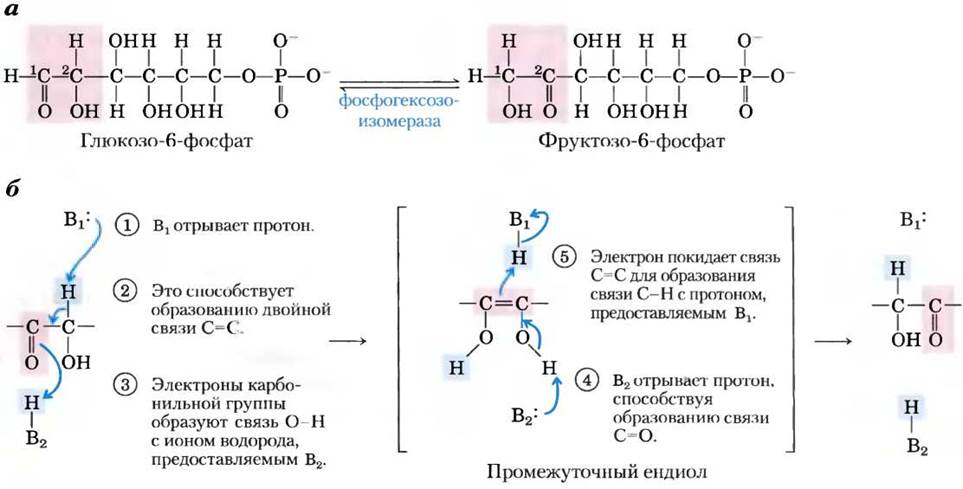
Intramolecular rearrangements, isomerizations, and eliminations. Another common type of cellular reaction is the intramolecular rearrangement, in which the redistribution of electrons leads to structural changes without altering the overall oxidation state. For instance, various functional groups may undergo oxidation-reduction transformations, but the molecule as a whole retains its initial oxidation state. Groups attached to carbon atoms linked by a double bond can undergo cis-trans transitions, which may be accompanied by a shift in THE POSITION OF the double bond itself. A classic example of isomerization resulting from a redox reaction is The conversion of glucose-6-phosphate to fructose-6-phosphate during glycolysis (Fig. 13-6; this reaction is discussed in detail in Chapter 14): C-1 is reduced (the aldehyde is converted to an alcohol), while C-2 is oxidized (the alcohol is converted to a ketone). Figure 13-6b illustrates the electron transfer underlying this isomerization. Cis-trans isomerizations are exemplified by the reaction catalyzed by prolyl cis-trans isomerase, which is involved in the folding of certain Proteins (see Fig. 4-7b). A simple C=C bond shift occurs during the METABOLISM of oleic acid, a very common fatty acid (see Fig. 17-9). Fascinating examples of reactions involving double-bond migration can also be observed in cholesterol biosynthesis (see Fig. 21-33).
Fig. 13-6. Isomerization and elimination reactions. (a) The conversion of glucose-6-phosphate to fructose-6-phosphate, catalyzed by phosphoglucoisomerase. (b) The reaction proceeds via an enediol intermediate. Curved blue arrows indicate the movement of bonding electron pairs. The pink color highlights the course of oxidation from left to right. V1 and V2 represent ionizable groups of the enzyme that can accept and donate protons during the reaction (i.e., acting as acids or bases). Nucleophilic groups are highlighted in pink, and electrophilic groups in blue.
An example of an elimination reaction that occurs without changing the overall oxidation state of the molecule is the dehydration of an alcohol to form a C=C double bond.

Similar elimination reactions occur in amines.
Free-radical reactions. It was previously believed that the homolytic cleavage of a covalent bond to form free radicals was a rare event; however, it has now been discovered in A wide variety of biochemical processes. These include isomerizations involving adenosylcobalamin (vitamin B12) or S-adenosylmethionine, initiated by the 5'-deoxyadenosyl radical (see the reaction catalyzed by methylmalonyl-CoA mutase in Box 17-2); certain radical-initiated decarboxylation reactions (Fig. 13-7); some reductase reactions, such as that catalyzed by Ribonucleotide reductase (see Fig. 22-41); and specific rearrangements, such as the reaction catalyzed by DNA photolyase (see Fig. 25-27).
Fig. 13-7. Free-radical-mediated decarboxylation reactions. Heme biosynthesis (see Fig. 22-24) in Escherichia coli involves a decarboxylation step in which the propionyl side chains of coproporphyrinogen III are converted to the vinyl groups of protoporphyrinogen IX. When Bacteria grow under anaerobic conditions, the oxygen-independent coproporphyrinogen III oxidase enzyme, also known as the HemN protein, promotes decarboxylation via the free-radical mechanism depicted here. The acceptor of the released electrons remains unknown. For simplicity, only the PARTS OF THE molecules essential for describing the reaction mechanism are shown; Complete Structures are presented in Fig. 22-24. When E. coli grows in the presence of oxygen, this reaction is replaced by an oxidative decarboxylation catalyzed by a different enzyme.

Group-transfer reactions.
Living organisms frequently carry out Reactions Involving the transfer of an acyl, glycosyl, or phosphoryl group from one nucleophile to another. Acyl-group transfer typically proceeds via The addition of a nucleophile to the carbonyl carbon of the acyl group, forming a tetrahedral intermediate:
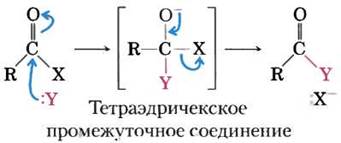
An example is the reaction catalyzed by Chymotrypsin (see Fig. 6-21). In principle, substitution can occur via either an SN1 or an SN2 mechanism, as illustrated in Fig. 6-25 for Lysozyme.
Phosphoryl-group transfer reactions play a special role in metabolism and are discussed in Section 13.3. A vital Metabolic Strategy involves attaching good leaving groups to metabolic intermediates to "activate" them for subsequent transformations. Good leaving groups in Nucleophilic substitution reactions include inorganic orthophosphate (phosphoric acid anions H3PO4—a mixture of H2PO4- and HPO42-, commonly abbreviated as Pi) and inorganic pyrophosphate (P2O74-, abbreviated as PPi); phosphoric acid esters and anhydrides are sufficiently activated for further reaction. Furthermore, nucleophilic substitution is facilitated by attaching a phosphoryl group to a poor leaving group such as a hydroxyl group. Nucleophilic substitution in which the PO32- phosphoryl group acts as the leaving group occurs in hundreds of metabolic reactions.
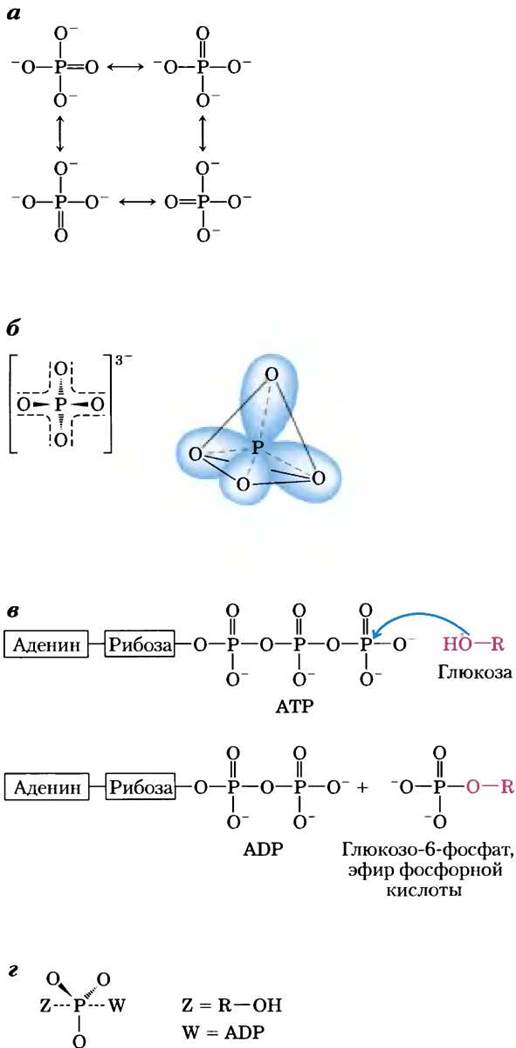
Phosphorus can form five covalent bonds. Inorganic orthophosphate Pi (Fig. 13-8a) is conventionally depicted with three single P–O bonds and one double P=O bond; while convenient, this representation is far from accurate. In reality, all four phosphorus-oxygen bonds in Pi are equivalent and possess partial double-bond character, giving the anion a tetrahedral structure (Fig. 13-8b). Because oxygen is more electronegative than phosphorus, the electron pair is shared unequally: the centrally located phosphorus atom bears a partial positive charge and can therefore act as an electrophile. In numerous metabolic reactions, the PO32- phosphoryl group is transferred from an ATP molecule to an alcohol, yielding a phosphate ester (Fig. 13-8c), or to a carboxylic acid, forming a mixed anhydride. When a nucleophile attacks the electrophilic phosphorus atom, ATP is converted into a relatively stable intermediate in which phosphorus is pentavalent (Fig. 13-8d). Phosphoryl transfer is completed by the departure of the leaving group (ADP). A large family of enzymes catalyzing phosphoryl transfer from ATP is designated as Kinases (from the Greek kinein, meaning "to move"). For instance, hexokinase "moves" a phosphoryl group from ATP to a glucose molecule.
Fig. 13-8. Alternative representations of The structure of inorganic orthophosphate. (a) Three oxygen atoms are linked to the phosphorus atom by single bonds, and the fourth is attached by a double bond; four distinct resonance structures can be drawn. (b) More accurate resonance structures in which all four oxygen-phosphorus bonds have partial double-bond character, with hybrid orbitals forming a tetrahedron centered on the phosphorus atom. (c, d) When a nucleophile Z (here, the OH group at C-6 of glucose) attacks ATP, a substitution occurs, generating ADP (represented here as W). This SN2 reaction proceeds via a pentavalent phosphorus intermediate.
However, phosphoryl groups are not the only moieties that activate molecules for subsequent reactions. Thiols (thiools), in which the oxygen atom of an alcohol group is replaced by sulfur, also serve as effective leaving groups. Thiols activate carboxylic acids by forming thioesters. In subsequent chapters, we will examine several reactions—including lipid synthesis pathways catalyzed by fatty acid synthases (see Fig. 21-2)—in which nucleophilic Substitution at the carbonyl carbon of a thioester results in acyl group transfer to another residue.
Oxidation-reduction reactions.
In Biomolecules, carbon can exist in five distinct oxidation states depending on the elements with which it shares electrons (Fig. 13-9), and transitions between these states are fundamental to metabolism (redox reactions are covered in Section 13.4). In many Biological Oxidation processes, compounds lose two electrons and two hydrogen ions (for simplicity, we will refer to this as the loss of two hydrogen atoms). Such reactions are generally termed dehydrogenations, and the enzymes that catalyze them are called dehydrogenases (Fig. 13-10). In some, though not all, biochemical oxidation reactions, a carbon atom forms a covalent bond with an oxygen atom. Enzymes catalyzing these processes are termed oxidases; if the oxygen atom is derived directly from molecular oxygen (O2), the enzymes are called oxygenases.
Fig. 13-9. Oxidation states of carbon in biomolecules. A series of Organic compounds, each of which can be derived by The oxidation of a carbon atom (highlighted in red) in the preceding compound. Carbon dioxide is the most oxidized form of carbon found in living systems.

Fig. 13-10. An oxidation-reduction reaction. The oxidation of lactate to Pyruvate is illustrated. Dehydrogenation occurs—the removal of two electrons and two hydrogen ions (equivalent to the removal of two hydrogen atoms) from the C-2 atom of lactate to yield pyruvate (a ketone). In cells, this reaction is catalyzed by Lactate dehydrogenase, and the electrons are transferred to the cofactor nicotinamide adenine dinucleotide (NAD). The reaction is reversible; Pyruvate can be reduced by electrons from the cofactor.

Any oxidation process is inevitably coupled to a reduction, in which an electron acceptor acquires the electrons removed during oxidation. Oxidation reactions are typically exergonic (think of a campfire: the organic compounds comprising wood are oxidized by the molecular oxygen in the air). Most living cells derive the energy they require by oxidizing fuel molecules such as CARBOHYDRATES and fats (photosynthetic organisms harness solar energy by capturing light). The catabolic processes described in Chapters 14 through 19 (i.e., energy-yielding processes) consist of sequences of oxidation reactions in which electron flow from fuel molecules to oxygen is mediated by electron carriers. The high electron affinity of molecular oxygen renders the overall electron-transfer process exergonic, providing the Free energy necessary for ATP synthesis, which is the primary objective of Catabolic pathways.
Many reactions across all five types considered here proceed in the presence of cofactors, such as Coenzymes or Metal Ions (examples include vitamin B12, S-adenosylmethionine, folate, nicotinamide, and iron). Cofactors bind to enzymes—either reversibly or virtually irreversibly—thereby facilitating the catalysis of specific chemical transformations (see Section 6.1, Vol. 1). Most cofactors participate in a relatively narrow, well-defined group of related reactions. In the following chapters, we will examine the most important cofactors. Grouping biochemical processes by their cofactors offers an alternative perspective for their study, as all reactions involving a given cofactor are inherently interconnected.
Biochemical and chemical equations are not at all the same thing
Biochemists often write metabolic reactions using simplified schemes, which is especially noticeable in reactions involving ATP. Phosphorylated compounds can exist in multiple ionization states and, as discussed above, bind magnesium ions in the process. For example, at pH 7.0 and an Mg2+ concentration of 2 mM, ATP exists as a mixture of ATP4-, HATP3-, H2ATP2-, MgHATP-, and Mg2ATP. However, when discussing the Biological Role of ATP, we are rarely concerned with such fine details and do not treat ATP as a single defined chemical species. Consequently, biochemists write the ATP Hydrolysis reaction in the following generalized form:
АТР + Н2O —> ADP + Pi
where ATP, ADP, and Pi actually represent a mixture of ionic species. At the same time, the apparent Equilibrium Constant K'eq= [ADP] [Рi]/[АТР] depends on pH and the concentration of free Mg2+ ions. Note that biochemical equations (such as the scheme above) omit hydrogen and Mg2+ ions because their concentrations remain constant (unchanged during the course of the biochemical reaction). Thus, a biochemical equation does not need to balance the number of H and Mg atoms or electrical charges, whereas a chemical equation must strictly balance all participating elements (C, N, O, and P in this example).
For comparison, we can write a chemical equation that balances all elements and charges. For instance, in the absence of magnesium, ATP hydrolysis at pH >8.5 can be expressed as follows:
АТР4- + Н2О —> ADP3- + HPO2-4 + Н+
The corresponding equilibrium constant (К'eq - [ADP3-] [НРO2-4][Н+]/[АТР4-]) depends solely on Temperature, pressure, and the Ionic strength of the solution.
In biochemistry, both Methods of writing metabolic reaction equations are used. The chemical notation is essential when we need to account for all atoms and charges, which is required when describing a reaction mechanism. The biochemical notation is used to determine the direction of spontaneous reactions at specified pH and [Mg2+] values, as well as to calculate the equilibrium constant.
In this book, we primarily use the biochemical reaction notation, except when discussing reaction mechanisms; The values of ∆G'° and К'eq correspond to pH 7 and a Mg2+ ion concentration of 1 mM.
Summary of Section 13.2 Chemical foundations of Biochemical Reactions
■ The multitude of chemical reactions occurring in living organisms can be classified into five primary types.
■ The carbonyl group plays a crucial role in C—C bond formation and cleavage reactions. A carbanion, stabilized by adjacent carbonyl groups or (less frequently) imino groups or cofactors, often forms as an intermediate.
■ Electron redistribution can lead to intramolecular rearrangements, isomerizations, and the elimination of functional groups. Such reactions include intramolecular redox reactions, cis-trans double-bond rearrangements, and double-bond Migrations.
■ Homolytic covalent bond cleavage resulting in free radical formation occurs in certain metabolic reactions, such as isomerizations, decarboxylations, and reductase-catalyzed reactions.
■ Phosphoryl group transfer reactions play an especially vital role in the cell; they serve as a means to activate molecules that would otherwise be incapable of undergoing further chemical transformations.
■ Oxidation-reduction reactions involve the loss and gain of electrons: one substance accepts electrons and is reduced, while another donates electrons and is oxidized in the process. Oxidation reactions typically release energy and play a critical role in catabolic pathways.
Last update: 06/08/2026
Editorial and Educational Adaptation: This material has been compiled based on the primary/original source text. The project team performed an editorial review, corrected technical inaccuracies, structured sections, and adapted the content for an educational format.
What was processed:
- elimination of formatting defects (OCR errors, structural breaks, corrupted characters);
- editorial organization of content;
- standardization of terminology in accordance with academic sources;
- verification of factual statements against the original source text.
All mentions of the author, publication year, and origin of the primary text have been preserved in accordance with the source.