Biochemistry: The Chemical Reactions of Living Cells, Volume 2 - D. Metzler 1980
Types of Reactions Catalyzed by Enzymes
ß-Cleavage and Condensation
Substitution at the Carbonyl Group (Type 5.A Reactions)
In the presence of suitable catalysts, $\beta$-keto acids can undergo Hydrolysis driven by the nucleophilic attack of a Water molecule on the carbonyl group. The enzyme oxaloacetate acetylhydrolase has been isolated from Aspergillus niger [141]:
Class="center">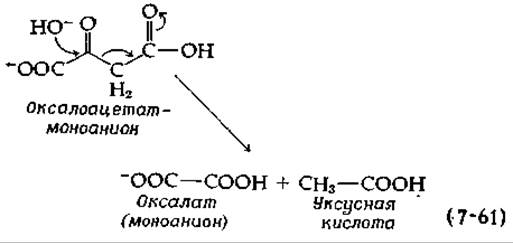
Thiolases have been studied in much greater detail [142, 143]. One of the primary Functions of these Enzymes is the Cleavage of $\beta$-ketoacyl-CoA derivatives, which proceeds via the displacement of a thiol group by another CoA molecule:
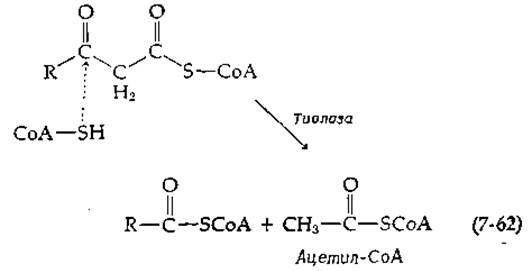
This reaction represents a key chain-shortening step in the $\beta$-oxidation pathway of Fatty acids, leading to their degradation (Fig. 7-1). Given that thiolases are inhibited by Reagents targeting —SH groups, it has been proposed that an active-site thiol group initially reacts with the $\beta$-carbonyl group, as depicted in equation (7-62), forming an intermediate complex. In the second step, the acyl group is subsequently transferred to CoA. Furthermore, certain thiolases are known to form Schiff bases with their substrates [143].
Last update: 06/08/2026
Editorial and Educational Adaptation: This material has been compiled based on the primary/original source text. The project team performed an editorial review, corrected technical inaccuracies, structured sections, and adapted the content for an educational format.
What was processed:
- elimination of formatting defects (OCR errors, structural breaks, corrupted characters);
- editorial organization of content;
- standardization of terminology in accordance with academic sources;
- verification of factual statements against the original source text.
All mentions of the author, publication year, and origin of the primary text have been preserved in accordance with the source.