Biochemistry and Molecular Biology - Belyasova N.A. 2002
Metabolism. Energy-requiring processes
Metabolic integration
The role of key intermediates in metabolic integration
At any given moment, several hundred Chemical Reactions take place within a metabolizing Cell, and arguably, all of them are interconnected in one way or another. This is made possible by the tight integration of cellular METABOLISM and its multi-level regulation. The integration of constructive and Energy Metabolism was partially discussed in Chapter 8; here, we will focus on key intermediate metabolites—substances that enable The Cell to coordinate the Metabolic pathways of various classes of Organic compounds.
Fig. 19.1 illustrates a simplified scheme of the integration of Major Metabolic Pathways common to most Cells and organisms. As can be seen, the breakdown and Biosynthesis of complex organic compounds (Proteins, Nucleic Acids, CARBOHYDRATES, Lipids) are interconnected primarily through Pyruvate, acetyl-CoA, and the intermediates of The Tricarboxylic Acid Cycle.
The primary key metabolites include pyruvate, acetyl-CoA, oxaloacetate, and a-ketoglutarate. Let us examine their roles in cellular metabolism.
Pyruvate. This three-carbon a-keto acid links Glycolysis and Gluconeogenesis, as well as Carbohydrate Metabolism with the metabolism of lipids, proteins, Isoprenoids, and Ketone Bodies (Fig. 19.1).
Pyruvate is produced in cells primarily during hexose Catabolism, The oxidation of lactate (which accumulates in Muscles during Lactic acid Fermentation), and the deamination of Alanine. Hexose catabolism was detailed in Chapter 9. Lactic acid fermentation is a major metabolic process (Chapter 10) that actively occurs in the muscles of humans and animals under conditions of insufficient oxygen supply. Here, lactate production allows the Organism to rapidly regenerate NAD+, which is essential for ATP generation during glycolysis (the contraction and relaxation of Muscle fibers require ATP Hydrolysis).
The lactate accumulating in muscles enters the bloodstream and is transported to the Liver, where it is oxidized back to pyruvate. During gluconeogenesis, Pyruvate can be converted into glucose. This sequence of reactions is known as the Cori cycle.
Class="center">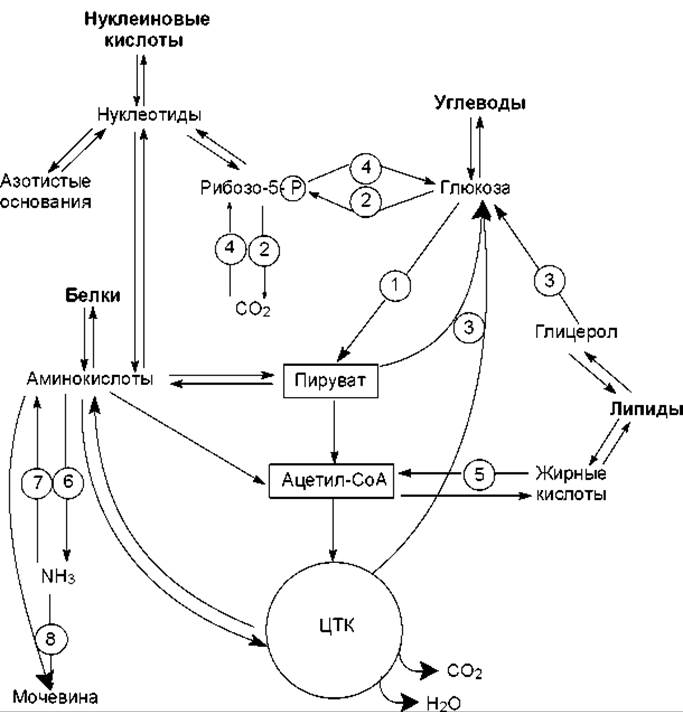
Fig. 19.1. Interrelation of major cellular processes (simplified diagram): 1 — glycolysis; 2 — Pentose Phosphate Pathways; 3 — gluconeogenesis; 4 — Calvin cycle; 5 — ß-Oxidation of Fatty acids; 6 — deamination; 7 — amination of keto acids; 8 — Urea Cycle; TCA — tricarboxylic acid cycle
Alanine is formed from pyruvate via Transamination reactions (Fig. 16.8) involving Amino Acids produced during protein proteolysis. Carried by the bloodstream to the liver, alanine is converted back into pyruvate, serving as a carrier of ammonium nitrogen, which is then incorporated into The urea cycle in the liver. In addition, alanine derived from pyruvate can be incorporated into Peptides.
The conversions of pyruvic acid (Fig. 19.2) are also linked to Carboxylation and Decarboxylation reactions. The first process, occurring in Mitochondria, yields oxaloacetate, which can either enter the TCA cycle (as one of the most important anaplerotic reactions) or be converted into phosphoenolpyruvate and subsequently into glucose (gluconeogenesis).
In the second case, pyruvate undergoes oxidative decarboxylation to form acetyl-CoA, which also acts as a key metabolite.
Another vital aspect of pyruvate transformations is various Types of fermentation in which pyruvic acid serves as a substrate. Acetyl-CoA. The primary sources of this key intermediate are pyruvate and Fatty acids (via oxidative decarboxylation and ß-Oxidation, respectively). Furthermore, acetyl-CoA is produced from ketogenic amino acids upon The breakdown of their carbon skeletons. The Fate of acetyl-CoA, like that of other key metabolites, depends on the needs of the cell (organism): it can be fully oxidized in the tricarboxylic acid cycle as its substrate; it can undergo sequential Condensation to form 3-hydroxy-3-methylglutaryl-CoA, a precursor of Cholesterol, terpene compounds (isoprenoids), and ketone bodies (acetoacetic acid, 3-hydroxybutyric acid, and acetone); or it can be converted into fatty acids (Fig. 19.2). As previously noted, mammalian organisms cannot convert acetyl-CoA into carbohydrates. At the same time, plant and microbial cells are capable of synthesizing gluconeogenesis precursors—and consequently carbohydrates—from acetyl-CoA (Fig. 11.7).

Fig. 19.2. Main transformations of pyruvate and acetyl-CoA in cellular metabolism
In addition to the aforementioned reactions, acetyl-CoA participates in the synthesis of amino acids—specifically Arginine, leucine, Lysine (in fungal cells), and Cysteine (in certain microorganisms)—and serves as a substrate for Butyric Acid and acetone-butanol fermentations.
The involvement of key TCA intermediates (oxaloacetate, a-ketoglutarate) in Metabolic Integration can be easily traced in the diagrams shown in Fig. 19.1 and 19.2.
To summarize, it should be emphasized once again that all metabolic processes occurring within a cell (organism) are interconnected through intermediate metabolites, which act as products of certain metabolic pathways and substrates for others. This interconnectedness and interdependence allow the cell (organism) to coordinate its capabilities with its physiological needs and rapidly "fine-tune" its metabolic rate in response to changing environmental conditions. Naturally, this delicate mechanism would be impossible without the Regulation of Metabolic pathways.
Last update: 06/08/2026
Editorial and Educational Adaptation: This material has been compiled based on the primary/original source text. The project team performed an editorial review, corrected technical inaccuracies, structured sections, and adapted the content for an educational format.
What was processed:
- elimination of formatting defects (OCR errors, structural breaks, corrupted characters);
- editorial organization of content;
- standardization of terminology in accordance with academic sources;
- verification of factual statements against the original source text.
All mentions of the author, publication year, and origin of the primary text have been preserved in accordance with the source.