Biochemistry - The Chemical Reactions of Living Cells, Volume 2 - D. Metzler 1980
Organization of Metabolism: Catabolic Pathways
Fermentation: "Life Without Oxygen"
Butyric Acid and Butanol Fermentation
Several different Types of Fermentation are carried out by Bacteria of the genus Clostridium, as well as by rumen-dwelling bacteria such as Eubacterium (Butyrbacterium) and Butyrivibrio. For example, in one type of fermentation, glucose is converted into butyric and acetic acids, as well as CO2 and H2 [equations (9-32) and (9-33)]:
Class="center">
The ATP yield (37 g mol per 1 mol of glucose) is higher (50% efficiency) than in any Other types of fermentation considered here.
Another type of fermentation leads to The formation of butanol and isopropanol, as well as ethanol and acetone. During the Formation of the first two compounds, the ATP yield is 27 g mol of ATP per 1 mol of fermented glucose [equation (9-34)].
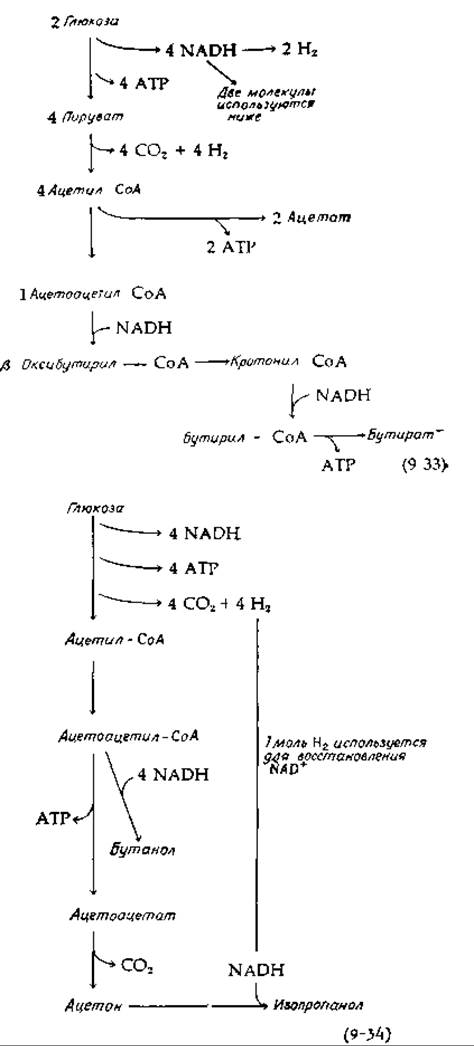
Overall reaction

Note that in both equations (9-33) and (9-34), the reversible reduction of NADH by hydrogen plays a crucial role. In bacteria of the genus Clostridium, this reaction is catalyzed by a ferredoxin-dependent Hydrogenase (Chapter 10, Section E, 1, a).
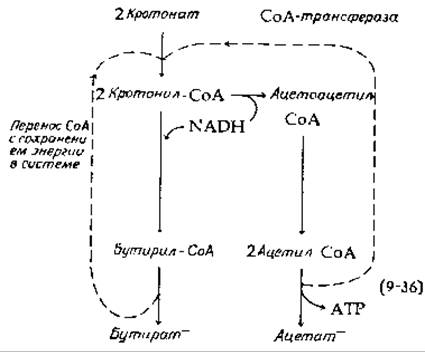
A similar fermentation process [equation (9-35)] is carried out by Clostridium kluyveri:

It should be noted that the value of —∆G' in this case is lower than in all previously discussed fermentation processes, yet it is fully sufficient for the synthesis of a single ATP molecule. The process proceeds in accordance with the scheme shown in equation (9-36). The bond energy of butyryl-CoA and one of the acetyl-CoA molecules is captured by the system and used at the initial stage to form crotonyl-CoA. During its conversion, an acetyl-CoA molecule is released, which is converted into acetyl phosphate and subsequently into acetate, yielding ATP.
Last update: 06/08/2026
Editorial and Educational Adaptation: This material has been compiled based on the primary/original source text. The project team performed an editorial review, corrected technical inaccuracies, structured sections, and adapted the content for an educational format.
What was processed:
- elimination of formatting defects (OCR errors, structural breaks, corrupted characters);
- editorial organization of content;
- standardization of terminology in accordance with academic sources;
- verification of factual statements against the original source text.
All mentions of the author, publication year, and origin of the primary text have been preserved in accordance with the source.