Biological Chemistry - Berezov T. T., Korovkin B. F. 1998
Vitamins
Fat-Soluble Vitamins
Vitamin D Group
Vitamin D (calciferol; antirachitic vitamin) exists as several compounds that differ in both chemical Structure and biological activity. For humans and animals, Vitamins D2 and D3 are considered the active forms, although vitamin D4 (dihydroergocalciferol) is also known in the literature. Natural products predominantly contain provitamins D2 and D3 — ergosterol and Cholesterol, respectively.
In 1924, A. Hess, M. Weinstock, and independently H. Steenbock obtained an active preparation that prevented The Development of Rickets in children by exposing plant oils and foodstuffs to ultraviolet (UV) rays with a wavelength of 280–310 nm. It turned out that the active principle was associated with a sterol identified as ergosterol, which was named vitamin D1. In 1932, A. Windaus isolated ergosterol from Yeast and demonstrated that the true vitamin D is not ergosterol itself, but its conversion product formed upon UV irradiation, which was named vitamin D2, or calciferol. In 1956, the International Commission on Chemical Nomenclature proposed a new name for vitamin D2 — "ergocalciferol".
From a chemical standpoint, ergosterol (ergosterin) is a monohydric unsaturated cyclic alcohol whose structure is based on a condensed cyclopentanoperhydrophenanthrene ring system. Under the action of UV rays, ergosterol is converted into vitamin D2 through a series of intermediates (lumisterol, tachysterol):
Class="center">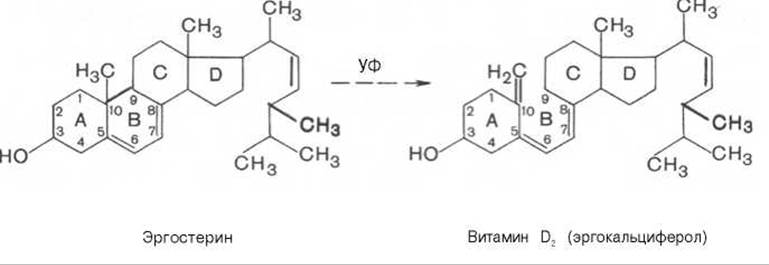
Vitamin D2 is formed from ergosterol As a result of the Cleavage of the bond between the 9th and 10th carbon atoms of ring B under METABOLISM/18.html">The Influence of UV rays.
In 1936, A. Windaus's laboratory isolated an antirachetically active preparation from fish oil and named it vitamin D3. It was discovered that the precursor of vitamin D3 is not ergosterol, but cholesterol. In 1937, A. Windaus isolated 7-dehydrocholesterol from the superficial layers of pig Skin, which upon UV irradiation was converted into active vitamin D3:
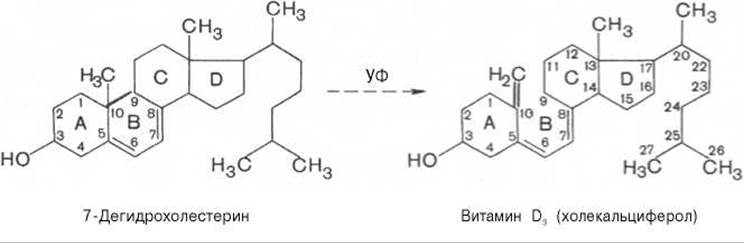
It should be noted that due to the presence of cholesterol and 7-dehydrocholesterol in human skin Lipids, the synthesis of vitamin D3 is possible upon solar irradiation or exposure of the body surface to ultraviolet lamps. This method is particularly widely used in the Treatment of rickets in children.
Vitamins D2 and D3 are colorless crystals with a melting point of 115–117°C, insoluble in Water, but readily soluble in fats, chloroform, ether, and other fat Solvents.
A deficiency of vitamin D in the diet of children leads to the development of a well-known disease — rickets, the Pathogenesis of which is based on alterations in phosphorus-calcium metabolism and impaired deposition of calcium phosphate in Bone tissue. Therefore, the main symptoms of rickets are caused by a disruption of normal osteogenesis. Osteomalacia, or bone softening, develops. Bones become soft and, under the weight of the body, take on deformed O- or X-shapes. Characteristic thickenings, known as "rachitic rosary", appear at the costochondral junctions of the Ribs. Children with rickets have a relatively large HEAD and a distended abdomen. The Development of the latter symptom is caused by Muscle hypotonia. The impairment of osteogenesis in rickets also affects tooth development; the eruption of the first Teeth and The formation of dentin are delayed. A characteristic feature of Vitamin D deficiency in adults is the development of Osteoporosis due to the leaching of previously deposited salts; bones become brittle, frequently leading to fractures.
Biological role. The Significance of vitamin D has only recently begun to be clarified. Evidence has been obtained that under physiological conditions calciferols are functionally inert. According to H. DeLuca et al., vitamin D performs its biological Functions in the body in the form of active metabolites derived from it, particularly 1,25-dihydroxycholecalciferol [abbreviated as 1,25(OH)2D3] and 24,25-dihydroxycholecalciferol [24,25(OH)2D3]*, with hydroxylation at the 25-position occurring in the Liver, while the same process at the 1-position takes place in the Kidneys. Enzymes catalyzing these reactions are called hydroxylases or Monooxygenases. Molecular oxygen is utilized in the hydroxylation reactions. It has been shown that specific 1α-hydroxylase is present not only in the kidneys but also in bone tissue and the Placenta. There is undeniable evidence that these very active metabolites, fulfilling a hormonal rather than a biocatalytic role, function within the homeostatic regulatory system of calcium metabolism and bone mineralization. Specifically, 1,25(OH)2D3 participates in regulating the absorption of Ca and P in the intestine, bone resorption, and the reabsorption of Ca and P in the renal tubules. Osteogenesis and bone remodeling processes, conversely, are regulated by 24,25(OH)2D3. Autoradiography has demonstrated the accumulation of 1,25(OH)2D3 in The Cell nuclei of target Organs (kidneys, Brain, Pancreas, Pituitary Gland, mammary gland), where it promotes the synthesis of mRNA, Ca-binding Proteins, and Hormones Regulating Calcium Metabolism; at the same time, it is not detected in the liver, Spleen, Skeletal Muscle, or Heart muscle. The hypothesis regarding the existence of a specific intracellular protein acting as a calciferol receptor has been confirmed. It has been shown that 1,25(OH)2D3 induces the differentiation of certain leukemic Cells, which presumably indicates a possible link between vitamins of the D group and tumor growth. This does not mean, however, that the functions of vitamin D are carried out solely through the nuclear apparatus of the cell. Very recently, new metabolic pathways for D vitamins have been discovered, involving oxidation at the 23-position to form 23,25(OH)2D3 or the 23-hydroxylated form of 1,25(OH)2D3. Moreover, 24- and 26-hydroxylated metabolites of D3, particularly the 1-oxy derivatives of the latter, have proven to be 10 times more active in their biological action than native 1,25(OH)2D.
Natural occurrence and daily requirement. The highest amounts of vitamin D3 are found in animal products: butter, egg yolks, liver, and fats, as well as in fish oil, which is widely used for the Prevention and treatment of rickets. Among plant products, vegetable oils (sunflower, olive, etc.) are the richest in vitamin D2; yeast also contains high amounts of vitamin D2. For the prevention of rickets in childhood, In addition to A balanced diet including butter, milk, fats, meat, and other products, ultraviolet irradiation of the skin surface (sunbathing, UV lamps) is recommended, as well as plant-based foods that help enrich them with vitamin D. The daily requirement of vitamin D for children ranges from 10 to 25 μg (500–1000 IU) depending on age, the physiological state of the Organism, The ratio of phosphorus and calcium salts in the diet, and other factors. For an adult, a minimal amount of vitamin D is sufficient.
* The precursor of these metabolites is 25-hydroxycholecalciferol, which is considered the primary circulating (transport) form of all calciferols.
Cases of hypervitaminosis D in humans are observed during "Shock" therapy for rickets and certain dermatoses (lupus). Hypervitaminosis has been noted after the intake of more than 1,500,000 IU of vitamin D per day. The intake of very large doses of vitamin D can be fatal. In experimental animals, hypervitaminosis is accompanied by increased deposition of hydroxyapatite in bones and certain Internal Organs. In dogs, for example, calcification of the kidneys has been noted. All these symptoms disappear after discontinuation of vitamin administration.
Last update: 06/08/2026
Editorial and Educational Adaptation: This material has been compiled based on the primary/original source text. The project team performed an editorial review, corrected technical inaccuracies, structured sections, and adapted the content for an educational format.
What was processed:
- elimination of formatting defects (OCR errors, structural breaks, corrupted characters);
- editorial organization of content;
- standardization of terminology in accordance with academic sources;
- verification of factual statements against the original source text.
All mentions of the author, publication year, and origin of the primary text have been preserved in accordance with the source.