Influenza: Diagnosis, Treatment, Prevention - V.D. Moskaliuk 2010
Influenza
Pathogenesis
A unique property of microorganisms such as Viruses is that they exist and multiply exclusively inside living Cells—not just any cells, but specifically those where conditions for their development are most favorable. For the Influenza virus, the entry gates into The Human Body are the Cells of the Upper Respiratory Tract mucosa.
Carried by inhaled air, the influenza virus reaches the mucosa of the upper respiratory tract and penetrates the columnar epithelium with the help of the enzyme neuraminidase. Inside these cells, another viral enzyme, polymerase, synthesizes RNA.
First, the RNA breaks down into separate particles—genes—and each of them engages in The process of viral Replication. Viral genes synthesize Proteins and new genes. New viruses are assembled from this material. It all happens much like on the assembly line of a large factory, where a machine is gradually built piece by piece from individual components. Thus, viruses are formed within The Cell from individual proteins and genes. Finally, they rupture The cell membrane, the cell dies, and the newly minted pathogens are ready to infect new cells.
The entire process of building a viral particle takes 3 hours. Within 5–6 hours, their numbers reach the thousands, and in 24 hours—millions. Consequently, anywhere from 24 to 48 hours elapse between the moment of infection and the appearance of the first symptoms of the disease. During this time, the virus accumulates in sufficient quantities to affect all susceptible cells. Infected cells perish, and their remains along with viral toxins enter the bloodstream, leading to the clinical manifestations of the disease we call the flu.
Viral replication causes destruction and desquamation of the epithelium. The degenerative process also spreads to the interstitial tissue. Viruses penetrate the lymphatic capillaries and subsequently enter the bloodstream, resulting in viremia and general toxemia.
Class="center">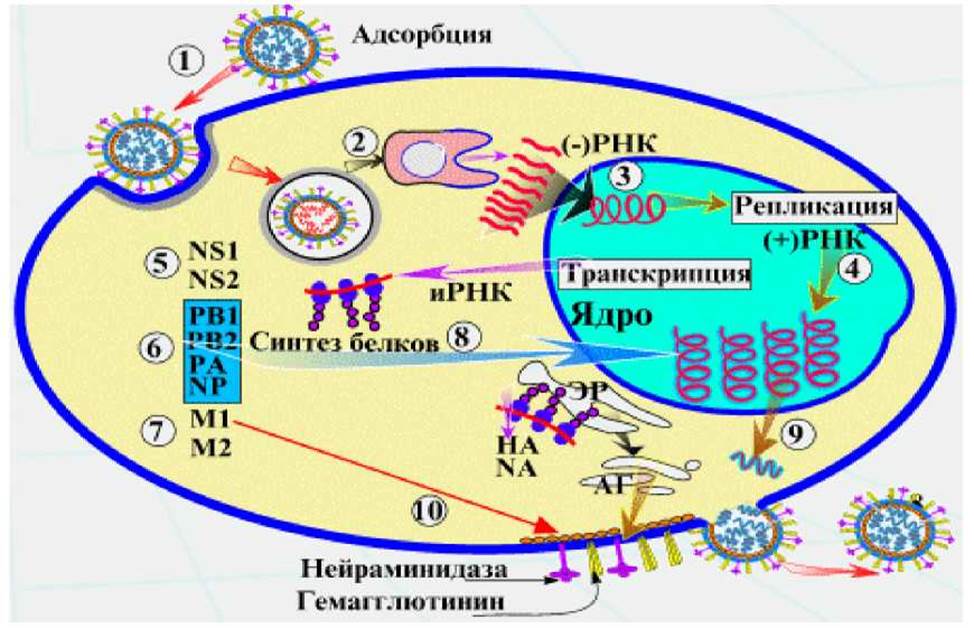
Fig. 3. Pathogenesis of influenza.
Virion toxins act as a capillariotoxic poison, inducing Circulatory Disorders. These are particularly pronounced in the central and autonomic nervous systems. Significant damage occurs in the lung tissue, leading to Pneumonia and Atelectasis.
Influenza "opens the door" to secondary microflora, which frequently causes inflammation of the Lungs, Paranasal Sinuses, Middle ear, renal pelvis, etc. An allergic state of the body also develops, thereby activating underlying chronic conditions such as tuberculosis, rheumatism, and nephritis. Fig. 4 schematically illustrates The Mechanism of influenza progression.

Fig. 4. Pathogenesis of influenza.
At the peak of the illness, Two phases of immune responses can be traced (Fig. 5). During the first 3–4 days, the body defends itself using nonspecific substances—interferon, tissue inhibitors, Ribonuclease, and the inflammatory response.
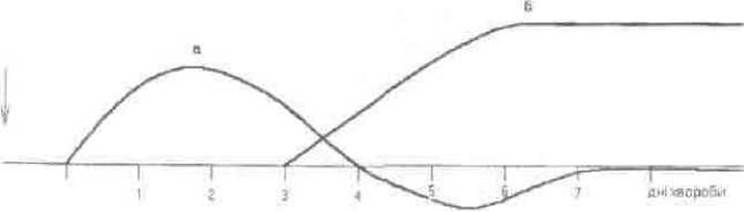
Fig. 5. Scheme of the body's defense reactions in influenza: a - nonspecific, b - specific
Starting from the 4th–5th day, anti-influenza Antibodies appear: antihemagglutinins, virus-neutralizing, and Complement-fixing antibodies. In accordance with these changes, nonspecific and specific phases of Immunity are distinguished. They can be schematically represented as two curves.
It is easy to see that the most vulnerable period is the 4th day, which corresponds to the intersection of these curves. At this time, the body's nonspecific defense is already depleted, while specific antibodies have only just begun to form, and their concentration is still insufficient to overcome the influenza virus.

Fig. 6. Classification of influenza.
The duration of immunity depends on the viral type. Following influenza caused by type A virus, immunity persists for no more than 2 years; for type B, up to 3–4 years; and following type C, it lasts a lifetime.
The possibility of the existence of an inapparent form of influenza and its role in the spread of the pathogen is currently under Structure/133.html">Discussion. Contemporary literature cites numerous reports on the Isolation of the influenza pathogen in healthy individuals, whereas until very recently, so-called healthy virus carriage was vigorously denied.
Last update: 10/08/2026
Editorial and Educational Adaptation: This material has been compiled based on the primary/original source text. The project team performed an editorial review, corrected technical inaccuracies, structured sections, and adapted the content for an educational format.
What was processed:
- elimination of formatting defects (OCR errors, structural breaks, corrupted characters);
- editorial organization of content;
- standardization of terminology in accordance with academic sources;
- verification of factual statements against the original source text.
All mentions of the author, publication year, and origin of the primary text have been preserved in accordance with the source.