PLANT PHYSIOLOGY AND BIOCHEMISTRY
Lecture Notes
5. PHOTOSYNTHESIS
Photosynthesis is The process of synthesizing Organic compounds from inorganic precursors (carbon dioxide and Water) using light energy and Photosynthetic Pigments (chlorophyll, bacteriochlorophyll, Bacteriorhodopsin), often resulting in the release of oxygen as a byproduct.
Class="center">
Photosynthesis is the only process on Earth that increases the Free energy of the biosphere by utilizing an external energy source—the Sun—thereby sustaining both plants and all heterotrophic organisms, including humans.
Photosynthesis is the process of transforming absorbed light energy (E) into the chemical energy (E) of organic (and inorganic) compounds.
The primary role in these transformations is played by the reduction of CO2 to the level of CARBOHYDRATES, a process that can release oxygen. However, photosynthetic reactions can also involve the reduction of sulfates or nitrates, The formation of H2, and the Utilization of Light energy (E) for membrane transport and other cellular processes. Photosynthesis is fundamental to the Energetics of the biosphere.
History of Photosynthesis Research
Since ancient times, people have marveled at how large plants can grow on barren rocks. In 1727, the English botanist and chemist S. Hales proposed that plants derive a significant portion of their "food" from the air, and that light absorbed by the leaves "improves" this "food."
Similar ideas were expressed by I. Newton and M. Lomonosov.
Experimental research in photosynthesis began with the experiments of the English chemist J. Priestley, who placed plants under a Glass jar with a candle. This led to the discovery of oxygen (1774). A year later, independently of J. Priestley, the French scientist A. Lavoisier discovered and named oxygen. Somewhat later, the Dutch physician J. Ingenhousz discovered that plants release oxygen only in the light, while in the dark, they absorb it, similar to animal Respiration.
In 1782, the Swiss researcher J. Senebier established that plants also absorb CO2 in the light. This was confirmed by the Swiss scientist T. de Saussure, who used quantitative analysis to prove that The amount of CO2 absorbed equals the amount of O2 released. However, the increase in the plant's dry mass significantly exceeded the amount of absorbed CO2 and Mineral Substances. T. de Saussure concluded that organic mass is also formed from water. This was later confirmed by the French agricultural chemist J. Boussingault (1840).
In 1865, the German plant physiologist J. Sachs demonstrated that starch is formed in leaves under light and is localized within METABOLISM/14.html">Chloroplasts (Sachs' starch test). Subsequently, the German physiologist Engelmann (1881) proved that it is the chloroplasts themselves that release oxygen in the light.
Reflecting on processes in living plants, J.R. Mayer and H. Helmholtz formulated the law of conservation and transformation of energy. Based on purely theoretical reasoning, they asserted that green plants absorb radiant solar energy and convert it into chemical energy. Experimental confirmation of this theory was provided by the eminent plant physiologist K.A. Timiryazev, who presented his findings in his doctoral dissertation, "On the Absorption of Light by Plants" (1875).
He established: a) that the intensity of CO2 assimilation is maximal when plants are illuminated with red light (which is most strongly absorbed by chlorophyll); b) that chlorophyll acts as an optical sensitizer (increasing light sensitivity) and participates directly in the process of photosynthesis. K. Timiryazev also formulated THE CONCEPT OF The Cosmic Role of plants: photosynthesis is the only process by which cosmic solar E is captured and retained on Earth. In the chloroplast, radiant solar E is converted into the chemical E of carbohydrates. Starch, gluten, Cellulose, and Other Compounds, by storing solar E, serve as our food and provide the E for all life processes.
The results of the first 100 years of research into plant aerial Nutrition following J. Priestley's experiments are summarized by the General Equation of photosynthesis:
6СО2 + 6Н2О + light (hv) → С6Н12О6 + 6О2.
Two Phases of Photosynthesis
The equation above does not clarify the Origin of the oxygen—is it from CO2 or H2O? Initially, it was believed that photosynthesis involved the photolysis of CO2, producing formaldehyde and carbon monoxide:

However, these substances are toxic to plants.
The Russian biochemist A.N. Bakh and the Dutch microbiologist C.B. van Niel hypothesized that The primary photochemical reaction of photosynthesis involves the dissociation of water. This idea was later confirmed by the experiments of the English physiologist R. Hill. In 1937, he discovered that isolated chloroplasts, when exposed to light, decompose water and release oxygen in the presence of e- acceptors (benzoquinone)—this is known as the Hill reaction. The process of water decomposition occurs in three stages:
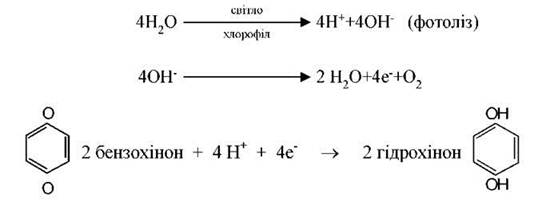
Direct experimental evidence that O2 in photosynthesis is released specifically from water was obtained in the 1940s by American and Soviet scientists working independently. Gradually, it was understood that the general equation of photosynthesis encompasses two groups of reactions: one associated with the photodissociation of water, the release of O2, and electron transport, known as the Light-dependent phase; and the second, which uses CO2 to synthesize glucose and can occur in the absence of light, known as the light-independent (dark) phase.
Experimental confirmation of the existence of these two Phases of Photosynthesis came from flashing light experiments. They demonstrated that the peak intensity of photosynthesis is achieved not under continuous illumination, but rather under pulsed light conditions.
It was subsequently determined that the Temperature coefficient Q10 for the first group of reactions is approximately 1, as photochemical reactions are independent of temperature; conversely, for the Dark Phase of photosynthesis, Q10 at temperatures between 15 °С and 25 °С ranges from 2.0 to 2.5, which is characteristic of chemical or enzymatic processes. Thus, The rate of photosynthesis is limited by the speed of its chemical (dark) reactions.
In the 1950s, American physiologist D.I. Arnon experimentally discovered the phenomenon of Photophosphorylation, proved that NADPH and ATP are the End products of the light-dependent phase of photosynthesis, and ultimately established that the light phase occurs in the thylakoids of the chloroplast, while the dark phase takes place in the stroma.
Thus, the entire process of photosynthesis is divided into light and dark phases:
- the light phase involves the absorption of radiant E by chloroplast pigments and its conversion into the chemical energy of ATP and NADPH, accompanied by the photolysis of water and the release of O2; all these processes occur within the chloroplast membranes (specifically, the thylakoid membranes).
- the dark phase involves the fixation of CO2 and its reduction into carbohydrates. This process consumes ATP energy. It is temperature-dependent, does not require light, and takes place in the stroma of the chloroplasts.
Last update: 07/08/2026
Editorial and Educational Adaptation: This material has been compiled based on the primary/original source text. The project team performed an editorial review, corrected technical inaccuracies, structured sections, and adapted the content for an educational format.
What was processed:
- elimination of formatting defects (OCR errors, structural breaks, corrupted characters);
- editorial organization of content;
- standardization of terminology in accordance with academic sources;
- verification of factual statements against the original source text.
All mentions of the author, publication year, and origin of the primary text have been preserved in accordance with the source.