Medical Genetics - V. M. Zaporozhan 2005
Congenital Malformations
Gene families responsible for hereditary developmental defects. Developmental genetics
Today, despite the fact that A large number of human genes have been sequenced, the Genetic control of developmental processes is not yet fully understood. At the same time, groups of genes responsible for specific stages of Embryogenesis have been identified. Many genes controlling embryogenesis encode so-called METABOLISM/31.html">Transcription factors (which control the transcription of specific genes by activating or repressing it). It is believed that transcription factors control the expression of genes involved in regulating fundamental processes of embryogenesis, such as segmentation, embryonic induction, Cell migration, Cell Differentiation, and programmed cell death (apoptosis). Embryonic development is also regulated by growth factors, cell growth factor receptors, growth factor signaling pathway genes, and other factors.
Class="center">
Fig. 9.10. Thoracopagus
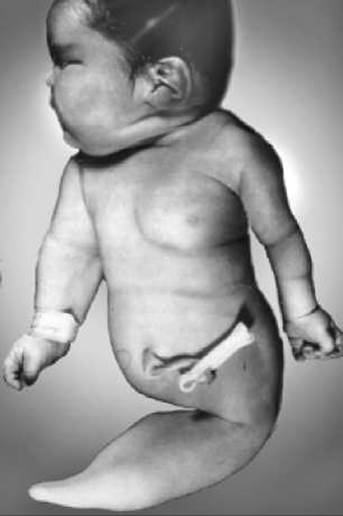
Fig. 9.11. Sirenomelia

Fig. 9.12. Cyclopia
The genes that control the Cytology/cytology/16.html">Early stages of embryonic development are remarkably conserved. Several Gene families identified in vertebrates have proven to be homologous to genes controlling development in the fruit fly Drosophila and other invertebrates. Mutations in many genes from these families lead to isolated or multiple malformations. Let us examine Examples of gene families involved in The regulation of developmental processes.
1. Segmentation genes — a group of genes that control segmentation in insects. In mammals, three homologues of these genes have been identified, known as Sonic Hedgehog, Desert Hedgehog, and Indian Hedgehog. They determine polarity in the Central Nervous system and control The formation of the Skeleton and limbs. The Sonic Hedgehog (SHH) gene plays a leading role in neural tube development. Mutations in this gene lead to holoprosencephaly (failure of the Forebrain to divide into hemispheres) (Fig. 9.13).
2. Homeobox genes — homeobox (HOX) genes. In the fruit fly Drosophila, HOX genes control segment-specific development. Mutations of these genes in Drosophila lead to numerous developmental anomalies; for example, limbs may form in place of antennae. These genes contain a conserved sequence of 180 nucleotide pairs known as the homeobox. The genes encode transcription factors. Four clusters of HOX genes have been identified in humans (Table 9.6).
Mutations in the HOXA13 gene cause a rare hereditary pathology known as hand-FOOT-genital syndrome. The syndrome is inherited as an autosomal dominant trait and is characterized by shortening of the first and fifth digits, hypospadias in boys, or a bicornuate Uterus in girls. Mutation of the HOXD13 gene also leads to a rare pathology known as polysyndactyly (an autosomal dominant defect characterized by the presence of an extra digit between the third and fourth fused digits).
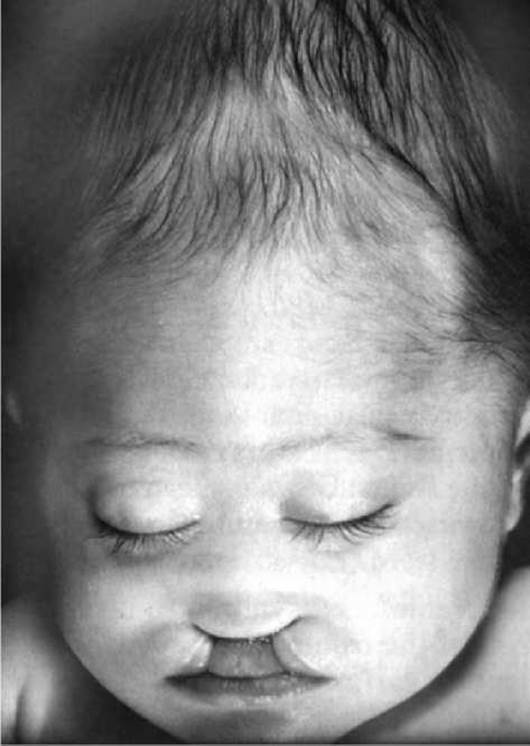
Fig. 9.13. Holoprosencephaly (hypertelorism, median cleft lip and palate, failure of the forebrain to divide into cerebral hemispheres)
Several other development-controlling genes also contain a homeobox-like Structure (MSX2 and EMX2 genes). A mutation in the MSX2 gene can cause craniosynostosis (premature fusion of Skull bones), while a mutation in the EMX2 gene causes a severe Brain malformation (schizencephaly).
3. Paired genes — paired-box (PAX) genes. These are genes containing a highly conserved DNA sequence known as the paired-box. The sequence encodes a transcription factor consisting of 130 Amino Acids. Nine PAX genes have been identified in humans and mice. In mice, they play a crucial role in The Development of The Nervous System and spine. In humans, four mutations of PAX genes associated with developmental defects have been identified. Mutation of the PAX3 gene leads to Waardenburg syndrome (type 1), which manifests as sensorineural Hearing loss, a white forelock of Hair, and iris heterochromia; it has an Autosomal dominant inheritance pattern (Fig. 9.14). The gene is localized on chromosome 2 (2q35).
Table 9.6. HOX gene clusters in humans
|
Cluster |
Number of genes |
Chromosomal localization |
|
HOXA (HOX1) |
11 (1-7, 9-11, 13) |
7p |
|
HOXB (HOX2) |
10 (1-9, 13) |
17q |
|
HOXC (HOX3) |
9 (4-6, 8-13) |
12q |
|
HOXD (HOX4) |
9 (1, 3, 4, 8-13) |
2p |
Mutations of the PAX2 gene (10q24) cause renal-coloboma syndrome (renal anomalies associated with eye defects, predominantly of the iris and Optic nerve). Mutations of the PAX6 gene (11p13) lead to aniridia (absence of the iris), and mutations of the PAX8 gene (2q12) result in ectopic or aplastic Thyroid Gland.
4. SOX genes. These are a group of genes containing a structure homologous to the domain of the SRF gene (a gene localized on the Y chromosome that plays a central role in Sex Determination). This homologous domain was named the HMG box (high mobility group), and the genes containing it are called SOX genes (SRY-type HMG box). These genes encode transcription factors and are expressed in many Tissues during embryogenesis.
A mutation of the SOX9 gene on chromosome 17 leads to campomelic Dysplasia. This is an autosomal recessive disorder characterized by campomelia (bending of the Tibia and sometimes the Femur bones), disproportionate dwarfism, Hermaphroditism, and a male karyotype in patients with a female phenotype. This gene is expressed in the developing skeleton, where it encodes type II Collagen, as well as in the Gonads and genital primordia.
Mutations of the SOX10 gene on chromosome 22 lead to a rare form of Waardenburg syndrome, in which patients are at high risk of developing Hirschsprung's disease.
5. T-BOX (TBX) genes. T genes play a leading role in mesoderm development in mice. Heterozygous carriers of this gene have a short tail and sacral spine defects. The gene encodes a transcription factor. Homologues of the T gene have been found in The Human Genome (TBX genes). One of the clusters of these genes is localized on chromosome 12 (TBX3 and TBX5 genes). Mutation of the TBX5 gene leads to Holt-Oram syndrome (Heart-hand syndrome), an autosomal dominant disorder characterized by Congenital heart defects and upper limb malformations ranging from hypoplasia of the thumb (Fig. 9.15) and radial ray hypoplasia to phocomelia. Mutations of the TBX3 gene cause ulnar-mammary syndrome (ulnar ray defects and mammary gland hypoplasia).
6. Zinc finger genes. This is a group of genes that encode zinc-containing transcription factors. Mutations in these genes are responsible for the development of many monogenic malformations. For example, large deletions or translocations of the GLI3 gene, localized on chromosome 7 (7p13), lead to Greig cephalopolysyndactyly syndrome. The syndrome is characterized by Syndactyly, polydactyly, and cranial anomalies. Frame-shift mutations are observed in Pallister-Hall syndrome (polydactyly, hypothalamic hamartomas, imperforate anus).

Fig. 9.14. Waardenburg syndrome (hypertelorism, telecanthus, broad nasal bridge, iris heterochromia, white forelock)
Mutations of the WT1 gene (11p13) cause Wilms Tumor and Denys–Drash syndrome (hermaphroditism, nephritis, and progressive renal failure). Mutations of the ZIC2 gene (13q32) lead to holoprosencephaly, while ZIC2 (Xq26) mutations cause developmental and positional defects of unpaired Organs, such as The Heart, Liver, and Spleen.
7. Growth factors. They play a crucial role in the regulation of embryogenesis; a prime example is the fibroblast growth factor. Signal Transduction for this growth factor is mediated by four Tyrosine Kinase Receptors (FGFR1, FGFR2, FGFR3, FGFR4). Mutations in the FGFR1 gene (8p11) are responsible for Pfeiffer syndrome (a form of acrocephalosyndactyly); various mutations in the FGFR2 gene (10q25) cause Apert and Pfeiffer syndromes (different forms of acrocephalosyndactyly) as well as Crouzon syndrome (craniofacial dysostosis characterized by brachycephaly, oxycephaly, exophthalmos, shallow orbits, and maxillary hypoplasia); mutations in the FGFR3 gene (4p16) cause Crouzon syndrome, while other mutations in the same gene (4p16) are associated with Achondroplasia, Hypochondroplasia, and Thanatophoric Dysplasia.
Genetics of Multifactorial Malformations
Numerous susceptibility genes for multifactorial malformations have now been identified. For instance, susceptibility to neural tube defects may be linked to a mutation in the gene encoding methylenetetrahydrofolate reductase (MTHFR). This enzyme catalyzes The conversion of 5,10-methylenetetrahydrofolate to 5-methylenetetrahydrofolate and plays a key role in homocysteine metabolism.
The administration of Folic acid prior to planned Pregnancy and During the first 12 weeks of gestation significantly reduces the risk of these malformations.
Experiments on mice have also demonstrated The Role of PAX genes in the development of neural tube defects.

Fig. 9.15. Hypoplasia of the thumbs in Holt–Oram syndrome
Last update: 11/08/2026
Editorial and Educational Adaptation: This material has been compiled based on the primary/original source text. The project team performed an editorial review, corrected technical inaccuracies, structured sections, and adapted the content for an educational format.
What was processed:
- elimination of formatting defects (OCR errors, structural breaks, corrupted characters);
- editorial organization of content;
- standardization of terminology in accordance with academic sources;
- verification of factual statements against the original source text.
All mentions of the author, publication year, and origin of the primary text have been preserved in accordance with the source.