Basics of Medical Genetics - Buzhiyevska T.I. 2001
General Genetics
Molecular Bases of Heredity
The Molecular Foundations of Heredity are formed by Nucleic Acids: DNA (found in all microbes, unicellular organisms, plants, insects, and animals) and RNA (found in certain Viruses, including oncogenic ones). It is within these large Biopolymers that the Genetic information of living beings is recorded using a unified language whose alphabet consists of 4 letters: nucleosides. In DNA, information is laid out through the alternation of adenine (A), thymine (T), guanine (G), and cytosine (C), which form specific sequences by linking via deoxyribose residues and phosphorus into a single-stranded molecule. Subsequently, two complementary strands form Hydrogen Bonds: adenine-thymine (AT) and guanine-cytosine (GC), which twist to form a double helix—predominantly right-handed, functioning simultaneously as a biological and informational entity (Fig. 2, the "serpentine ladder"). The RNA molecule has a single-stranded Structure. Instead of thymine, it contains uracil (U), and instead of the deoxyribose residue, it contains ribose (chemically a slightly different pentose).
The nucleic acid (NA) molecule has the capacity for reproduction, duplication, or Replication. It is nucleic acids, not Proteins, that reproduce and replicate. In the presence of required components and appropriate Enzymes, a complementary strand of new DNA is synthesized on the template of each strand of double-stranded DNA (following their Separation). Replication is semi-conservative and template-driven. Each double-stranded molecule contains both a maternal (old) and a daughter (new) strand of NUCLEOTIDES.
At the level of unicellular organisms, there is no death from old age. This mechanism ensures the stability of genetic information and its preservation during transmission to descendants.
Class="center">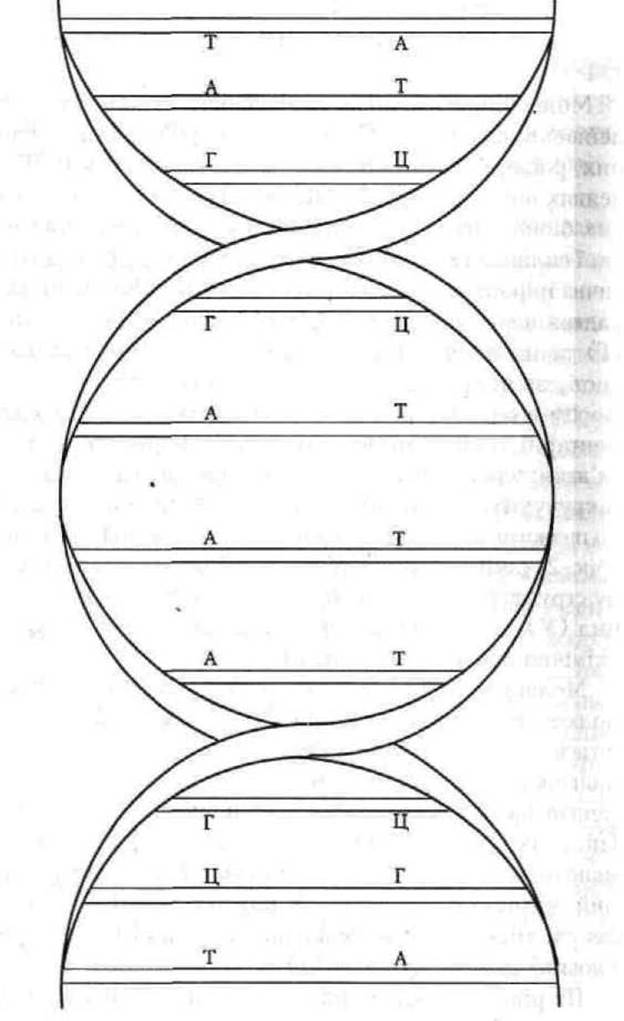
Fig. 2. Double-stranded DNA molecule. The strands are complementary and antiparallel. Complementarity by A-T (adenine-thymine) and G-C (guanine-cytosine) Base Pairs.
During the Selection/27.html">Realization of Genetic information, decoding takes place: the language of nucleic acids (four letters: A, T, G, C) must be translated into the language of proteins (20 Amino Acids, conventionally 20 letters). This is made possible by the triplet principle: one amino acid corresponds to a sequence of three nucleotides in the nucleic acid. For instance, the sequence adenine, adenine, adenine (AAA) codes for phenylalanine, and ATT codes for Lysine. Therefore, METABOLISM/28.html">The Genetic Code is triplet-based. However, from 4 letters (A, T, G, C), 64 different 3-letter combinations can be obtained (43 = 64), whereas only 20 amino acids exist in nature. The remaining triplets (codons)—combinations of three nucleotides—are not superfluous. Three of them (ATC, ACT, ATT) are terminating codons, signaling the end of synthesis, acting as punctuation marks (like a period or comma in language). Others provide a safety margin for The Genome because they code for the same Amino acids as the primary triplets (Fig. 3). Consequently, the genetic code is degenerate: a single amino acid can be encoded in DNA by 2–4 triplets. Within a Gene, codons are arranged one after another, like words in a sentence, and do not overlap, which simplifies the record and makes it stable. The genetic code is non-overlapping. In All living organisms on Earth, the same triplets encode the same amino acids within the genetic program. The genetic code is also universal. We must remember the CHARACTERISTICS OF THE genetic code: triplet-based, degenerate, non-overlapping, and universal. Yet, every rule has exceptions. Over the past 30 years, researchers have studied and collected such exceptions; they turned out to be numerous, leading to new hypotheses and theories that gave rise to modern mobile genetics, which replaced classical genetics. Today we know that: 1) the genetic program is not entirely stable: mobile dispersed genes, or elements, exist that change their position, jumping from place to place; 2) within a gene, there are regions with meaning (exons) and without it (introns); 3) a large Amount of Information serves regulatory Functions; 4) the gene is divisible; 5) the genome contains not only unique coding sequences but also a vast number of information repeats; 6) the recording of genetic information *can* differ from the universal. Information molecules are found in Eukaryotic Cells not only in The Nucleus (the primary, largest program) but also in certain cytoplasmic Organelles: Cell/35.html">Mitochondria, Plasmids, and other DNA or RNA carriers. Thus, in mitochondria, the code differs from the universal one.

Fig. 3. Principle of genetic information coding — 3 out of 4. The code is triplet-based, unified, degenerate, and non-overlapping; ■ — terminating codons; ↑ — initiation codon.
The realization of genetic information, specifically Protein Synthesis, takes place in cytoplasmic structures known as Ribosomes. To deliver the blueprint for a protein from DNA to the ribosomes, The Cell employs special mechanisms and mobile molecules. Based on current knowledge, the mechanism is called Transcription, and the molecules are various types of RNA. Transcription means copying information from DNA to RNA. Meanwhile, the core process in Protein synthesis is Translation—the translation of information from one language to another.
The coded record of the protein molecule's structure is transferred from DNA to Messenger RNA (also known as mRNA, or "messenger" RNA; synonyms: iRNA, mRNA, t-RNA) through complementary, template-driven RNA Synthesis on DNA, which is comparable to replication (DNA-to-DNA Synthesis). The RNA molecule copies the entire eukaryotic gene along with non-coding introns. Such temporary molecules are called pre-mRNA.
Pre-mRNA molecules move from the nucleus to the Cytoplasm, specifically to ribosomes, which consist of ribosomal RNA (rRNA) and proteins. Along the way, pre-mRNAs are modified, and non-coding regions (introns) are removed. The Significance of introns is likely profound, though not yet fully deciphered.
The third type of RNA comprises relatively small molecules (tens of nucleotides) of Transfer RNA (tRNA), which deliver specific activated amino acids to the ribosomes (Fig. 4), placing them at the appropriate position in the polypeptide chain determined by the mRNA codon. Only the tRNA molecule contains an anticodon complementary to the mRNA codon.
We have already defined how RNA differs from DNA. Proteins are synthesized According to the mRNA blueprint; therefore, the triplets coding for Amino acids are most often written in the complementary language of RNA: for phenylalanine, it will be UUU, while terminating codons are UAG, UGA, and UAA.
Thus, The process of realizing hereditary information from gene to phenotype (protein synthesis being one of them) follows the pathway: DNA > RNA > protein.

Fig. 4. Diagram of a transfer RNA molecule specific for phenylalanine (anticodon AAA).

Fig. 5. Sergiy Mykhailovych Gershenzon (1906–1998), a Ukrainian geneticist who discovered the genetic role of nucleic acids, the mutagenic activity of the latter and of viruses, and demonstrated the possibility of reverse transcription, which laid the foundation for The Development of mobile genetics.
In the era of mobile genetics, the existence of information transfer from RNA to DNA has been established. Reverse transcription was predicted and discovered by S.M. Gershenzon (Fig. 5) and experimentally proven conclusively by Nobel laureate H.M. Temin. Adding DNA-to-DNA and RNA-to-RNA replication (which may exist in certain viruses) to this, the final scheme of the Information Flow takes the following form:

The synthesis of nucleic acids on a protein template has not yet been proven and is presumably blocked by the Laws of Thermodynamics. For its hypothetical existence, unknown Energy Sources would be required.
At the end of the 20th century, it became known that the human genotype contains 50,000–100,000 different genes. They encode products necessary for cell survival (housekeeping genes), Organism survival (luxury genes), or, in our view, encode nothing at all. The latter are currently termed selfish genes or redundant genetic information, which may either hold a memory of past evolution or serve as a reserve (blueprint) for future evolution.
The entire volume of genetic information is under the strict control of regulatory mechanisms. All genes interact with one another, forming a unified system. The regulation of their activity occurs both through relatively simple schemes—where a gene product alters The activity of the same or another gene—and through complex multi-level mechanisms. These include processes regulating gene activity at the Stages of Transcription (before, during, and after), translation (before, during, and after), coordinated and cascading group Introduction/30.html">Regulation of Gene labor (their expression), the participation of Hormones (general signaling molecules) in this process, chemical modification of DNA, and other general modifiers of Gene Expression. The expression of an individual gene depends on the composition (genotype) in which that gene resides. Consequently, there is varying penetrance (manifestation) and expressivity (degree of expression) of genes for both normal (wild type) and mutant alleles.
These concepts were first introduced into genetics by N.V. Timoféeff-Ressovsky. An individual human genotype determines the degree of penetrance and expressivity of specific diseases, even to the complete absence of a clinical pathological picture despite the presence of seemingly necessary quantities of mutant genes.
Last update: 08/08/2026
Editorial and Educational Adaptation: This material has been compiled based on the primary/original source text. The project team performed an editorial review, corrected technical inaccuracies, structured sections, and adapted the content for an educational format.
What was processed:
- elimination of formatting defects (OCR errors, structural breaks, corrupted characters);
- editorial organization of content;
- standardization of terminology in accordance with academic sources;
- verification of factual statements against the original source text.
All mentions of the author, publication year, and origin of the primary text have been preserved in accordance with the source.